Get Full Government Meeting Transcripts, Videos, & Alerts Forever!
Get email alerts on the Lot Splitting topic
No spam. Unsubscribe anytime.
Senate committee hears bill to allow administrative lot splits to increase middle-housing supply
Summary
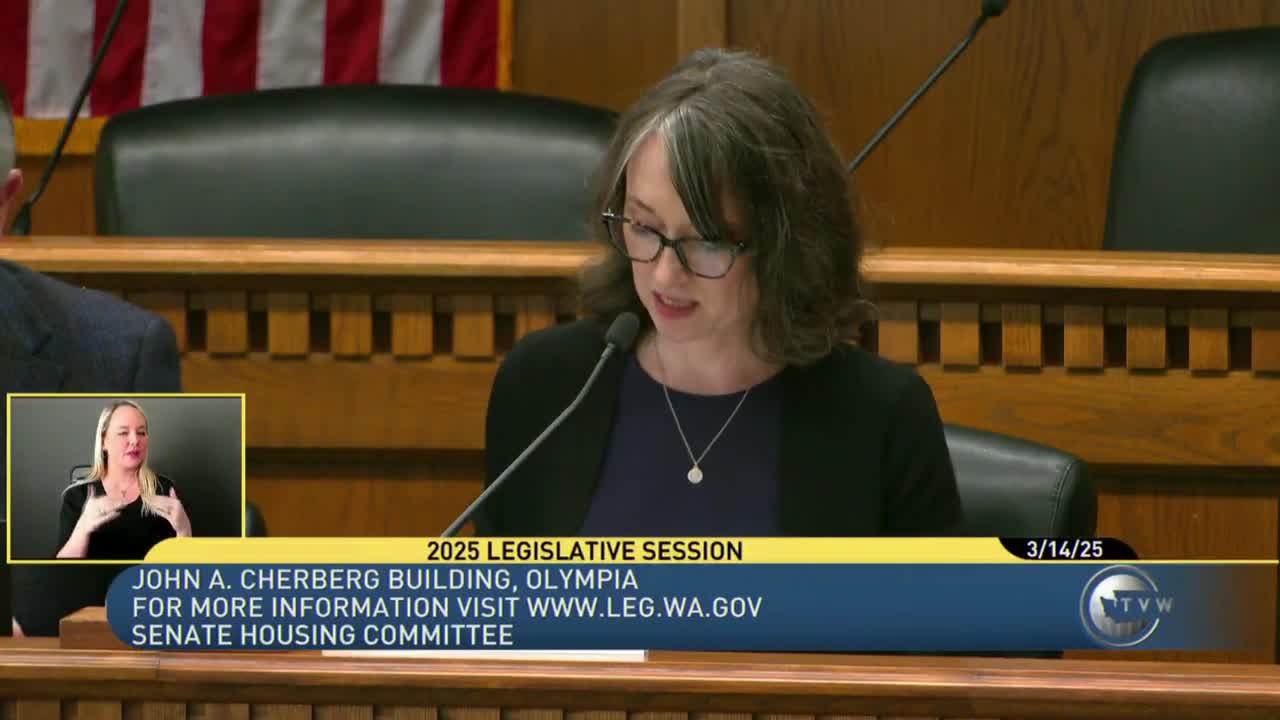
A substitute House bill to create an administrative lot‑split process for lots subject to middle‑housing requirements drew support at the Senate Housing Committee on March 14.
A substitute House bill to create an administrative lot‑split process for lots subject to middle‑housing rules drew support at the Senate Housing Committee on March 14.
Staff briefed senators on the bill, describing a process that ties lot‑split eligibility to cities’ middle‑housing minimum density requirements under the Growth Management Act and which would allow an applicant to seek administrative approval of a lot split concurrently with a building permit. "A new buildable lot and residential building permit must be approved and is not subject to administrative appeal under certain conditions," the staff summary said.
Representative Andrew Barkus, the bill’s prime sponsor, told the committee the proposal reflects three years of work and stakeholder negotiation. "This is the third year and what I would believe is the best iteration of this product to put in front of you," Barkus said, adding the bill addresses concerns around critical areas, egress, buildability and infrastructure. He said the intent is for the process to result in a clearly buildable lot.
Supporters from the building and housing sectors said the measure would create more lower‑cost starter homes and give homeowners options to extract equity while staying in place. Dan Berdelet of the Sightline Institute said the bill contains guardrails to ensure newly created lots are buildable and noted the administrative process reduces barriers for typical homeowners. The Building Industry Association and Habitat for Humanity also testified in favor, citing affordability and increased owner‑occupant opportunities.
Several local jurisdictions and developers urged the committee to refine technical language. Bill Clark, representing Washington Realtors, told senators the bill this year is framed as a subdivision code change rather than a planning directive and stressed it must ensure legal access, water and sewer availability, and other typical subdivision standards. City representatives and water districts raised concerns about impacts on critical aquifer recharge areas and asked for clarifying amendments related to water supply and long‑term aquifer protection.
The staff briefing noted compliance timelines: cities with a comprehensive plan update due in 2027 must include lot‑splitting rules in that update; other cities must comply within two years of the bill’s effective date. The Department of Commerce would issue implementation guidance. A fiscal note and local cost estimates are available, per staff.
Committee members asked about the scope of eligible lots (the bill as drafted applies to residential zones) and whether conversions in mixed commercial/residential areas would be addressed; sponsors and staff said the bill focuses on residential zones and that other conversion mechanisms exist.
The hearing was suspended for the bill to allow further work and amendments.
Ending: Proponents asked the committee to advance the bill with technical fixes; opponents and some jurisdictions asked for amendments addressing critical aquifer recharge protections and displacement mitigation measures.