Get Full Government Meeting Transcripts, Videos, & Alerts Forever!
Get email alerts on the Transportation Bridges Funding topic
No spam. Unsubscribe anytime.
County road leaders warn federal bridge-data mandate, shrinking gas-tax revenue strain Michigan road funding
Summary
County road officials told the Transportation Appropriations Subcommittee that new federal bridge-inspection and load-rating requirements plus declining fuel-tax revenue have widened a funding gap for local roads and bridges and will require state help to meet a roughly $22.5 million compliance cost over five years.
County road officials told the Transportation Appropriations Subcommittee that a new federal requirement to add data and custom load-rating analyses to the National Bridge Inventory will impose substantial costs on counties and could jeopardize federal aid unless the state helps cover the match.
Ed Noyola, identified in the meeting as the committee’s invited chief deputy director, told members the federal rule requires 54 additional National Bridge Inventory data points and bespoke bridge load modeling that must be entered into AASHTO’s bridge-rating software by 2027. “This is not a request. This is a mandate,” Noyola said, urging the Legislature to consider assistance to cover the state/local share.
The new reporting and load-rating work, Noyola said, will require an estimated $22.5 million statewide to complete, with an 80/20 federal/state funding split assumed. He said the department is examining options for the state match — including toll credits or federal-aid redistribution — but that those options are not guaranteed. The presenters said the department is considering an initial $5 million state contribution for the first years to secure the work and demonstrate good faith to federal partners.
Why it matters
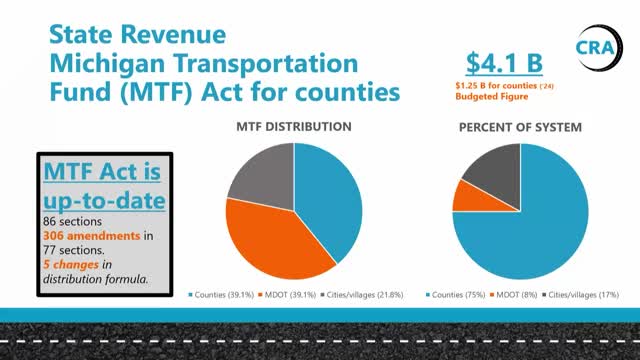
County road agencies already shoulder most local road responsibility: presenters said counties account for about 75% of Michigan’s road miles — roughly 90,000 miles — and that counties own about 5,868 bridges. Denise Donahue, chief executive officer of the County Road Association, described the scale of need documented in the association’s county road investment plan and gave a county-bridge funding figure: the county bridge network’s assessed need was reported at about $265 million and rose by roughly $43 million from 2021 to 2023.
Presenters told the committee the bridge funding gap is large: there were 401 applications for critical-bridge funding totaling about $515 million in a recent call for projects while available funds for that program were roughly $80 million. County speakers said counties also face application limits (traditionally three bridges per county; presenters said a pending change would reduce that limit to two), which further constrains local access to scarce bridge dollars.
Funding picture and revenue trends
Presenters reviewed the Michigan Transportation Fund (MTF) and other revenue sources. They said the MTF budgeted roughly $4.1 billion for fiscal 2024 and that state revenues flowing into MTF include fuel taxes, vehicle-registration (weight) taxes, an income-tax transfer and a roughly $100 million share of marijuana tax revenue. The presenters gave a state-revenue subtotal of about $3.8 billion from those sources and said local contributions (millages, special assessments and bonds) form the second-largest source, with federal aid providing a smaller share.
Denise Donahue emphasized that fuel-tax revenue is declining: she cited a roughly 10% drop in gallons sold over 25 years (excluding 2020 pandemic effects), and said that because roughly 40% of MTF is derived from gas-tax-related receipts, that decline hampers long-term capacity to maintain roads.
Local roads versus federal-aid roads
Officials said pavement-condition goals differ for federal-aid (primary) roads and local (non-federal-aid) roads. The presenters said the target for federally eligible primary roads is 90% in “good” condition while current statewide condition sits near 65%. For local roads (non-federal-aid), they said the goal is 60% in good condition while current condition is about 44% — a shortfall they attributed to ineligible status for federal aid and limited local revenue.
Other cost pressures
Presenters explained that replacing large culverts increasingly triggers environmental and hydraulic requirements that force upsizing to structures that meet the federal definition of a bridge; that upsizing substantially increases project cost compared with a culvert replacement. They also noted that bridge replacement-cost estimates follow MDOT’s scope and cost templates and that a typical bridge deck is estimated at about 20% larger than the previous surface area to meet modern safety and geometric standards.
Compliance timeline and risk
Noyola and Donahue said the federal timeline (entry into national systems and completion of load-rating analyses by 2027) is aggressive and represents an “unfunded mandate” for many local agencies without in-house bridge engineers. Donahue said some counties — St. Clair, Oakland and Kent — have made partial progress but that many counties lack the staff or contracts to finish the work without external support. Presenters estimated the statewide cost profile stepping down slightly in years three through five but insisted prompt state planning and a funding commitment would be needed to meet federal expectations and avoid risking federal-aid eligibility.
Meeting outcome and next steps
There was no formal committee action; the subcommittee lacked a quorum and did not approve minutes. Presenters said they have discussed possible state-level supplements and program changes with the House appropriations staff and with MDOT bureau staff, and they asked the committee to consider state assistance for the match portion required by the bridge-load modeling requirement. They also said the County Road Association will continue working with MDOT and federal partners to coordinate a single, statewide approach instead of 300-plus separate local entries.
The subcommittee adjourned without taking votes because it did not have a quorum.