Get Full Government Meeting Transcripts, Videos, & Alerts Forever!
Get email alerts on the Corrections Budget topic
No spam. Unsubscribe anytime.
Michigan Department of Corrections outlines FY26 budget priorities focused on pay, recovery coaches and housing pilot
Summary
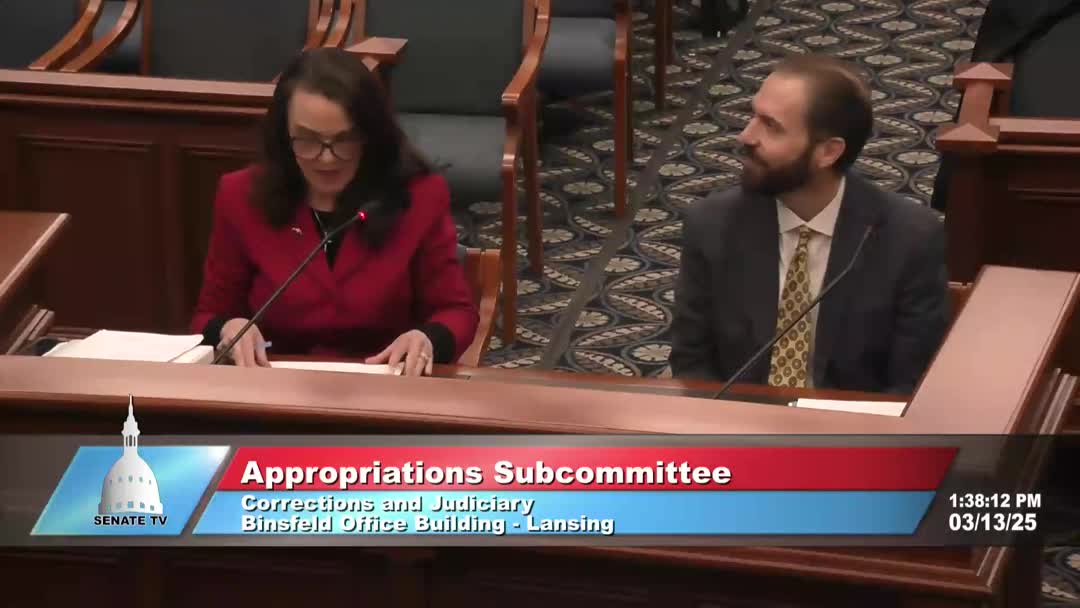
The Appropriations Subcommittee on Corrections and Judiciary heard a presentation from Department of Corrections Director Heidi Washington on the governor’s FY26 executive budget recommendation, which emphasizes staff pay and retention, expanded recovery and reentry supports, and targeted one-time investments.
The Appropriations Subcommittee on Corrections and Judiciary heard a presentation from Department of Corrections Director Heidi Washington on the governor’s FY26 executive budget recommendation, which emphasizes staff pay and retention, expanded recovery and reentry supports, and targeted one-time investments.
Director Heidi Washington, who led the presentation, told the committee the department employs about 11,000 people and oversees roughly 33,000 people in prison, about 9,000 on parole and about 33,000 on probation. “The governor's FY26 budget supports the department and its mission of public safety by supporting our staff and making strategic investments,” Washington said.
The nut of the proposal is a near-term focus on pay and workforce stability. The executive recommendation requests nearly $60 million for negotiated increases and related costs, including $27 million to fund a previously negotiated 3% raise for all classified employees and roughly $17 million to fund an accelerated corrections officer pay schedule that allows new officers to advance faster. The budget also funds a new top-step increase effective Oct. 1, 2025 that Washington said will raise top-step officers to about $35.22 per hour.
Washington emphasized retention alongside recruitment, citing two recent recruit classes of 281 and 285 and noting vacancy improvements at several facilities. She told senators the department still faces higher vacancy rates in parts of the Upper Peninsula and at Jackson-area sites and singled out Marquette, Alger and Cotton (Jackson) as having some of the highest vacancy rates, which she said are “about 30%” at the highest sites. Washington said other facilities have vacancy rates below 15% and some near zero.
The committee heard a package of programmatic requests intended to reduce recidivism and improve reentry. The executive recommendation includes $6 million to embed 48 peer recovery coaches statewide and $600,000 to support training and oversight for about 250 incarcerated individuals who could serve as peer coaches while still in custody. Washington said peer recovery coaches — people with lived experience who are in long-term recovery — have contributed to reductions in substance use, parole violations and absconding in pilot sites.
The proposed budget also asks for $1.5 million to expand community-based services for probationers in three “prosperity” regions, and a $2 million one-time housing pilot intended to spur public–private or nonprofit development of transitional housing for people leaving prison. Kyle Kaminski, legislative liaison who oversees reentry programs, told the committee the $2 million is expected to be stretched across multiple sites and used to leverage outside investment through a competitive bid process rather than fully fund construction.
Education and workforce programs were another central theme. Washington described Michigan as a national leader in correctional education, with 12 postsecondary programs and more than 1,200 active students in MDOC-run programs. The budget continues funding for the Thumb Education Center — a re-purposed facility project the department expects to operate by late FY26 — and maintains support for bachelor’s degree programs and vocational villages that Washington said produce significantly lower recidivism.
Operational modernization requests include $3.4 million in one-time funding to automate inmate counts and purchase related technologies (moving from paper counts to an electronic itinerary and pass system) and $2.1 million for rising medical supply costs. The department also proposes internal transfers of $2.75 million into prisoner transportation and $1.75 million into a contraband prevention fund to buy technologies such as package and body scanners and to explore drone-detection tools.
On health care and public-health items, Washington said the budget requests $2 million for hepatitis C treatment. She noted the department continues to treat people entering custody who have not received treatment in the community and uses fibrosis scores to help prioritize care, while saying anyone diagnosed is eligible for treatment. The department also reported nurses received a roughly 20% pay-scale increase that has helped convert some contract nurses to state positions.
Committee members asked for additional data and follow-up. Senator Irwin pressed on the status of pension legislation and its effect on staff morale; Washington said compensation improvements available now are the department’s primary focus and that many employees value immediate pay and benefits. Senators also asked for more detailed recruitment and retention data; Washington agreed to supply the department’s report showing academy graduations, departures by length of service and internal promotions.
On several policy and operational items, the department described current practice but offered no formal committee action during the hearing. Washington said the department is coordinating with the Department of Health and Human Services on a “11 15 waiver” that could enable Medicaid-covered services to start before release and might be leveraged by the housing pilot. She also said the department is revising its policy on payment of incarcerated people who are both students and hold institutional jobs: an upcoming director’s office memorandum will clarify that students with an institutional job will be paid both stipends and job payments in full.
Law-enforcement technology rollout and privacy concerns were raised around body-worn cameras. Washington said the body-worn camera rollout is in phase 1, the department is collecting user feedback and a revised policy is expected within about a week to address issues including camera activation around strip searches.
No formal votes or committee decisions occurred during the hearing; the session was a presentation and Q&A. Washington closed by thanking the committee and offering to provide additional reports and data the senators requested.
The department’s witnesses and several senators indicated follow-up paperwork and boilerplate language may be supplied to the subcommittee for review as the budget moves through the legislative process.