Get Full Government Meeting Transcripts, Videos, & Alerts Forever!
Get email alerts on the Budget topic
No spam. Unsubscribe anytime.
Tewksbury business manager frames FY26 school budget as special-education costs rise
Summary
At a March 11 public hearing the district presented a FY26 budget request that would raise the school share of town spending and shift how capital projects are funded, while warning of rising special-education and transportation costs and uncertainty in federal and state grants.
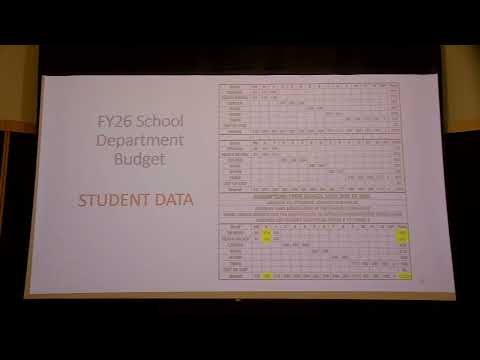
Business manager Mr. Libby presented the Tewksbury Public Schools proposed FY26 budget at a public hearing on March 11, describing a working budget that will continue to change before final town-meeting approval in May.
Mr. Libby said the district arrived at a budget request representing a 4.14% increase in school operating costs from the current year and that, when fixed costs and debt are included, the overall year-over-year change is 3.63%. He described salary, operating and capital outlay as the three district-controlled parts of the budget and noted fixed costs such as health insurance and retirement are managed with the town.
The presentation focused on three near-term pressures: higher out-of-district tuition and transportation costs, growing special-education needs, and a temporary reduction in capital outlay funding. Mr. Libby told the committee that tuition spending will rise in FY26 and that the district baked a 3.67% increase to state-set out-of-district tuition rates into the draft budget. He also described a planned increase in the budgeted tuition line and substantial use of the state “circuit breaker” reimbursements to offset high-cost special-education placements.
Nut graf: The budget hearing highlighted that rising special-education and transportation expenses, combined with uncertain grant revenues, are the principal factors pushing the request higher and changing how the district plans to fund building projects.
Key details and context - Circuit breaker and tuition: Mr. Libby explained the circuit breaker program reimburses a portion of high-cost special-education expenses and that the district’s net claim has increased. For FY25 the district saw a significant allocation but noted the state reimbursed educational expenses at about 75% while trimming the transportation component to roughly 44% this year; the district used that lower transportation reimbursement in its FY26 planning. Mr. Libby said the tuition budget line was increased and that circuit-breaker activity produced large swings year to year. - Title I and grant risk: The superintendent’s team said the district received a warning the Title I allocation could be reduced by about $170,000; the district is planning conservatively for that reduction while noting the warning did not yet become a final cut. - Capital and E-rate: The presentation described a deliberate move to shift much capital outlay out of the operating budget for FY25–FY26, making future projects subject to town-meeting warrant articles. Mr. Libby recommended seeking funding at the May town meeting for an E-rate-funded wireless access-point upgrade across schools; he said the federal/state E-rate program would cover a share of the cost and reduce the district’s up‑front expense. - Staffing and contracting: The district plans to convert some contracted classroom aides to employees where feasible, move some special-education programming between primary schools, and implement recommendations from a recent independent special-education audit. Mr. Libby said salary and step/longevity changes remain the largest single budget driver.
What officials asked School committee members pressed on circuit-breaker assumptions and whether the district’s FY26 plan assumes the same lower transportation reimbursement from the state. Mr. Libby said the district modeled FY26 using the 44% transportation reimbursement used in FY25 because the state trimmed the transportation share in response to a claims surge.
Next steps Mr. Libby said the school committee will continue line-item reviews with building principals and department heads, finalize the budget with the town manager and finance committee, and present warrant articles for capital projects at the May town meeting. He said detailed account-level reports and cost-center summaries are posted on the school business office web page.
Ending The public hearing closed after committee questions; no formal district spending vote was taken at the hearing. The committee and administration reiterated they will continue refining the FY26 request ahead of town‑meeting consideration in May.