Get Full Government Meeting Transcripts, Videos, & Alerts Forever!
Get email alerts on the Labor Procurement topic
No spam. Unsubscribe anytime.
City explains community workforce agreement; ordinance requires CWAs for contracts over $250,000
Summary
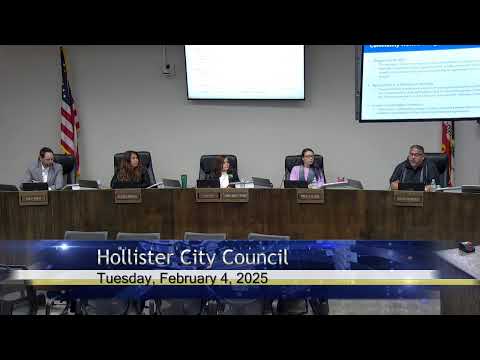
City staff updated the Hollister City Council on the city’s Community Workforce Agreement with the Santa Clara and San Benito County Building and Construction Trades Council and on the ordinance amendments requiring CWAs for public construction contracts over $250,000.
City staff presented an update on the city’s Community Workforce Agreement (CWA), a pre-hire agreement the city has used for public construction contracts and which the council amended into local purchasing rules.
Dave Marione, the city manager, told the council the ordinance was amended in December 2023 to require use of CWAs for public construction contracts valued at $250,000 or more; that ordinance amendment amended section 3.06 of the city’s purchasing code and codified the California Uniform Public Construction Cost Accounting (CUPCCA) provisions the city had previously adopted.
Marione reviewed key CWA provisions: no-strike/no-lockout commitments to keep projects moving; grievance and arbitration procedures; a pre-job conference requirement to align unions, contractors and project managers before work starts; union referral and registration requirements for craft employees; contributions to vacation, pension and benefit trust funds; and mandatory use of state‑approved apprenticeship programs and veteran employment pathways (including references to “helmets to hard hats” programs and local pre-apprenticeship programs).
Marione said the current CWA is a three‑year agreement that became effective Jan. 16, 2024, with an automatic rollover unless parties meet to negotiate changes before expiration. He said the agreement has been used on projects already under construction and noted the city has received differing numbers of bids on CWA projects: for example, a recent roadway project closely matched its engineer estimate and drew multiple bids, while the combined IWTP/Bridal Road package drew only two bids and exceeded the engineer’s estimate.
Council members asked about the $250,000 threshold, noting that other cities use higher thresholds (up to $1 million or more). Marione said the $250,000 figure was a council direction following earlier presentations and that municipalities set thresholds based on their size and procurement patterns.
On benefits, staff said CWAs can expand access to union-sponsored apprenticeship and training pipelines, create partners for grant and funding support, and reduce the city’s risk of substandard work or wage‑theft complaints by enforcing trust fund contributions and prevailing wage compliance. Staff also noted options for the council going forward: wait until the three‑year term expires and then amend or rescind the CWA; or amend the CWA and the ordinance before that date.
The council did not take new formal action on the CWA at the meeting; the presentation was received and staff requested possible direction from the council.