Get Full Government Meeting Transcripts, Videos, & Alerts Forever!
Get email alerts on the Wastewater Services topic
No spam. Unsubscribe anytime.
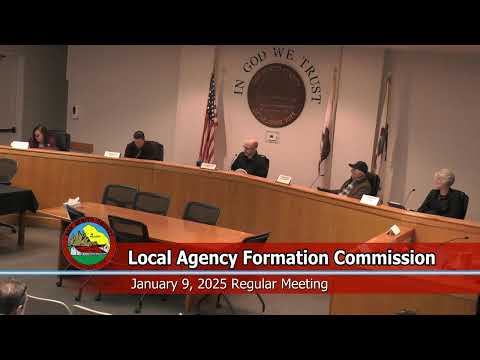
San Benito LAFCO pauses wastewater MSR after commissioners raise growth concerns
Summary
The San Benito Local Agency Formation Commission voted 3-2 to pause the wastewater municipal service review schedule and postpone a February public hearing, asking staff for a written analysis of parts of the draft MSR that could be construed as growth-inducing or that change governance options for wastewater services.
The San Benito Local Agency Formation Commission on an acting 3-2 vote moved to postpone a scheduled February public hearing on its wastewater municipal service review and to suspend the MSR work plan pending a staff report further explaining parts of the draft that could affect growth and governance.
The action followed a detailed presentation by Executive Officer Jennifer Stevenson on the draft wastewater MSR, a multi-agency review that examines wastewater service providers in the county and outlines possible governance options including consolidation, a regional sanitation district, the creation of a subsidiary district, joint powers authorities, and activation of latent wastewater powers by the county water district. Stevenson said the report covers seven providers and recommends specific steps including dissolving County Service Area (CSA) 45 and pursuing consolidation or annexation between Trace Pinos and Sunny Slope County Water Districts.
Why it matters: LAFCO MSRs and the determinations that follow inform spheres of influence and boundary changes that, in turn, shape which agencies can provide sewer service to development. Commissioners who voted to pause the process said they wanted clearer, section-by-section explanations of where the MSR could lead to additional development or transfer of service authority.
Stevenson and legal counsel Joshua Nelson repeatedly emphasized that the MSR identifies options and does not itself change service boundaries or authorize development. "The intention isn't to open more growth. It's really to address the out of various service connections that have already been made," Stevenson said. She later added, "The document just identifies options. There's nothing in no way can LAFCO initiate any one of these changes of organizations. That would be up to the member agencies themselves," language she repeated while answering commissioners' procedure questions.
The draft lists practical options and their trade-offs: a regional sanitation district could consolidate out-of-area connections into a single provider but would require lengthy coordination, potential transfer of asset ownership and environmental review; a subsidiary district would let the City of Hollister retain local control while legally serving some areas outside city limits but would require at least 70 percent of the district's land area and registered voters to be inside the city; a joint powers authority could be a quicker, transitional approach that does not require LAFCO approval but raises questions of representation for unincorporated areas. The MSR also recommends clarifying LAFCO policy language about the Hollister "urban area" and retiring an older "urban service area" term that the report says is inconsistent with Government Code definitions.
During discussion, Commissioner speakers emphasized contrasting concerns: supporters of pausing the process said a newly seated Hollister city council and board of supervisors deserve clearer information before LAFCO moves forward; opponents said delaying would stall work LAFCO has already completed after a prolonged period without an executive officer. David Marione, City Manager for the City of Hollister, told the commission the administrative draft is a staff-level circulation and had not yet been presented to the Hollister City Council.
The motion to suspend the MSR schedule and postpone the hearing passed on roll call: Commissioner Kozmicki — yes; Commissioner Zenger — yes; Commissioner Stevens — yes; Commissioner Betancourt — no; Commissioner Jordan — no (3–2). The motion directed staff to return with a written breakdown of key changes and the specific parts of the MSR that could be construed to enable growth or governance changes.
The commission’s next steps, as described in the presentation, included continuing work on MSRs for water, fire protection and health care districts, and county service areas, while separately pursuing recommendations regarding CSA dissolutions and potential consolidations or annexations.
Ending: Commissioners and staff noted the MSR remains available for public review; the paused schedule applies to formal action and the February hearing only, pending the follow-up staff report.