Get Full Government Meeting Transcripts, Videos, & Alerts Forever!
Get email alerts on the County Budget topic
No spam. Unsubscribe anytime.
Belknap County delegation approves FY‑25 budget after cuts to several outside agencies
Summary
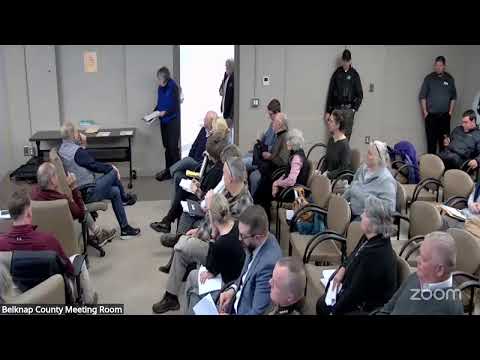
After hours of debate and multiple amendments, the Belknap County delegation voted 11–5 to approve the recommended FY‑25 budget. Delegates previously approved a 50% reduction in funding to four outside agencies (9–6) and rejected other proposed cuts.
Belknap County delegates approved a FY‑25 spending plan after extended debate and a series of amendments. The delegation’s final vote to adopt the budget passed 11–5.
The budget review committee presented the committee’s recommendation to the delegation, describing total recommended expenditures, revenue assumptions, use of fund balance and the resulting amount to be raised by property taxes. Committee members said recommended total expenditures were about $37.7 million and that the committee proposed using roughly $1.3 million of fund balance; the committee presented revenues of about $13.9 million and an amount to be raised by property taxes of roughly $22.0 million. The committee also reported that the suggested budget would translate to a single‑year increase that delegates characterized in discussion as roughly in the mid‑single digits (committee figures presented an approximate 6.2% comparison to the prior year before some amendments).
Debate focused on three main clusters of concern: - Outside agency funding: Delegates debated funding for non‑county, nonprofit organizations that receive county appropriations, including UNH Cooperative Extension, the Belknap County Conservation District, Lakes Region Mental Health Center, and CASA. One amendment proposed replacing the proposed FY‑25 amounts for those four agencies with 50% of each agency’s FY‑24 budgeted amounts. The delegation adopted that amendment by a 9–6 vote. The amendment as passed set the following FY‑25 amounts, as moved on the floor: UNH Cooperative Extension $82,500; Belknap County Conservation District $25,000; Lakes Region Mental Health Center $16,000; CASA $3,750. Supporters of the amendment argued that outside agencies should rely more on fundraising and non‑tax revenues in a tight fiscal climate; opponents said those agencies leverage state and federal funds and provide services that would cost the county more if not funded through partnerships. - Restorative justice/diversion: Delegates discussed a proposed cut of about $42,407 to the restorative justice program (a proposal that would have reduced funding and thus affected the program’s capacity). The motion to reduce that line item was withdrawn after extended questions from members and information requests about caseloads, program outcomes and grant revenue; delegates and public speakers emphasized diversion’s role in preventing deeper criminal justice involvement among youth and young adults. - Corrections staffing and public safety: A proposed reduction to corrections‑wage funding to remove funds for a newly requested position failed on a 10–6 vote (the motion was not adopted). Department heads and law enforcement representatives cautioned that understaffing correctional facilities could raise safety risks and that statewide bail‑reform proposals could increase short‑term jail populations.
After considering member amendments and partnering department input, the delegation voted 11–5 to adopt the budget as modified by the committee’s recommendations and floor changes. Delegates noted the final package reduces the tax increase compared to the commissioners’ initial proposal; one analysis presented on the floor said the committee numbers, after the amendment to outside agencies, lowered the projected amount to be raised by taxes from about a 6.2% increase to roughly 5.5%.
Public input: Several members of the public and nonprofit leaders addressed the delegation during the public comment period, urging continued funding for Cooperative Extension, conservation services, mental health services, restorative justice and community action programs. Presenters and public commentors emphasized those organizations’ role in economic development, environmental protection, food systems, mental‑health care and prevention services.
What to watch: Delegates and county staff flagged pending state‑level decisions and regulatory actions that could affect future local budgets (the Department of Revenue Administration was cited in meeting discussion for state revenue monitoring). Delegates also discussed the potential fiscal impacts of state bail‑reform measures and other state policy changes on local corrections costs and caseloads.
Sources and context: Budget‑line figures, votes (including a 9–6 amendment vote reducing four outside agencies to 50% of FY‑24 levels, and the final 11–5 adoption vote), and department presentations were recorded in the delegation meeting transcript and summarized by the budget review committee chair.