Get Full Government Meeting Transcripts, Videos, & Alerts Forever!
Get email alerts on the Title Ix Policy Revision topic
No spam. Unsubscribe anytime.
MMSD board hears Title IX coordinator on reverting district policy to 2020 rules; board requests legal clarification
Summary
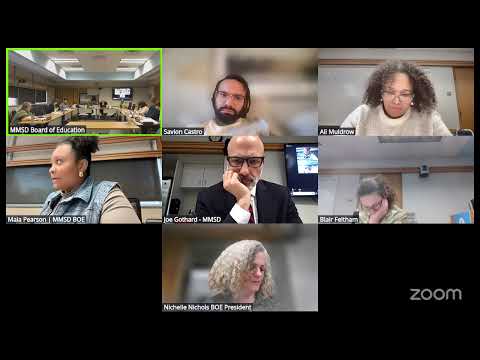
The Madison Metropolitan School District Board of Education on March 13 received a presentation from Title IX coordinator Yvetta Sloan about proposed changes to the district’s Title IX policy (8012a) and agreed to consider the draft as a first read while requesting additional legal clarification.
The Madison Metropolitan School District Board of Education on March 13 received a presentation from Title IX coordinator Yvetta Sloan about proposed changes to the district’s Title IX policy (8012a) and agreed to consider the draft as a first read while requesting additional legal clarification.
Sloan told the board she previously presented updates in June 2024 and that the district’s 2020 policy already covered much of the protections and procedures the 2024 regulations had addressed. “My name is Yvetta Sloan. I’m the Title IX coordinator for the district,” Sloan said, adding that the proposed revision would largely revert language to the 2020 regulation while explicitly listing protected categories in the policy text.
Board members said they wanted more information about legal authority and operational details before a second read. Board member Ali asked how the policy’s disciplinary language — which states that board members who violate the policy could be removed from office or barred from district premises — would be executed and whether the district should wait for further federal guidance. “Is there a reason why we’re changing this policy now versus waiting to see what the current presidential administration wants to do with Title IX?” Ali asked. Petra, a district staff member, and another staff speaker identified as Dr. Gothard said the district had received a Department of Education directive and that OCR (the Office for Civil Rights) instructed districts to revert to the 2020 regulations.
Discussion focused on three substantive differences between the 2020 and 2024 Title IX rules that affect local practice: the definition standard for what constitutes sexual harassment (2020 uses “severe and/or pervasive”; 2024 had broadened that standard), how a formal complaint is defined and filed (2020 required a signed formal complaint; 2024 allowed verbal reports to trigger investigations), and whether informal resolution can be offered without a filed formal complaint. Sloan explained the district’s harassment procedures and said the policy document would revert to 2020 definitions while retaining the district’s existing internal ‘‘sexual misconduct’’ category that captures conduct outside the federal Title IX harassment definition.
Board members pressed for documented legal guidance and cited uncertainty about whether a federal agency letter — described in the meeting as a Department of Education “dear colleague” letter directing reversion — constitutes the appropriate legal mechanism. Several members asked the administration to bring a legal colleague to the next read to explain the basis for adopting the reversion and to provide any relevant legal memoranda or letters.
District staff said the redline materials before the board show two sets of changes: the line-by-line reversion to the 2020 text and a separate insertion identifying protected categories explicitly on page 1 and page 3 of the proposed policy. Petra said the final proposed draft will merge those redlines so board members can compare the current policy, the reverted text, and the version that includes the explicit protected-class language before the second read.
No formal action to adopt the policy was taken. The board agreed to treat the materials as a first read and directed staff to return with: the cited Department of Education/OCR correspondence, a legal analyst who works on Title IX to answer specific legal questions, a merged redline showing the proposed protected categories, and a memo summarizing the differences in complaint processes between the 2020 and 2024 regulations.
Board members said the district’s program historically has covered categories and processes beyond the bare federal minimum, and Sloan said reverting “isn’t gonna make much of a change” in local practice because the MMSD program already included broader protections and procedures. The board did not vote on policy adoption and will revisit the item at a future meeting with the requested legal context.