Get Full Government Meeting Transcripts, Videos, & Alerts Forever!
Get email alerts on the Strategic Priorities topic
No spam. Unsubscribe anytime.
Bonita Springs councilors agree on seven strategic priorities, set workshops on beach access, parking and sewers
Summary
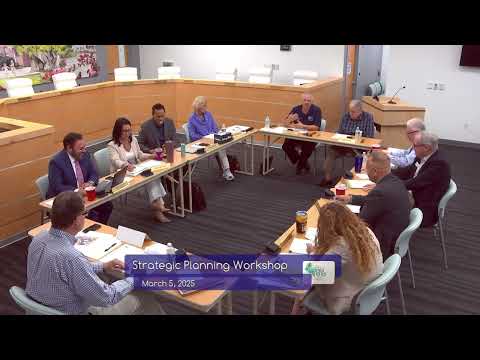
At a March strategic-priorities workshop, Bonita Springs officials agreed by consensus on seven citywide priorities and identified a set of workshop topics including beach access, a downtown parking structure, e-bike/multimodal rules, rails-to-trails and sewer/septic coordination with utilities.
Bonita Springs City Council members and staff on March 13 reached consensus on seven strategic priorities for the city and identified a series of workshop topics to develop implementation steps and public outreach.
The priorities adopted by consensus are: improve stormwater management and resiliency; improve vehicular and multimodal transportation networks; community aesthetics, parks and facilities; environmental protection; strengthen city finances; government transparency and efficiency; and economic development.
The priorities emerged from a facilitated session that asked each council member to identify and then collectively refine strategic focus areas. Jim, the session facilitator, guided the group through wordsmithing and suggested adding the word resiliency to stormwater, which participants accepted. Justin said, “I think the way Jim said it with resiliency is I think that works because that's a buzzword of the state and it unlocks dollars,” and the group agreed to the revised phrasing.
Councilmembers and staff discussed specifics that could be advanced as near-term workshops or public-facing efforts. Workshop topics the group agreed to develop include beach and water-access strategies (including discussion about Lovers Key State Park access and county/state coordination), a downtown parking structure and overall parking strategy, a focused conversation on e-bikes and multimodal transportation policy, rails-to-trails planning, review of the future land‑use map, and coordination with Bonita Springs Utilities (BSU) on sewer expansion and septic-system replacement.
Several councilmembers emphasized finance and delivery. Mike said he was “pretty happy with the priorities,” while noting workshops on financing and on moving slower long‑running projects to completion. Laura framed economic development as central, saying, “I think it all comes down to economic development because everything stems down to where's the money coming from.” Council members also discussed pursuing grants, FEMA reimbursements and other outside funding as part of the finance strategy; staff reported they had secured a 50% upfront FEMA reimbursement on some storm-related work and that a FROC refunding had been approved at about 40% for future storms.
Staff and council discussed several implementation and outreach items tied to the priorities. These included streamlining building-permitting processes and online submittals, continuing monthly project status briefings on the capital improvement program, developing an educational “Bonita Springs 101” video or short series for residents, and hosting public workshops on topics such as raising homes (flood/elevation programs) and accessory dwelling units (ADUs). Derek (staff) explained legal and enforcement limits regarding e-bikes and noted the state classification is evolving; council asked staff to prepare research and invite law-enforcement input for the e-bike/multimodal workshop.
Council members also asked for further coordination with regional partners. Speakers noted that many transportation corridors are county roads and that some beach-access parcels and park issues involve state and county agencies; the group asked staff to invite those partners for relevant workshops. Chris asked staff to provide clearer information about BSU’s sewer master plan and how the city and BSU might coordinate funding or phased extensions so septic systems can be addressed without unduly burdening existing ratepayers.
The session closed with staff tasked to assemble the workshop outlines and bring dates back to council, and with agreement to record or videotape public-facing educational materials. Councilmembers said the workshops should focus on actionable items—funding options, project timelines, and measurable objectives—rather than broad principle statements.