Get Full Government Meeting Transcripts, Videos, & Alerts Forever!
Get email alerts on the Elections topic
No spam. Unsubscribe anytime.
Board votes to defend lawsuit, suspends Election Commission and directs ordinance changes
Summary
The Shasta County Board of Supervisors on Tuesday voted in closed session to retain counsel and defend the county in Ladd v. Thomas Toller and reported a 4-1 decision to suspend meetings of the county Elections Commission until the lawsuit is resolved.
The Shasta County Board of Supervisors on Tuesday voted in closed session to retain counsel and defend the county in Ladd v. Thomas Toller and, in a subsequent public report, voted to suspend meetings of the county Elections Commission until the lawsuit is resolved.
In the closed-session report, County Counsel Joseph Larmer told the board it voted 5-0 to appoint counsel to defend the claim Ladd v. Thomas Toller. The board also voted 4-1, with Chairman Scribe voting no, to suspend meetings of the Elections Commission until the lawsuit is resolved. Counsel Larmer reported those actions when the board returned to open session.
Why it matters: The suspension and the closed-session decision generated extensive public comment during the meeting; members of the public and commission officials urged the board to keep the commission active and to act on the commission’s recommendations, while others urged the board to back county staff and await court resolution.
Board actions and follow-up: After the closed-session report, the board considered ordinance changes to Chapter 2.07 of the Shasta County Code governing the Elections Commission. Stephanie Blankenship, chief deputy clerk of the board, presented proposed amendments that would change the number and cadence of commission meetings and add reporting requirements. The board adopted a motion to direct staff to bring back an item forming an ad hoc Board-level committee to work on election matters while the commission is suspended; that motion, introduced by Supervisor Plummer and seconded by Supervisor Long, passed 5-0.
Supervisor Plummer later proposed and the board approved an amended meeting schedule for the commission that will be reintroduced: 10 meetings in a non-statewide-election year and six meetings in a statewide election year (with provision for special meetings). The clerk said the amendment will be reintroduced at the Feb. 25 meeting for formal enactment. The amended cadence passed on a 5-0 vote.
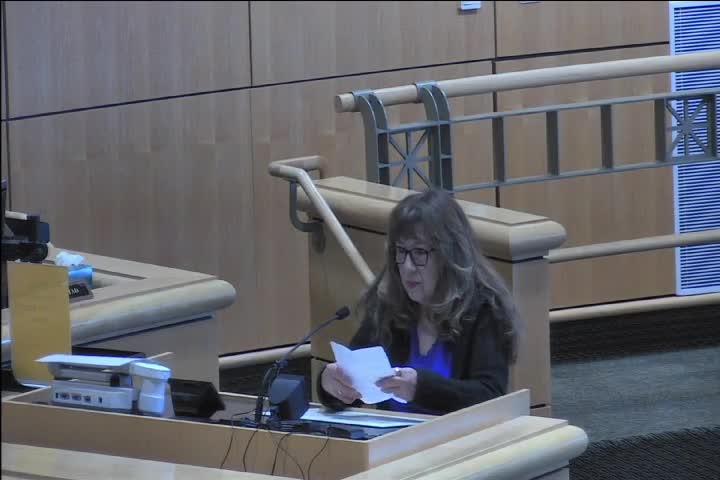
Public comment at length focused on perceived problems with election administration and the commission’s work. Ronin Lund, who identified themself as the current chair of the Elections Commission, told the board the commission’s planned special meeting had been cancelled after it was not posted because of the pending litigation and that commissioners were not parties to the lawsuit. “I would like to remind the board that neither I nor the other commissioner are parties to this lawsuit,” Lund said, noting commissioners act as observers by ordinance.
Joanna Francisca, assistant county clerk and registrar of voters, asked the board to consider the practical effect of meeting frequency in election years and recommended more meetings in non-statewide election years to allow staff time to implement improvements. She said having more meetings during non-election years would better allow the department and commission to update procedures and prepare for the next election.
Other speakers urged the board to restore or keep frequent commission meetings, to pursue transparency measures, or to allow the commission to complete its recommended actions. Several public speakers raised legal concerns, argued that the suspension looked like witness intimidation, and urged the board to adopt commission recommendations rather than curtailing the commission. At least one speaker told the board they had been advised by legal counsel that the board’s vote to suspend the commission raised Brown Act issues.
Ending: The board recorded its closed-session votes and instructed staff to return with the ordinance amendment for reintroduction on Feb. 25; it also directed staff to draft an ad hoc committee item. The suspension remains in effect “until the lawsuit is resolved,” per the board’s recorded action; the board did not take further action on R4 (anticipated litigation) and gave direction on R5 (real property negotiation) during closed session but made no public report beyond that direction.