Get Full Government Meeting Transcripts, Videos, & Alerts Forever!
Get email alerts on the Environment Basin Project topic
No spam. Unsubscribe anytime.
Police jury adopts resolution opposing East Grand Lake project citing basin wetland concerns
Summary
Assumption Parish Police Jury voted to adopt a resolution opposing the East Grand Lake project in the Atchafalaya Basin, citing potential wetland filling, sedimentation and impacts to crawfish production and flood capacity.
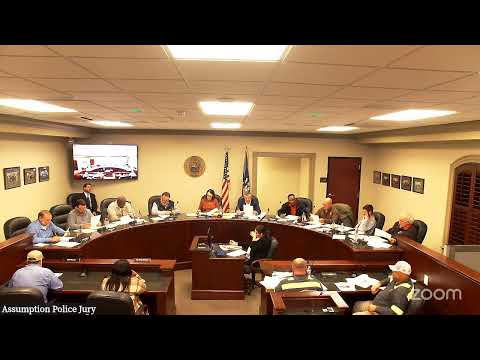
At its Jan. 8 regular meeting the Assumption Parish Police Jury unanimously adopted a resolution expressing opposition to the proposed East Grand Lake project in the Atchafalaya Basin.
The resolution, introduced after committee discussion and a presentation from the Chapel Basin Keeper (who had briefed the jury in December), enumerates concerns that the basin’s wetland forests are nationally unique, that the basin supports the world’s largest crawfish production, and that projects which introduce river water and sand into side lakes can silt and fill productive wetlands. The text of the resolution states that similar projects in the northern basin have "decimated those areas" and called for local engagement and mitigation approaches including sediment traps.
The jury’s president read and presented the resolution during the regular meeting; a police juror moved adoption, it was seconded and the motion passed by voice vote. The resolution also publicized a community meeting organized by basin stakeholders for Jan. 16 at 6 p.m. at Bayou Pigeon Heritage Hall where residents and basin groups plan to review the project and discuss suggested design adjustments to reduce sedimentation and wetland loss.
The resolution asks that the jury formally oppose the East Grand Lake project in its current form and urges stakeholders and state reviewers to consider alternatives and sediment controls during planning. The motion carried with no recorded dissent.
The resolution text emphasizes the basin’s flood-protection function for downstream communities and industrial corridors, and links wetland loss to broader flood risk and cultural and ecological consequences.