Get Full Government Meeting Transcripts, Videos, & Alerts Forever!
Get email alerts on the Telehealth Reimbursement topic
No spam. Unsubscribe anytime.
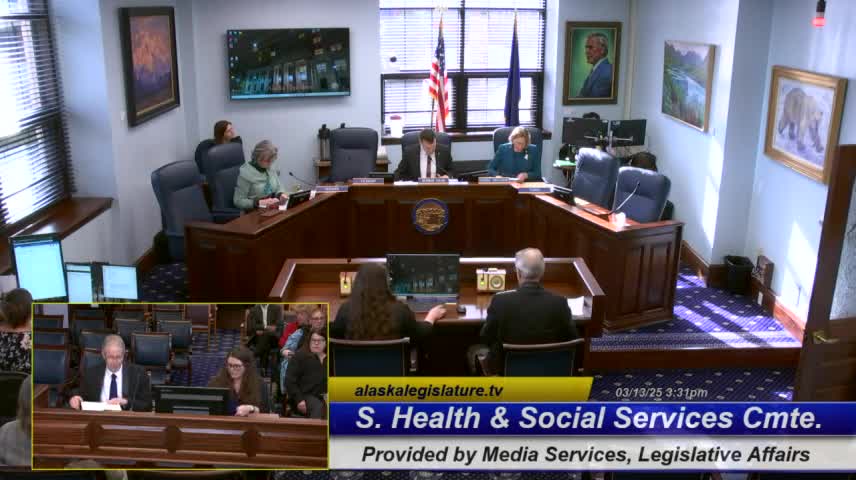
Senate committee advances telehealth parity bill but removes provider pay mandate
Summary
The Alaska Senate Health and Social Services Committee on March 13 adopted a committee substitute for SB83 that locks telehealth reimbursement rules into law, removes a provision on provider-specific pay differences, and sets an effective date of Jan. 1, 2026; members raised but did not resolve cost questions tied to Medicaid.
The Senate Health and Social Services Committee on March 13 adopted a committee substitute for Senate Bill 83, a measure that would codify telehealth reimbursement rules and set an effective date of Jan. 1, 2026.
The committee substitute (version O) removes a provision that would have required insurers to apply identical reimbursement rates to all health-care providers and adds language explicitly covering behavioral health services. The substitute also eliminates the sunset date tied to House Bill 265 (2022), making the COVID-era telehealth regulatory changes permanent.
Aria Wigan, committee aide, summarized the changes for the record, saying the prior version’s section requiring equal reimbursement for each provider was removed and that the phrase “including behavioral health services” was added to the services covered. She also said the substitute removed the sunset for HB265 and set an effective date of 01/01/2026.
Why it matters: The changes would preserve telehealth access rules created during the COVID-19 emergency and could affect how Medicaid and private insurers reimburse telehealth visits. Senator Hughes pressed for cost projections tied to Medicaid and whether removing the sunset date could increase Medicaid spending in later years.
Director Laurie Winghire of the Division of Insurance told the committee she does not administer Medicaid and could not provide Medicaid cost projections: “I don’t do Medicaid so I wouldn’t have that information. You’d need to get it from the Department of Health, ma’am.” She also said insurers who were surveyed told the committee staff they already pay telehealth visits at parity with in-person visits and that the office had not received letters of opposition from carriers: “they all advised us that they're already paying at parity.”
Committee debate also addressed a deleted provision (referred to in the hearing as section 3) that would have altered pay based on provider licensure. Senator Giesel said the proposed statutory change would have created “disproportionate pay for providers depending on their licensure” and preferred to omit that subject from SB83; Senator Clayman said the removed language will be addressed in separate legislation (SB121).
Actions and procedural history: The committee adopted the committee substitute as its working document after a staff summary and discussion. Senator Giesel moved the CS from committee with individual recommendations and attached fiscal notes; there were no recorded objections and the bill “moves from committee.” The committee did not take a recorded roll-call vote during the hearing; the chair noted no objections when the CS was reported from committee.
What remains unresolved: Members asked for Medicaid-specific cost projections beyond 2030 and whether private insurers had reviewed and accepted the substitute’s changes now that the Medicaid sunset had been removed. Committee members noted that the bill will still go to Finance for further review, where insurers and other stakeholders can present fiscal concerns.
The committee reported SB83 out with its committee substitute and recommendations; paperwork was signed following the session.