Get Full Government Meeting Transcripts, Videos, & Alerts Forever!
Get email alerts on the State Legislation topic
No spam. Unsubscribe anytime.
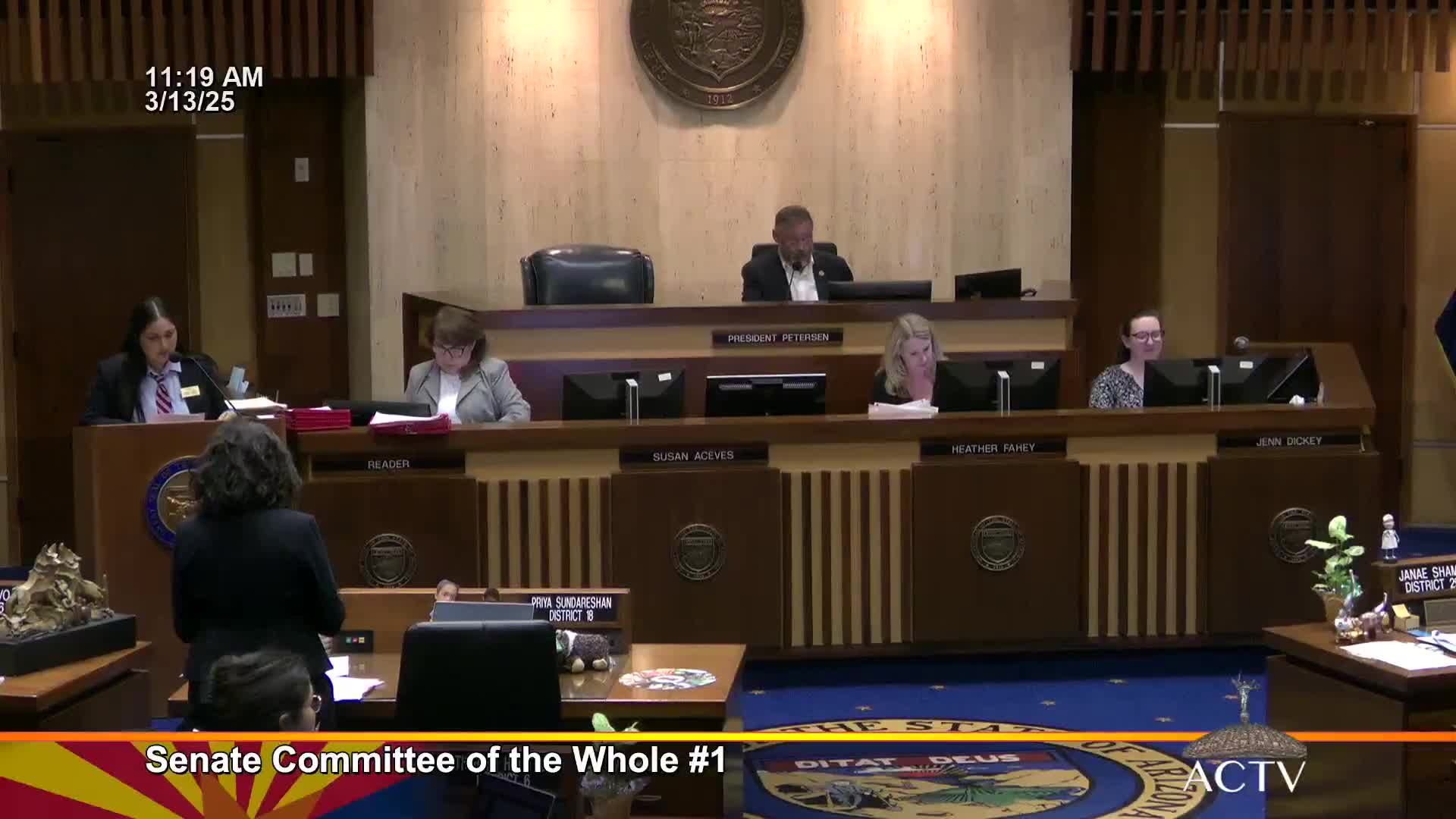
Arizona Senate approves wide package of bills; debates groundwater, biosolids, helium exemption and school AEDs
Summary
The Arizona Senate met March 13, 2025, at the State Capitol in Phoenix and passed a broad slate of legislation, including appropriations and regulatory changes, while holding extended floor debate on groundwater policy, biosolids regulation, a helium-exploration exemption and school AED funding.
The Arizona Senate met March 13, 2025, at the State Capitol in Phoenix and passed a broad slate of legislation, including appropriations and regulatory changes, while holding extended floor debate on water policy, environmental rules for biosolids, a heli um exploration exemption and emergency equipment for schools.
Why it matters: Several measures have direct operational effects for state agencies (ADOT, ADEQ, State Land Department), local governments and school districts; others change standards for public safety and environmental oversight. Multiple bills were sent to the House after recorded roll-call votes; several generated extended floor explanations and requests for further amendment on return from the other chamber.
Groundwater and rural water management
Lawmakers debated several measures addressing groundwater and rural water supplies. Critics said the primary bill discussed would apply only to a limited number of basins and would cap reductions at levels that, they argued, would not restore or stabilize groundwater in many rural communities. Opponents repeatedly raised practical concerns including the potential for unlimited banking of credits and the risk that some users might never come into compliance. Sponsors said the measures create a framework for basin management. The Senate passed one rural-groundwater bill (listed below) without the emergency clause; critics urged more comprehensive action and further negotiations.
Biosolids, PFAS and immunity
Members debated a bill that would change rules governing biosolids and soil amendments. Dissenting senators said the measure could limit agencies’ ability to restrict uses of sludge-containing materials and noted risks from contaminants such as PFAS. Opponents also criticized language they said would grant immunity to certain state entities from damages related to use of biosolids. After floor discussion, the Senate approved the bill and transmitted it to the House.
Helium-exploration exemption and environmental concerns
A measure exempting helium exploration wells from some APP (aquifer protection) processes drew multiple floor explanations. Supporters argued helium is an inert gas and that exemptions would help manufacturing and health-care uses dependent on helium. Opponents said the bill risked creating gaps in aquifer protections and urged continued negotiation with state agencies. The Senate approved the bill after debate and amendments.
Substance-abuse court-ordered evaluation
The Senate debated a bill establishing a standard for court-ordered evaluations for people with substance-use disorders and lowering the standard for continued civil evaluation. Several senators said involuntary evaluation carries clinical risks—particularly for opioid users whose overdose risk increases after short detentions—and urged caution. The measure passed the Senate and was sent to the House.
Automotive- and aviation-related tax carve-outs and other appropriations
A package of appropriations and tax measures reached the floor. Members expressed competing views on whether certain tax changes (for example, exemptions tied to aircraft maintenance) represent necessary economic development or untargeted giveaways. Appropriations for long-term care, trail and forestry funding, workforce training, and health programs were also considered and largely approved.
AEDs in public high schools
The Senate considered legislation to appropriate funding for automated external defibrillators (AEDs) and related requirements for public high schools. Sponsors framed the bill as a practical, affordable step to protect students who experience sudden cardiac events; the chamber approved the measure with an emergency clause.
Executive confirmations and next steps
The Senate confirmed two gubernatorial nominees (executive director, Arizona State Lottery Commission; director, Residential Utility Consumer Office) and recessed to return on Monday, March 17. Several senators requested additional amendments on House versions of bills they said require further stakeholder input.
Votes at a glance
- SB1086 (transportation planning; restrictions on ADOT demand-management targets) — Passed; recorded floor tally reported in the Chamber as 17 ayes, 11 nays, 2 not voting; transmitted to the House. - SB1089 — Passed; recorded as 17 ayes, 11 nays, 2 not voting; transmitted to the House. - SB1212 (biosolids; new section added to Title 49) — Passed; recorded as 16 ayes, 12 nays, 2 not voting; transmitted to the House. - SB1215 (litigation-financing rules; new chapter on litigation financing) — Passed; recorded as 27 ayes, 1 nay, 2 not voting; transmitted to the House. - SB1232 (changes to arrest-warrant rules) — Passed; recorded as 18 ayes, 10 nays, 2 not voting; transmitted to the House. - SB1278 (creates Department of Natural Resources; reassigns some permitting authority) — Passed on the floor after extended debate; roll-call tally reported by the secretary in the transcript but not legible in the stenographic record provided (tally: not specified in transcript excerpt); transmitted to the House. - SB1290 (prohibits brass knuckles for minors) — Failed on third reading; the chamber recorded the result as failing to pass (vote recorded in the transcript as 11 ayes, 17 nays, 2 not voting); bill failed on floor. - SB1520 (rural groundwater management, enacted without emergency clause) — Passed and transmitted to the House; recorded as 18 ayes, 10 nays, 2 not voting; did not carry an emergency clause. - SB1521 (related groundwater/procedural changes) — Passed on third reading and sent to the House; the transcript records passage but the floor tally printed in the provided excerpt is not clearly legible (tally: not specified in transcript excerpt). - SB1257 (court-ordered evaluations for substance-abuse disorders) — Passed on third reading; secretary recorded the result in the transcript as 16 ayes, 11 nays, 3 not voting; transmitted to the House. - SB1460 (appropriations for MDMA-assisted therapy pilot; third reading) — Passed; recorded as 18 ayes, 9 nays, 3 not voting; transmitted to the House. - SB1707 (appropriation for AEDs in public high schools; emergency clause) — Passed with emergency clause; recorded as 26 ayes, 1 nay, 3 not voting; transmitted to the House.
Nominations
- Alec Esteban Thompson — Confirmed as executive director, Arizona State Lottery Commission (Senate advised and consented). - Cynthia Ann Zwick — Confirmed as director, Residential Utility Consumer Office (Senate advised and consented).
What to watch next
Several senators said they expect further amendment on the House side for water bills and the biosolids measure. Sponsors and opponents repeatedly urged continued negotiation with state agencies (ADEQ, State Land Department, Department of Water Resources) and stakeholders before final enactment.
Ending
Following the votes and two confirmations, the Senate recessed to reconvene Monday, March 17, 2025, at 1:15 p.m. The recorded journal and bills were transmitted to the Arizona House for further consideration.