Get Full Government Meeting Transcripts, Videos, & Alerts Forever!
Get email alerts on the Tribal Education Compacts topic
No spam. Unsubscribe anytime.
Alaska committee hears HB 59 to pilot state-tribal education compacts
Summary
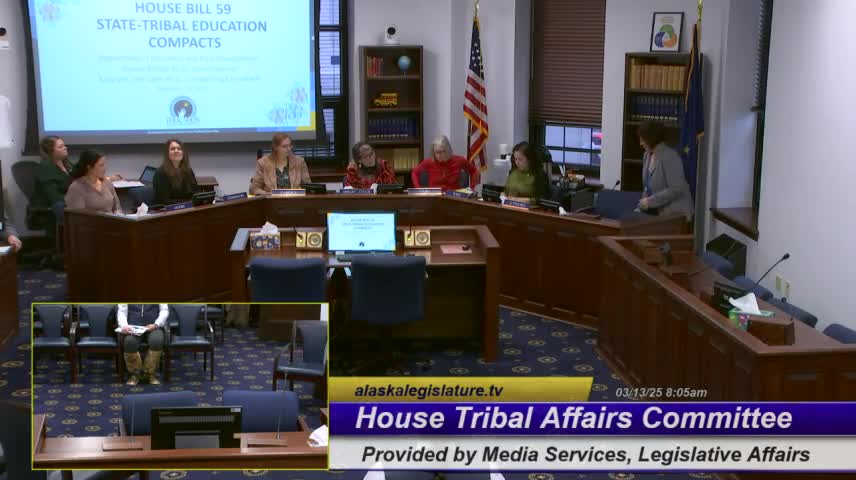
At an introduction hearing March 13, the House Tribal Affairs Committee reviewed House Bill 59, a proposed 7-year pilot that would allow federally recognized tribes to operate "tribally compacted" public schools under state-tribal compacts, using the state foundation formula for funding and a one-time start-up grant.
The House Tribal Affairs Committee heard an introductory presentation March 13 on House Bill 59, which would authorize the Department of Education and Early Development to negotiate state-tribal education compacts allowing federally recognized tribes or tribal organizations to operate tribally compacted public schools funded through the state's foundation formula.
"Please know that the bill before you is designed to inspire tribal and community ownership of educational excellence in Alaska," Commissioner Dina Bishop, Department of Education and Early Development, told the committee during the hourlong presentation.
The bill would create a 7-year demonstration: a startup phase followed by five years of operation for participating tribally compacted public schools. The Department of Education, working with tribal partners, drafted a compact model and a legislative package that, in the department's description, aims to align compacted schools with Title 14 public education law while allowing tribes flexibility over curriculum, staffing and some operational policies.
Why it matters: HB 59 is intended as a pilot to test whether government-to-government compacts can expand culturally based, tribal-run public schooling while preserving state reporting, fiscal oversight and student protections. Supporters told the committee the measure grew from multi-year consultations and a 2022-state negotiated directive tied to Senate Bill 34 (codified as a non-codified law in chapter 43, SLA 22) and from a larger process that included five tribal partners selected for a demonstration project.
Key provisions and mechanics
- Authority and scope: Section 2 of the draft bill, as explained to the committee, grants the commissioner authority to negotiate and execute compacts. Compacts would be government-to-government agreements between the state and a federally recognized tribe or tribal organization to operate one or more tribally compacted public schools.
- Governance and status: Under the draft language presented, a tribe that enters a compact would function as the local education agency for that tribally compacted school — "the tribe functions as the school district," Joel Isaac, a compacting consultant with DEED, told the committee. The compact would require a governing body (established by the tribe or tribal organization) and mandate that the school meet public-school obligations such as special education services and public reporting.
- Teacher certification and staffing: The compacting model requires that teachers be certified and that tribes put training or credentialing on file with the department so the state can verify that compact-trained teachers meet Title 14 standards. The presenters emphasized that compact-authorized training could be tailored to language and culture while still accounting for statutory certification requirements and safety checks.
- Funding: The department's fiscal presentation proposes that tribally compacted schools be funded under the existing foundation formula and be eligible for federal and state funding that flows to school districts. In addition, the fiscal note proposes a one-time start-up grant in each school's first operational year set at 45% of the base student allocation (the fiscal presentation used a base student allocation of $5,960), producing an estimated FY26 cost of about $17.5 million statewide for the five proposed pilot sites (roughly $5.4 million in start-up grants plus $12.1 million in ongoing foundation funding). Heather Heineken, DEED director of finance and support services, described the departmental fiscal note as a "$0 system loan" because the department does not anticipate separate administrative costs beyond existing funds and transfers into the Public Education Fund.
Questions and concerns raised
Committee members pressed presenters on several operational and fiscal questions. Representative Ashley Kerrick asked whether a tribally compacted school would function as a district or as a district-and-school hybrid; Isaac and Commissioner Bishop clarified that, under the bill's draft language, the tribe would operate as the local education agency and the compacted school would be its school.
Representatives asked how compacts would affect relationships with existing districts on issues such as transportation, special education, shared facilities and capital requests. DEED staff said those intergovernmental arrangements would be negotiated locally and that existing tools such as memoranda of understanding and shared-services agreements could be used. Commissioners and staff noted that compacted schools would be eligible for federal entitlements (special education, Indian education) when operating as a local education agency.
Several members asked about local contributions from boroughs or municipalities. Commissioner Bishop and DEED staff said tribes do not have taxing authority and that, as with Regional Educational Attendance Areas, there is no statutory local-contribution requirement; however, tribes or local governments could provide grants or other support on a voluntary basis.
Other topics addressed by presenters included retirement plan participation for teachers (teachers working for tribally compacted schools would participate in the teacher retirement system), the need for clear conflict-resolution language in compacts to avoid disruptive closures, and use of uncodified law to avoid opening large swaths of Title 14 while piloting the program.
Fiscal numbers and projected pilot sites
DEED's fiscal presentation listed five tribal partners that expressed interest in the pilot and included projected average daily membership (ADM) figures supplied by those partners. The department's FY26 estimate used those projected ADMs and the one-time startup grant to arrive at the $17.5 million FY26 figure. The presenters cautioned that the final foundation formula allocations would be determined after the October 2025 student-count period and that the impact on existing districts is indeterminate because it depends on actual student transfers.
Process and next steps
Presenters said passage of HB 59 would authorize negotiations; compacts themselves would be negotiated and finalized after the law is in place. A compact would have to meet its stated conditions before a tribally compacted school opens and funding begins to flow. No committee vote occurred; the hearing was an introductory presentation and question-and-answer session.
"This is a pilot," Joel Isaac said during the hearing, framing HB 59 as a narrowly scoped test of the compacting mechanism rather than a broader rewrite of state education law.
Ending
Committee members thanked presenters and said they would follow up with specific technical questions. DEED officials pointed committee members to a legislative report and supporting documents that the department produced with tribal partners and outside contractors. The hearing concluded with no formal action taken on HB 59; any movement to create compacts would require passage of the bill and then negotiated agreements between the state and participating tribes.
(Reporting note: this article is based on a March 13, 2025, House Tribal Affairs Committee hearing and on fiscal notes and a departmental report presented to the committee.)