Get Full Government Meeting Transcripts, Videos, & Alerts Forever!
Get email alerts on the Revenue Forecast topic
No spam. Unsubscribe anytime.
Department of Revenue spring forecast: FY25 UGF unchanged, FY26 UGF down $70 million; oil-price sensitivity remains key
Summary
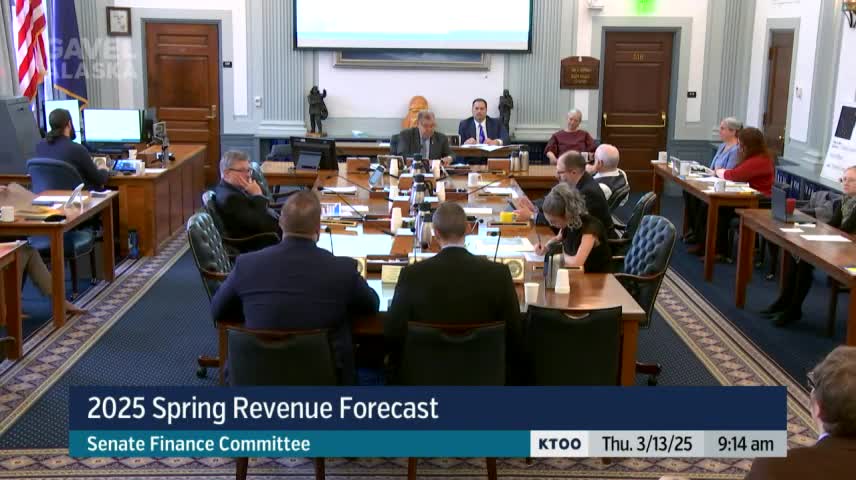
The Alaska Department of Revenue presented its spring 2025 revenue forecast to the Senate Finance Committee on March 13, reporting that unrestricted general fund (UGF) revenue for FY25 is essentially unchanged from the fall forecast and that UGF for FY26 has decreased by about $70 million.
The Alaska Department of Revenue presented its spring 2025 revenue forecast to the Senate Finance Committee on March 13, reporting that unrestricted general fund (UGF) revenue for FY25 is essentially unchanged from the fall forecast and that UGF for FY26 has decreased by about $70 million.
Commissioner Adam Crone (for the record at the hearing) said the top-line message was stability in the FY25 forecast “with a slightly higher expected petroleum revenues offset by slightly lower revenues from other sources,” and he identified a net $70 million reduction in UGF for FY26.
Why it matters: UGF feeds the state’s annual operating budget and shapes how much lawmakers can appropriate for services and for any Permanent Fund dividend. The forecast’s oil-price, production, and investment-return assumptions directly affect near-term budget choices.
Chief Economist Dan Stickel briefed the committee on the technical assumptions behind the spring forecast. The department incorporated actual data through February and used futures-market prices for crude to set the oil-price assumptions for the remainder of FY25 and FY26. For FY25 Department economists used a North Slope price in the low-to-mid $70s per barrel and applied a $68-per-barrel assumption for FY26 in the office’s baseline. Stickel emphasized that the forecast is “one scenario within a range of uncertainty.”
Permanent Fund and investment returns: The forecast incorporated actual permanent-fund returns through January and assumed a 7.9% annual return for the remainder of the current fiscal year and a 7.65% annual return for FY26 and beyond. The department noted the statutory/administrative calculation for the permanent fund transfer to the general fund uses the first five of the last six fiscal years as part of its trailing-average mechanism; that transfer was known for the upcoming year and did not change the spring forecast’s transfer amount.
Petroleum and other revenues: The department forecast that investment earnings, petroleum revenues, and federal funds together account for the large majority of total state revenue. For unrestricted petroleum revenue, the forecast separates oil-and-gas production tax, corporate income tax, petroleum property tax (state share), and royalties. The department reported unrestricted petroleum tax and royalty estimates of roughly $2.3 billion (outside the permanent fund transfer) in the FY26 baseline and reiterated a sensitivity rule of thumb: each $1 per-barrel change from the baseline Alaska North Slope price equates to approximately $35 million of unrestricted general fund revenue.
Production, costs, and capital spending: The forecast showed near-term production stability as declines in mature fields are expected to be offset by drilling and development activity; larger production increases are modeled later in the decade as projects such as Willow and Pikka are assumed to come online. Capital expenditures were $4.2 billion in FY24 and were expected to remain elevated in FY25 before stabilizing at roughly $3.4 billion per year; operating costs also rose, and transportation/netback costs averaged $10.53 per barrel in FY24 and were forecast to be just under $10 per barrel on average in coming years.
Nonpetroleum assumptions: The spring forecast assumes a stable, growing economy, continued strong tourism with approximately 1.6 million cruise passengers annually, and a multi-year recovery for fisheries tax revenue spread over about five years. The department said it did not include major new mining projects in its baseline but used futures-market prices to inform mineral-price assumptions.
Committee Q&A touched on petroleum property tax composition and municipality shares, the treatment of energy-relief and one-time payments in last year’s combined dividend, and how economic indicators feed the nonpetroleum tax forecasts. The department said it could provide detailed breakout tables (for example, property-tax by municipality) on request.
Ending: Department staff told the committee they would provide the spring forecast materials to legislators and that Legislative Finance would update its budget scenarios to reflect the new forecast. Department leaders described the forecast as robust—drawing from data through February and early March futures markets—but reminded members it remains a scenario subject to market volatility.