Lifetime Citizen Portal Access — AI Briefings, Alerts & Unlimited Follows
Alaska lawmakers hear support and concern for HCR 1 to study sport-fishing providers in Southeast
Loading...
Summary
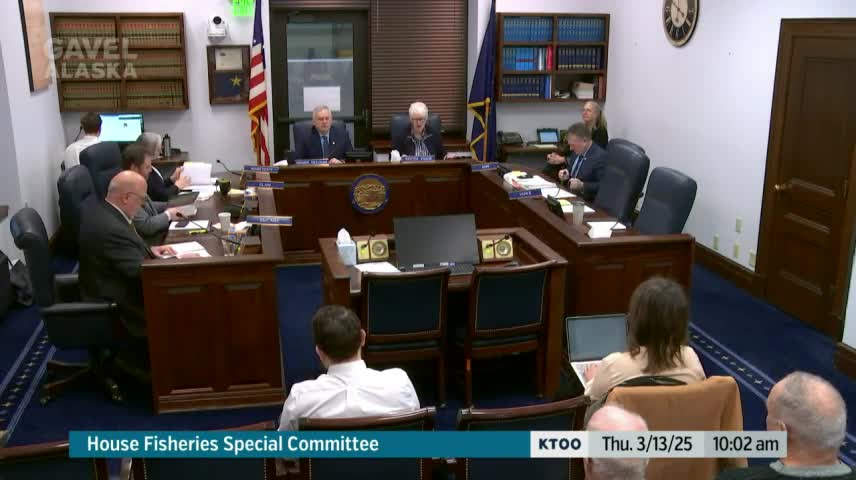
Representative Rebecca Himchute on March 13 told the House Special Committees on Fisheries that House Concurrent Resolution 1 would create a joint legislative task force to study sport fishing service providers in Southeast Alaska and recommend whether managed entry or other controls are warranted.
Representative Rebecca Himchute, sponsor of House Concurrent Resolution 1, told the House Special Committees on Fisheries on March 13 that HCR 1 would establish a joint legislative task force to study the sport fishing service sector in Southeast Alaska and recommend possible management options, including managed entry if warranted.
"This resolution is something that we worked on a great deal over the interim," Representative Himchute said at the start of the hearing, explaining the proposal grew out of stakeholder requests in Southeast where there is a high density of sport-fishing services. She told the committee the task force would "come back with recommendations using the voice from all sectors so that we aren't hearing from just the commercial side or just the guided side." The resolution as drafted limits the study area to waters of Southeast Alaska between Cape Suckling and Dixon Entrance and directs the task force to examine history, participation, and the feasibility of managed entry systems.
The resolution lists a multi-member task force that would include a legislator from each chamber, a member of the Board of Fisheries, tribal and public representatives, seats recommended by the Southeast Alaska Guides Organization (SEAGO), members from Southeast Alaska Fish and Game Advisory Committees, and two members with commercial fishing and policy experience. Thatcher Brower, staff to Representative Himchute, described the membership and duties and confirmed the task force could request technical support from the Alaska Department of Fish and Game and the Commercial Fisheries Entry Commission.
Supporters from the sport-fishing service sector and allied groups urged lawmakers to authorize the study and said it was driven by industry concerns about declining harvests and competition among user groups. Kim Lundeen, assistant executive director of the Southeast Alaska Guides Organization, told the committee the group's February 2024 study estimated $202,000,000 in outside revenue to Southeast Alaska, supporting about 1,750 jobs and generating roughly $11,000,000 in local tax revenue. "HCR 1 is about bringing everyone to the table to create a sustainable and a long term plan," Lundeen said.
Tracy Welch, executive director of United Fishermen of Alaska, said UFA's board supports HCR 1 and that commercial fishing interests were prepared to offer experience about the pros and cons of limited-entry approaches. Jill Weitz, government affairs liaison for the Central Council of the Tlingit and Haida Indian Tribes of Alaska, said tribal leaders support HCR 1 and emphasized that tribal citizens hold a significant portion of Southeast fishing permits and that management should protect subsistence and resident priorities.
Several charter operators and lodge owners from Southeast spoke in favor of the study and of examining managed entry options. They cited smaller harvest allocations for species such as king salmon and halibut, rising industry costs, increasing participation (including bareboat rentals), and concern that overcapitalization or unchecked growth could harm long-term economic viability for family-run businesses in remote communities.
Opposition or caution came from other quarters. Shannon Martin, executive director of the Kenai River Sport Fishing Association, called in to oppose HCR 1, saying a limited-entry program "would limit the public's access to a public resource." Monte Roberts, representing the Kenai River Professional Guide Association, warned that limiting entry can create barriers and transfer access to incumbents, drawing a contrast with big-game guiding programs.
Committee members probed scope and timeline. Some members, including Representative McCabe, urged a statewide approach given closures and pressure in Southcentral and other regions; others said Southeast may be an appropriate demonstration region because of its high guide density and unique treaty and user-group dynamics. Staff noted the draft resolution currently limits the geographic scope to Southeast but that the task force could recommend broader changes.
Legislative questions also focused on feasibility and schedule. Sponsors said the task force could request staff and agency support; the resolution's draft timeline for final recommendations would push work through the remainder of the legislative term, and committee members suggested the report date and resources may need adjustment to allow substantive work.
No final vote on HCR 1 occurred at the hearing. The committee chair announced that the plan was to set HCR 1 aside for further work and that a fiscal note is being prepared; the amendment deadline was set for Tuesday, March 18 at 5 p.m. and the committee will accept further work on the resolution. The committee record includes invited testimony, public comment from multiple Southeast operators and community leaders, and written materials referenced by sponsors and supporters.
The hearing made clear the two central tensions that the task force would be asked to reconcile if created: how to sustain and protect fisheries and local economies in Southeast while preserving public access to a public resource, and whether managed entry or other regulatory tools used in commercial fisheries can be adapted to sport-fishing services without creating unfair barriers to entry.
If the committee proceeds with HCR 1 as written, next steps listed in the hearing record are completion of a fiscal note, refinement of the task force membership and charge, and consideration of amendments by the March 18 deadline. Committee staff said task force members could request technical assistance from the Department of Fish and Game and the Commercial Fisheries Entry Commission if the panel is convened.