Get Full Government Meeting Transcripts, Videos, & Alerts Forever!
Get email alerts on the State Budget topic
No spam. Unsubscribe anytime.
Senate Finance hears Legislative Finance Division update on 3-year budget outlook, Permanent Fund dividend scenarios
Summary
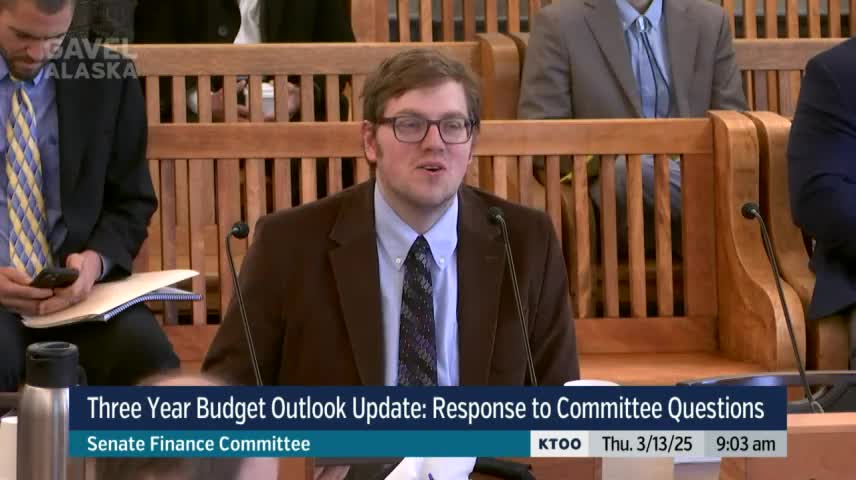
The Alaska Senate Finance Committee on March 13 heard an update from the Legislative Finance Division on its three-year budget outlook and alternative Permanent Fund dividend (PFD) scenarios that legislative leaders have asked the division to model.
The Alaska Senate Finance Committee on March 13 heard an update from the Legislative Finance Division on its three-year budget outlook and alternative Permanent Fund dividend (PFD) scenarios that legislative leaders have asked the division to model.
The update showed the Senate scenario that preserves a $75.25 PFD and projects persistent deficits, while a series of House scenarios presented earlier would produce larger near-term dividends but leave the state more exposed in later years. Legislative Finance staff said changes requested by committee co-chairs — specifically increasing K–12 foundation-related costs to reflect a rules-committee committee substitute of HB 269 and incorporating a faster Medicaid growth assumption — reduce the balanced-budget PFD available in those House scenarios.
Why it matters: The fiscal scenarios shape how much lawmakers could afford to pay Alaskans as a PFD and how large budget gaps will be in FY26–FY28. Committee members who favor continuing the PFD in some form pressed staff for numbers showing how different program and revenue assumptions change the dividend and resulting deficits.
Legislative Finance analyst Lexi Painter told the committee the office adjusted the House scenarios in two main ways at the committee chairs’ request: (1) it raised the foundation formula increases to match a committee substitute to HB 269 that the House adopted, and (2) it folded in a Medicaid-growth assumption from the Mesa report that the Senate had previously used. Painter said the rules-committee substitute added roughly $22 million for reading-incentive grants, which reduces the PFD available in a balanced-budget scenario.
Painter also said staff increased a contracts placeholder in the Senate scenario from $30 million to $40 million to reflect governor’s amendments that arrived late in the session and that more contracts were expected. The office included a $50 million placeholder for supplemental appropriations beginning in FY26 and included a school bond debt placeholder in its long-term scenario.
Under the House scenario presented earlier in the session and repackaged by Legislative Finance, a $1,000 increase in the Base Student Allocation (BSA) combined with other House-level changes produced a balanced-budget PFD of about $736 per recipient under the fall forecast assumptions; Painter warned that when the spring revenue forecast is applied that same scenario would show about a $70 million deficit. The Senate finance chair emphasized that the division’s alternate “scenario 5” — a more conservative, balanced-budget-from-fund-earnings approach — had been requested for committee review.
Committee members asked several clarifying questions, including about the comparison with last year’s dividend. Painter noted last year’s combined payment included a separate energy-relief payment; the PFD component was $75.25 per recipient and the combined distribution exceeded $1,700 per person when the one-time relief payment is included. Several senators told staff they remain interested in preserving some level of the PFD, though the committee record does not show a legislative decision on the dividend amount.
The Legislative Finance presentation concluded with staff agreeing to update its scenarios after the Department of Revenue released its spring revenue forecast; Painter said the office would return to the committee with revised numbers once the new forecast is incorporated.
Ending: The committee moved next to the Department of Revenue’s spring revenue forecast. No formal votes were taken on the scenarios presented by Legislative Finance during this hearing.