Alaska Village Electric Cooperative seeks battery energy storage for Chevak microgrid to double diesel displacement
Loading...
Summary
Bill Stam, president and CEO of Alaska Village Electric Cooperative, told the House Energy Committee that AVEC seeks Renewable Energy Fund support to install a battery energy storage system at Chevak that would pair with existing wind turbines and roughly double diesel displacement from about 20–25% to 40–50%.
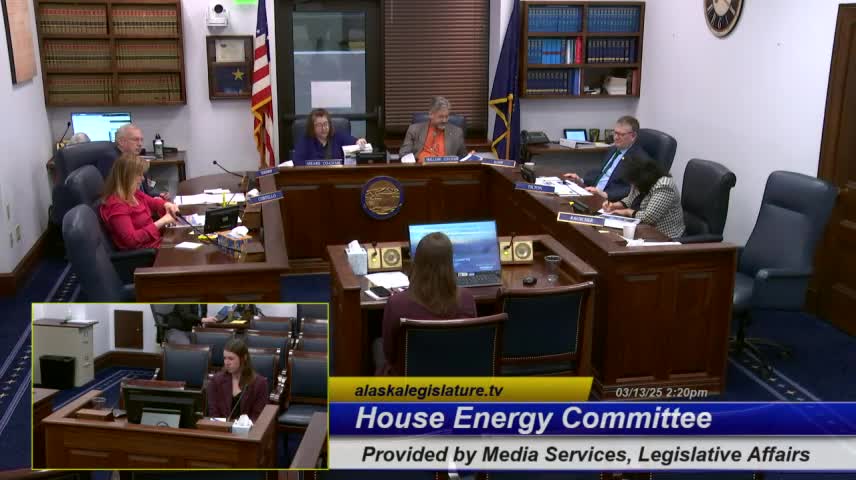
Bill Stam, president and CEO of Alaska Village Electric Cooperative, told the House Energy Committee on March 13 that AVEC seeks Renewable Energy Fund support for a battery energy storage system (BESS) at Chevak to pair with the community’s existing wind turbines and reduce diesel use.
Stam said AVEC serves 58 rural communities with more than 160 diesel generators and burns “over 9.5 million gallons of diesel fuel a year.” He told the committee that fuel dominates AVEC’s operating costs and that projects which increase the share of renewable generation and add energy storage can substantially reduce fuel consumption and maintenance costs.
Project purpose and benefits AVEC presented the Chevak proposal as a BESS integrated with four existing wind turbines to smooth variable generation, create synthetic spinning reserve, allow AVEC to operate smaller, more efficient diesel units more of the time, and reduce the need to start larger diesel gensets. Stam said the community currently displaces roughly 20–25 percent of diesel with wind and that adding storage could raise displacement to about 40–50 percent. AVEC’s modeling (Homer) showed increased captured wind energy and opportunities for “diesel off” hours; Stam said an inverter‑based BESS could form the grid and, in some conditions, keep power on without an immediately running diesel unit.
Costs, permitting and schedule Stam said AVEC has completed specifications and experience from three recent BESS projects (Stebbins, Shaktoolik, St. Mary’s) and expects categorical exclusion from NEPA for Chevak because work is located at the existing power plant site. He reported cost estimates had been escalated at least 25 percent since a 2023 application and that AVEC would seek additional funds from Department of Energy programs, Rural Utilities Service, Denali Commission and other federal sources in addition to any REF award. If funding were in hand by mid‑summer, Stam said AVEC could design and procure equipment in fall/winter and install and commission during the following year, with substantial commissioning and testing in the season after delivery.
Operational impacts Stam told the committee that BESS benefits extend beyond fuel savings: improved power quality, fewer starts on large engines (reducing overhaul frequency and O&M), and the possibility of short periods with diesel units offline. He described system components (battery modules, battery management, inverters, controls, HVAC) and noted safety and thermal management considerations for lithium‑ion‑phosphate batteries.
Ending Stam asked the committee to weigh the REF application alongside other rural projects, noting AVEC’s experience with earlier REF‑funded wind deployments and arguing the Chevak BESS would expand the value of existing renewable assets and reduce fuel costs and maintenance burdens.