Get Full Government Meeting Transcripts, Videos, & Alerts Forever!
Get email alerts on the Maritime Safety Arctic topic
No spam. Unsubscribe anytime.
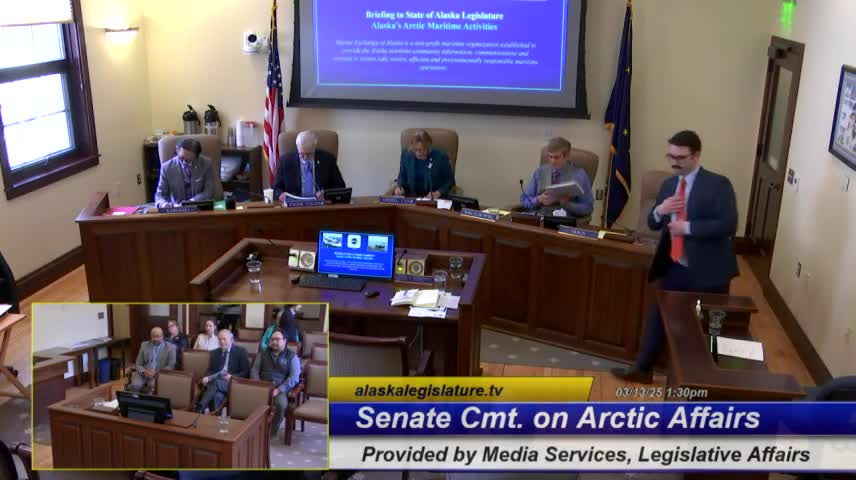
Marine Exchange of Alaska tells state committee it is expanding Arctic Watch to improve vessel tracking and early response
Summary
The Marine Exchange of Alaska told the Senate Arctic Affairs Committee on March 13 that it is expanding vessel-tracking and VHF communications in the Bering Strait and other Arctic approaches, seeking state support and industry cooperation to improve early detection, search-and-rescue response and environmental protection.
Juneau — The Marine Exchange of Alaska told the Alaska State Senate Arctic Affairs Committee on March 13 that it is stepping up its Arctic Watch effort to expand automatic identification system (AIS) tracking, VHF radio coverage and other shore‑side communications to improve safety, early detection and pollution prevention in the Bering Strait and adjacent waters.
The exchange’s founder, Captain Ed Page, said the nonprofit built the state’s vessel‑tracking network after receiving some funding from Exxon Valdez settlement money and that its operation center now monitors tens of thousands of commercial and fishing vessels. “Lives are being saved. The environment is being protected,” Page said.
The Marine Exchange described a multilayered approach that pairs AIS receivers, VHF voice relays and additional sensors at more than 50 sites across Alaska; a plan to add sites in Wales, Nome, Kivalina and Kotzebue this year; and work on a progressive web app so communities and mariners can see live vessel and ice information on tablets and phones. Byron Hayes, operations center supervisor, said the group also deploys weather stations, geofencing alerts (called “watchdogs”) and other tools used to warn vessels away from sensitive areas.
Why it matters: Committee members were shown examples in which exchange data helped search-and-rescue and pollution response. Hayes described the 2019 Scandies Rose response, where AIS data helped rescue survivors, and said the exchange has overheard distress calls that the Coast Guard did not immediately receive. “We were the only ones that heard the May Day,” Hayes said of one incident; he said notifying the Coast Guard led to aircraft being launched and people being rescued.
The presenters said the exchange’s terrestrial AIS and VHF network enables two important capabilities not available from satellite feeds alone: real‑time messaging to vessels and local geofenced alerts that can warn mariners about protected wildlife areas or temporary hazards. Page framed the work as prevention: “We need to focus more on prevention,” he told the committee, arguing early detection and earlier intervention reduce damage from groundings or spills.
Funding and partners: Page and Hayes described a mixed revenue model that includes state support, fees from commercial users, licensing to international customers and grants. They said the state’s contributions historically have been a minority share but catalytic; Page said the state paid roughly 20% of the capital cost for the exchange’s Juneau operations center. The exchange also has sought support from NOAA, the Alaska Ocean Observing System, the Coast Guard and foundations; presenters said some related grant requests to the governor and legislature are pending, and they asked about renewing use of a commercial passenger vessel excise tax to support operations.
Gaps and risks: Hayes told the committee that current Coast Guard VHF coverage meets only about 19% of the state’s shoreline‑to‑20‑mile requirement, compared with about 73% coverage in Southeast Alaska where the exchange has supplemented stations. Both presenters warned that federal budget and operational shifts — including changes in Coast Guard priorities or cutbacks at agencies that buy exchange services — could strain the nonprofit’s finances. Page said the exchange maintains reserves and seeks to diversify revenue but acknowledged uncertainty: “it can impact us,” he said when asked about potential federal cuts.
Policy and governance issues: Committee members asked about international and security questions raised by increased Arctic traffic. Page said the United States’ nonratification of the United Nations Convention on the Law of the Sea (UNCLOS) was a puzzling gap: “It’s embarrassing,” he said, adding that the exchange participates in International Maritime Organization (IMO) working groups and follows IMO guidance such as the Polar Code. On the topic of vessels that operate without AIS or that change identifying information — sometimes called “dark” or “ghost” vessels — Page and Hayes said terrestrial AIS, radar comparisons and other tools can flag anomalies and that those flags often prompt Coast Guard or port‑state checks.
Community engagement and next steps: The presenters said they are working with tribal delegates and 20 villages through “Bering Strait Voices” workshops and other outreach to identify best locations for sites and to enroll local points of contact. Hayes said planned Arctic Watch sites this year will prioritize communities where subsistence hunters and small local craft operate close to routes used by larger commercial vessels. The exchange’s Arctic Watch viewer is at arcticwatch.org, and presenters said they will continue rolling out sites, push vessel enrollment (at no cost to local participants) and refine the progressive web app.
The committee did not take formal action during the presentation. Senators asked the presenters follow‑up questions about Coast Guard capacity, double‑flagging and whether exchange operations would remain resilient to federal budget changes. The exchange said it will continue to seek state and private funds and to work with federal partners to expand coverage.
The Arctic Watch expansion places emphasis on prevention, local communications and rapid information sharing as traffic patterns change with seasonal ice retreat; the presenters recommended continued state engagement and funding to sustain the network.