Get Full Government Meeting Transcripts, Videos, & Alerts Forever!
Get email alerts on the Rural Hydro Projects topic
No spam. Unsubscribe anytime.
Pedro Bay seeks REF match for Knutson Creek hydro to replace diesel for village of about 34
Summary
Pedro Bay Village Council administrator said the Knutson Creek run‑of‑river hydro would supply roughly 96% of village utility demand, displace about 24,000 gallons of diesel generation fuel per year, and is seeking about $400,000 from the Renewable Energy Fund as nonfederal match toward an estimated $7.98 million capital cost.
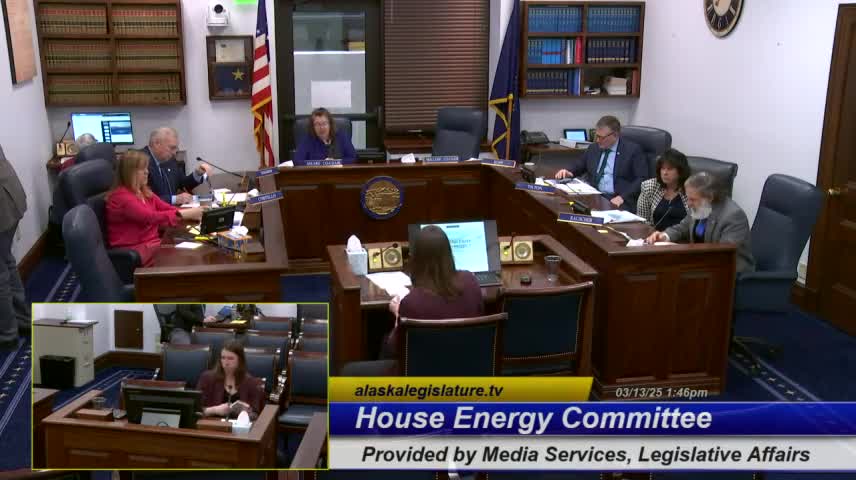
John Volke, administrator for the Pedro Bay Village Council, told the House Energy Committee on March 13 that his community of about 34 residents is pursuing the Knutson Creek run‑of‑river hydro project to reduce diesel imports, stabilize electric rates and help repopulate the village.
Volke said the proposed facility would divert up to 11.5 cubic feet per second through a 6,400‑foot penstock with roughly 205 feet of elevation drop to a roughly 25‑kilowatt powerhouse, meet about 96 percent of annual utility demand, and allow excess hydro output to support electric heating and limited load growth.
Why it matters: The village currently relies on diesel generation supplied almost entirely by air freight, Volke told the committee, burning roughly 24,000 gallons of diesel a year for electricity and facing high and volatile fuel prices. Pedro Bay’s administrator said fuel supply is vulnerable to weather and carrier availability; the community has explored barge options but generally depends on air deliveries.
Project details and status Volke said reconnaissance, feasibility and design/permitting work has been underway for years: reconnaissance began in 1989, feasibility work occurred 2010–2013, and design and permitting extended from 2014 to 2022. He said the project is FERC non‑jurisdictional, and that the team collected seven years of fishery and hydrology studies with “tens of sockeye” using the project area, limiting mitigation needs. The overall capital cost on the presenter’s slides was about $7,982,000; the applicant asked for roughly $400,000 from the Alaska Renewable Energy Fund to cover the nonfederal match portion of federal funding applications.
Timeline and financing Volke told the committee the applicant anticipates a two‑phase construction schedule and hoped to begin construction in 2026–2027 if funding is secured. He said the REF awards funded earlier studies and that the village has also applied to the Department of Energy and submitted a FY2026 congressionally directed spending request. Volke said the village expects the finished plant to be self‑sustaining in operation and to lower and stabilize electricity costs while creating local jobs and reducing diesel logistical risk.
Challenges and community priorities Volke emphasized permitting delays are largely behind the project but noted ongoing O&M costs would be borne by ratepayers. He described Pedro Bay’s priorities as protecting subsistence resources, enhancing local economy and encouraging families to return to the village; the village council recently purchased a former school building for community use. Volke said that while solar or wind were easier to deploy, hydro gives greater diesel displacement and a multi‑decade asset life.
Ending Volke asked the committee to consider Pedro Bay’s REF request as part of a broader portfolio of small rural hydro projects, saying the village hoped federal and state match would become available so construction could proceed.