Get Full Government Meeting Transcripts, Videos, & Alerts Forever!
Get email alerts on the Environmental Health Pfas topic
No spam. Unsubscribe anytime.
Alaska DOT details PFAS contamination, mitigation work at state airports
Summary
State transportation officials told the House Transportation Committee on March 13 that PFAS contamination tied largely to decades of firefighting-foam use has affected at least 30 sites in Alaska and that the department is testing, containing and piloting on-site remediation while pursuing replacement, cleaning and funding options.
State transportation officials on March 13 told the Alaska House Transportation Committee that polyfluoroalkyl substances (PFAS) linked to decades of firefighting-foam use and other sources have contaminated groundwater and soil at multiple airports and communities across the state, and that the Department of Transportation & Public Facilities (DOT&PF) is testing and piloting treatment while shifting to nonfluorinated foams.
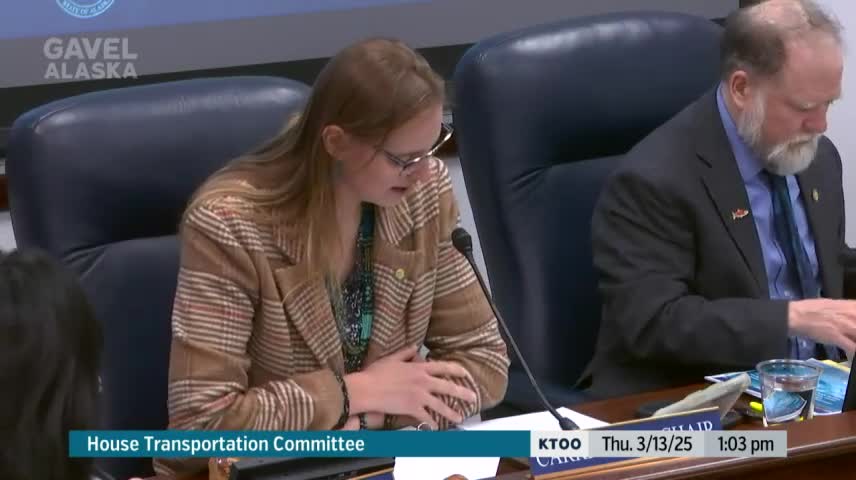
The presentation by Troy LaRue, division operations manager for Statewide Aviation, and Aaron Danielson, division operations manager at Fairbanks International Airport, explained how PFAS moves through water and soil, the limits of current disposal options and steps DOT&PF is taking to prevent further spread. "PFAS is just in about everything," LaRue said, describing the chemicals as a family of more than 6,000 compounds that are persistent in the environment.
Committee members sought specifics on exposure and cleanup costs; LaRue and Danielson outlined site characterization, pilot remediation projects and procurement steps aimed at both preventing further contamination and removing existing contamination where feasible.
LaRue told the committee the state is tracking more than 30 known PFAS-contaminated sites and that existing federal and state cleanup standards are changing as science evolves. "Right now, they're the toxic, minimum contamination level is set at 70 parts per trillion. We believe that's soon to become 4 parts per trillion," he said. LaRue and Danielson described how PFAS has been found in firefighting foams (aqueous film-forming foam, or AFFF), wastewater discharges, landfills and industrial emissions.
The department is piloting both containment and destruction technologies. Danielson described two pilot projects at Fairbanks International Airport: a thermal treatment pilot that processed about 1,400 tons of contaminated soil and produced nondetect results for perfluorinated compounds after treatment, and a water-treatment pilot at an historic fire-training pit that achieved a 99.9% reduction in PFAS in a test sample. "Thermal breakdown of PFAS is effective, but it does take a lot of energy and a lot of heat to do that," he said.
DOT&PF also said it has selected a nonfluorinated airport foam for future use nationwide. "We have selected National Foam, their Aveo F3 green foam for replacement of all of our fire trucks," Danielson said, describing F3 as a fluorine-free foam. He said the state will first chemically clean foam systems and piping in existing trucks to remove residual PFAS before filling them with the new product; the department has issued a request for proposals for the detergent-style cleaning and is evaluating responses for work covering the state's 139 airports.
Officials described logistical and cost barriers. LaRue said PFAS mitigation increased the cost of a Cordova project by about $8 million several years ago, a cost that delayed the project. He said moving contaminated materials out of state to specialty facilities also is expensive and that Alaska is pursuing more on-site treatment options to avoid shipping material to the Lower 48. "Our only other alternative then is to package this into great big super sacks and move it to the lower 48 where they do have people that can mitigate PFAS and PFOA," LaRue said.
Committee members pressed for health-impact information and remediation funding. LaRue told the committee DOT&PF relies on the Alaska Department of Environmental Conservation (DEC) and the Department of Health for health-related guidance and that some remediation has relied on spill-response funding; he said airport-improvement funding is not eligible to pay for PFAS remediation. The department is pursuing available federal funding and said Alaska’s congressional delegation is advocating for additional federal resources.
Officials discussed community-level responses. Where contamination has reached private wells, DOT&PF has provided alternate water supplies and, in some Fairbanks-area cases, connected properties to municipal water. Danielson said small-scale remediation for individual domestic wells has generally not been economically viable, though DOT&PF is installing filtration systems for some homes in rural settings and exploring agreements with homeowners.
Committee questions also covered how DOT&PF coordinates with DEC and health agencies on testing and notification, and whether the Department of Transportation has considered establishing hazardous-waste disposal capacity in Alaska to avoid out-of-state shipments. LaRue said the department prefers on-site solutions and is optimistic based on recent pilot projects; he confirmed the department is working with DEC to prioritize site characterization and community outreach.
LaRue and Danielson outlined engineering and contracting measures DOT&PF uses to avoid spreading contamination during airport construction and noted the department has changed training practices to reduce foam discharge since 2019. "Since 2019, working under FAA guidance, except for emergencies where fire is actually present and needed to deploy a triplet, we have not," LaRue said, describing changes in proportioning systems that let airports test pumps without discharging foam.
The committee did not take action; members asked DOT&PF to return with additional technical and health information and cost estimates. The department emphasized ongoing pilots, the detergent-cleaning procurement, and continued coordination with DEC and the Department of Health as next steps.
Ending: Committee members thanked the presenters and moved to the next agenda item, a separate presentation on leaded aviation gasoline.