Get Full Government Meeting Transcripts, Videos, & Alerts Forever!
Get email alerts on the Gun Violence Protection Orders topic
No spam. Unsubscribe anytime.
Committee holds first hearing on bill to allow temporary firearm removal for people judged at extreme risk
Summary
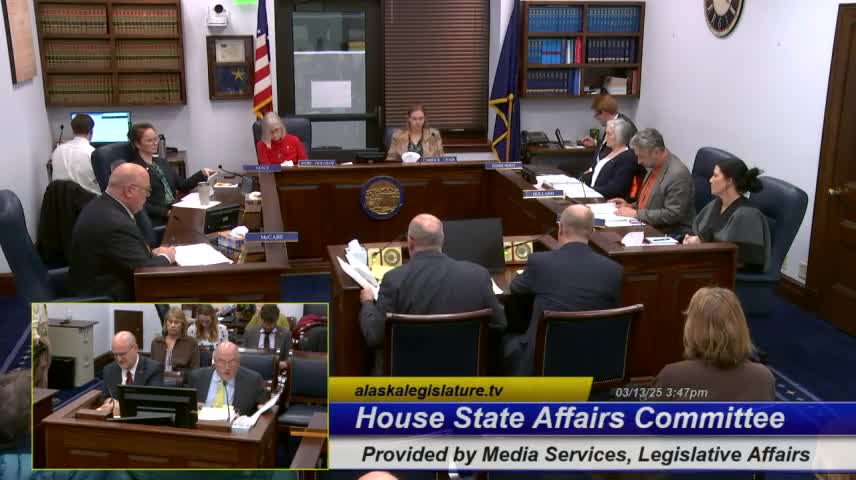
The House State Affairs Committee held a first hearing March 13 on House Bill 89, which would create civil gun-violence protection orders allowing a judge to temporarily restrict a person’s access to firearms when petitioners show evidence of significant risk.
The House State Affairs Committee held a first hearing March 13 on House Bill 89, which would create civil gun-violence protection orders authorizing a judge to temporarily restrict a person’s access to firearms and ammunition when the petitioner shows evidence that the person poses a significant risk to themselves or others.
Sponsor Representative Andy Josephson framed the measure as a public-health tool aimed at preventing firearm suicides and homicides. "This bill is not just about, our tragic problem with suicide, however. It's about, homicide deaths as well," Josephson said as he outlined three types of orders in the draft statute: emergency three-day orders signed by police, short-term ex parte orders (up to 20 days) and standard orders lasting up to six months.
The bill’s procedures and constitutional questions drew sustained attention. Josephson cited recent court decisions and a U.S. Supreme Court opinion he said supports temporary disarmament when a court finds a credible threat. He also pointed to published state-court rulings in Indiana, California, Connecticut, Florida and New York as precedent for similar laws.
Proponents and invited testimony
Several invited witnesses and a long list of public testifiers supported the bill as a targeted, temporary intervention to prevent suicide and mass violence. Jake Chandler, an investigator with a county district attorney's office in Oregon who has worked with Oregon extreme-risk orders, said his office "only apply for IRPO's on people that we believe were at risk for suicide or homicide and that they would attempt to carry out their plans if we did not intervene." Chandler described training for law enforcement and community partners and gave examples where an order was followed by engagement and apparent de-escalation.
Christopher Kurita, a threat-assessment investigator in Fort Lauderdale, described family-level crises in which no criminal charge was available and said law enforcement requests for risk-protection orders are made "under oath presenting evidence ... of the person's dangerousness," adding, "we don't take it lightly."
Public supporters — including veterans, school staff, counselors and family members of shooting victims — described instances they said illustrate gaps in the current law. Claire Ross, who said her son survived a neighbor’s shooting, asked lawmakers: "If your child is suicidal, wouldn't you want some support to remove the guns from their house until they were in a better state of mind?"
Opposition and constitutional concerns
Eileen Klein, state director for the NRA, told the committee the organization "strongly oppose[s] House Bill 89," arguing the measure risks due-process and Fourth and First Amendment violations and that it removes firearms without a criminal conviction or mental-health adjudication. Testifiers opposing the bill cited cases in other states where they said red-flag orders were used improperly, raised concerns about ex parte orders and warned the measure could be misused in domestic disputes.
Legal and procedural issues raised
Committee members and witnesses debated standard-of-proof questions and notice requirements. Josephson and witnesses described the bill’s layered safeguards: a six-month order requires notice and a finding by clear and convincing evidence; an ex parte short-term order requires heightened factual showing because the respondent may lack notice; emergency orders can be issued by police for immediate threats and last three days. The bill text also includes surrender and disposition timelines: in the sponsor's presentation the court would give respondents 24 hours to surrender or sell firearms and 48 hours for an officer to file a receipt documenting disposition.
Speakers discussed Alaska’s current law that allows firearm removal as part of domestic-violence protection orders (DVPOs) and noted that HB 89 would extend a similar remedy beyond household relationships to non-family situations where a petitioner shows a substantial risk.
Next steps
The committee heard extended public testimony and did not take a final vote. Members indicated they will continue the dialogue and expect follow-up hearings to examine constitutional, procedural and implementation issues, and to invite stakeholders back for detailed questioning.
Ending
Public testimony was left open for future hearings; the committee adjourned after hearing invited and public testimony, with members asking the sponsor and stakeholders to supply additional legal analysis and implementation detail for later consideration.