Get Full Government Meeting Transcripts, Videos, & Alerts Forever!
Get email alerts on the Infant Safe Surrender topic
No spam. Unsubscribe anytime.
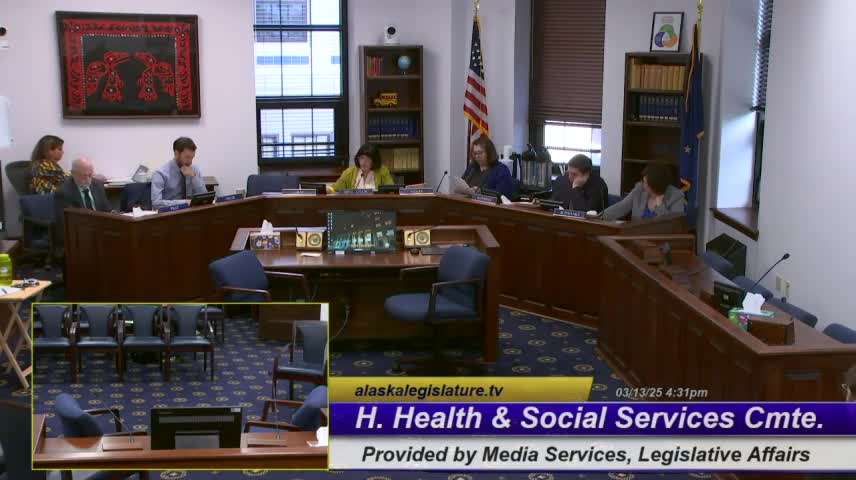
Committee hears support for infant 'safe surrender' devices; HB64 would authorize baby boxes as an alternate surrender method
Summary
House Bill 64 would add authorized climate-controlled infant "safety devices" (baby boxes) to Alaska's safe-surrender statute so a parent could anonymously relinquish a newborn at designated facilities; the committee heard largely supportive testimony from fire and dispatch officials and set the bill aside for further review.
House Bill 64, introduced by Representative Tomaszewski (staff David Goff testified in his absence), would authorize infant safety devices — climate-controlled, affixed "baby boxes" — as an additional legally protected method of safe surrender under Alaska's safe-haven law. The bill would add designated facilities (hospitals, emergency departments, freestanding birth centers, rural health clinics, police and fire stations and other DFCS-designated facilities) where an affixed device could be placed, require immediate notification of public safety and medical personnel when an infant is surrendered and describe equipment standards for the device.
The nut graf: Supporters said the face-to-face requirement in the existing law can deter parents who want anonymity and that baby boxes provide a safe, passive option that immediately alerts staff; witnesses described donated, volunteer-funded deployment models used in other states and urged the committee to allow the option to reduce unsafe abandonments.
Invited testimony included Doug Schrage, fire chief of the Anchorage Fire Department, who said the face-to-face requirement can be an impediment and recalled an infant abandoned a block from a downtown fire station in November 2024; "the face to face requirement of the current safe haven statue is an impediment to some people who want to be able to safely surrender their infant," he said. Julie Condell, a lead 911 dispatcher for the Anchorage Fire Department, supported the bill and said the boxes would trigger immediate alarms and dispatch so a child would be retrieved; "if we can even save 1 life through this process, that everything else becomes secondary," Condell testified. Lonnie Marney, a Fairbanks city council member, described community fundraising models and noted cost estimates provided by manufacturers and local donors.
Legal and implementation questions arose in committee discussion. Committee members asked about how the state would track anonymous surrenders for child-welfare purposes and whether federal Indian Child Welfare Act requirements and diligent-search obligations would still apply; Carla Erickson, a child-protection attorney with the Department of Law, said existing child-in-custody procedures would still require diligent searches to identify relatives and to determine whether ICWA applies. Committee members also asked about device maintenance and monitoring; witnesses described alarm and sensor systems, interior video for verification and vendor maintenance agreements in other states.
Ending: Committee members set HB64 aside for future consideration and requested additional information on implementation details including maintenance, deployment models, training and how Office of Children's Services would handle anonymous surrenders while meeting ICWA and diligent-search requirements.