Get Full Government Meeting Transcripts, Videos, & Alerts Forever!
Get email alerts on the Dui Diversion topic
No spam. Unsubscribe anytime.
Committee hears introductory testimony on DUI diversion bill to defer conviction for eligible first-time offenders
Summary
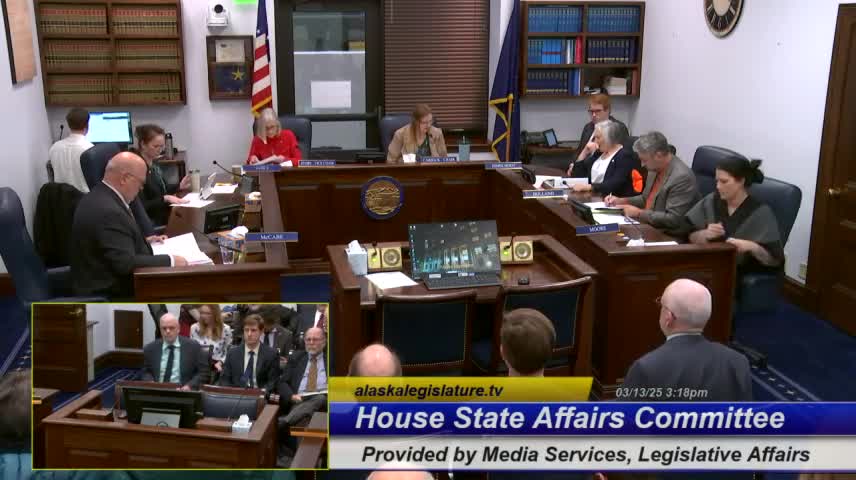
The House State Affairs Committee on March 13 took introductory testimony on House Bill 2, a bill that would allow courts to defer entering a conviction for certain first-time driving-under-the-influence cases if defendants complete a court-ordered diversion program.
The House State Affairs Committee on March 13 took introductory testimony on House Bill 2, a bill that would allow courts to defer entering a conviction for certain first-time driving-under-the-influence cases if defendants complete a court-ordered diversion program.
Supporters, including the bill sponsor and an Alaska defense attorney who requested the measure, said the program is intended to reduce the collateral harms of a DUI record — higher insurance costs, job loss and long-term family and financial consequences — while preserving accountability through program requirements.
"Alaska's DUI laws provide effective sticks that discourage people from driving while intoxicated," said Bill Satterberg, an attorney who testified in support. "On the other hand, the automatic application of these sticks creates hardships such as significantly higher insurance rates, loss of employment or unemployability, and family strife." Satterberg described a diversion model used in other states and said those programs can reduce repeat offenses.
Nancy Mead, general counsel for the Alaska Court System, provided state data and procedural context. "About 1,563" were first-time DUI cases in the last full year for which she had data, Mead said, "and seconds, there were about 300," adding that roughly 20 percent of convicted DUI offenders reoffend.
What the bill would do
Under the bill as presented, an eligible defendant would plead guilty and elect to enter a court-supervised diversion program; if the defendant completes the program and complies with terms and conditions, the original judgment would be deferred or set aside and the charge dismissed. Supporters said successful participants would avoid the statutory first-offense penalties they otherwise face, including the mandatory 72-hour jail term, a $1,500 fine, an SR-22 insurance requirement and possible license suspension for months.
Sponsor Mike Prox said the program would be limited to first-time DUI convictions or refusals absent other serious charges, and that the incentive to accept diversion would decline if the participant reoffends during a 15-year window.
Court concerns and open questions
Mead told the committee the court system needs more clarity in the bill’s procedures before the court can estimate workload changes. "There are several concerns with the bill as drafted that also lead me to say this will increase the court's workload," she said, noting the statute does not yet define the program’s administrative steps, hearing schedule or the litigation that may arise over eligibility.
Mead compared HB 2 to existing procedures such as a suspended entry of judgment used in other offense types and to local municipal practices. She said that where the bill differs from a straightforward suspended entry is that HB 2 describes a program, and that program may require additional hearings and filings. The bill includes a filing fee of $490 for the program petition; Mead said judges could waive the fee for indigent defendants but that the fee and the requirement that some costs be borne by participants are items to be examined.
Committee members pressed for data on case flow. Supporters said the measure could reduce court and prosecutor caseloads by diverting cases early; critics including Mead said uncertainty about program details could create additional hearings and appeals and therefore increase short-term workload even if long-term caseloads fall.
Next steps
The committee set House Bill 2 aside for a future hearing to allow sponsor and stakeholders to work on details the court raised, including clearer procedural language and definitions of program steps, filing and fee handling, and eligibility rules. No formal vote was taken.
Ending
Committee members said they expect to revisit HB 2 with proposed clarifications to the statute before considering formal action.