
Graduate student speakers warn UMaine System trustees cuts to assistantships and federal research funding threaten R1 research pipeline
Get AI-powered insights, summaries, and transcripts
Sign Up Free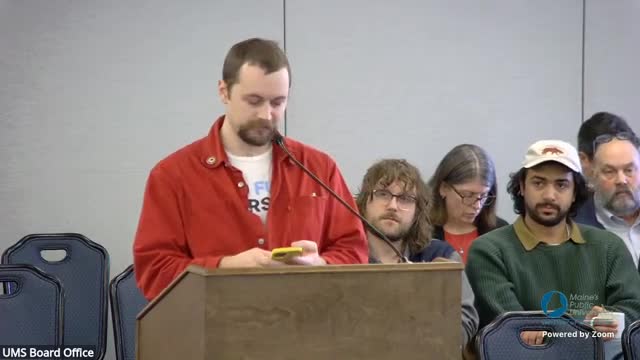
Summary
Graduate students and teaching assistants told trustees that low stipends, shrinking TA positions and uncertainty over federal research grants threaten recruitment and the University of Maine System’s R1 research capacity.
Multiple graduate students, several of whom said they hold teaching assistantships or research assistant positions, told the University of Maine System Board of Trustees that current funding levels put the system’s research capacity and R1 status at risk.
Eric Brown, who identified himself as a fourth‑year Ph.D. worker in ecology and environmental sciences, said his stipend is $27,000 before taxes and said many colleagues live on lower minimum stipends. "When we compare the resources provided to graduate workers here with those at public universities in our region like the universities of New Hampshire and Vermont, the minimum compensation when accounting for benefits for a grad worker here comes up about $7,000 to $8,000 short," Brown said.
Other speakers described similar strains. Sophie Craig, a Ph.D. candidate in the Graduate School of Biomedical Science and Engineering, said cuts to teaching assistantships reduced departments’ capacity to offer graduate positions and compelled remaining graduate TAs to work more hours for the same pay. "Reducing TA positions means that we will have fewer people to do the same amount of work," Craig said, linking reduced TA support to fewer admitted and graduating Ph.D. students and to long‑term risks for the university’s designation as an R1 research institution.
Miranda Satius, a first‑year master’s student in ecology and a member of the Graduate Workers Union, said her TA stipend is $17,000 a year and that level of support makes continuing to a Ph.D. elsewhere more attractive.
Speakers asked the board and system leaders to pursue designated state funding to shore up graduate assistantship support, to maintain faculty capacity for research mentoring, and to guard international students whose immigration status depends on campus positions. Several speakers connected stable graduate funding to the system’s ability to secure federal grants and the indirect costs those grants return to campuses.
Trustees did not take formal action on graduate‑worker compensation during the meeting. System presidents and provosts noted the concern and said they are monitoring federal research funding and enrollment trends; graduate‑worker speakers said they will continue advocacy and asked for a clearer commitment to funding from the system and state.
Ending: Graduate students left the meeting urging the board to secure dedicated funding streams to sustain assistantships and to preserve the pipeline that supports campus research and teaching. Trustees acknowledged the concerns and said campus leaders are reviewing budget and recruitment strategies.