
Weston committee reviews seven master‑plan scenarios, zeroes in on sustainability, parking and field impacts
Get AI-powered insights, summaries, and transcripts
Subscribe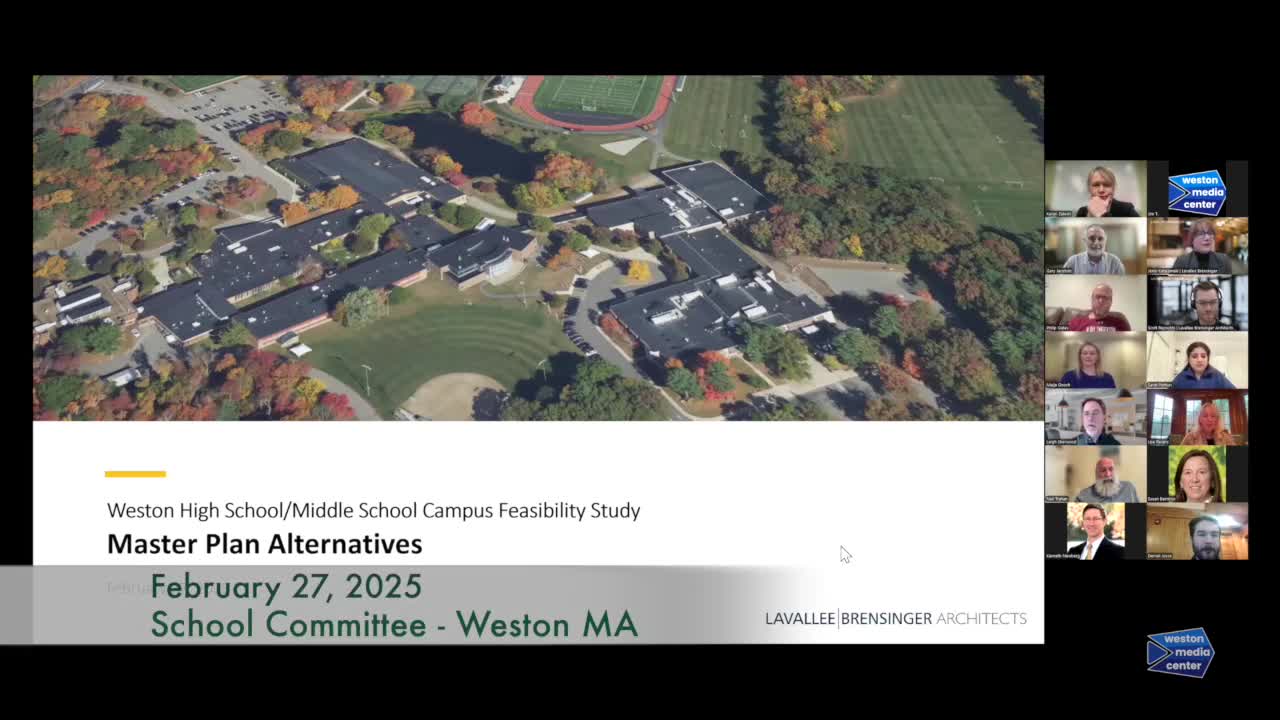
Summary
Weston Public Schools’ Master Planning Feasibility Committee on March 6 reviewed seven draft master‑plan scenarios for the district’s middle and high schools, focusing on sustainability goals, phasing options, parking and how each scenario would affect athletic fields.
Weston Public Schools’ Master Planning Feasibility Committee on March 6 reviewed seven draft master‑plan scenarios for the district’s middle and high schools, focusing on sustainability goals, phasing options, parking and how each scenario would affect athletic fields.
Jenny (Committee chair) opened the meeting by saying the “meat of the discussion is around the master plan alternatives” and that the group would review baseline and option schematics prepared by the district’s design team. The committee settled next engagement dates and asked the design team to return refined options for cost estimating.
The committee said the board will present a range of approaches so residents can evaluate tradeoffs. “We want you to like all of them best and help us,” Lee (Architect/consultant) told members as the team walked through site and phasing diagrams. The design team presented two baseline scenarios — a 10‑year “maintain and replace” baseline and a full renovation baseline — plus seven options that combine renovation, additions or all‑new construction in different phasing orders.
Nut graf: Committee members and consultants focused discussion on three decision drivers likely to define the project outcome: sustainability and energy choices (including whether to include geothermal and solar photovoltaic systems), parking and traffic circulation, and the effect of new construction on playing fields (especially if the town proceeds with a proposed fire station on site).
What was presented
Designers told the committee they used NESDAC enrollment projections as a working scenario: roughly 565 middle‑school students (about 50,000 square feet) and 788 high‑school students (about 240,000 square feet). The team showed two baseline cost/reference scenarios (baseline A: phased maintenance and system replacement over 10 years with no added program space or electrification; baseline B: a comprehensive renovation with electrification and air conditioning, roughly a three‑year construction sequence that likely would require temporary modular classrooms).
Architects then described seven schematic options: four renovation/addition hybrids and three all‑new alternatives. Options range from renovating both schools with additions to building two new schools in separate locations on the campus or a combined, physically connected middle/high school complex. Several schemes preserve the newer high‑school science wing for reuse; many schemes also show a potential field house as an add‑on that could be omitted if the town declined it.
Sustainability and energy systems
Julie Izagagny (Town sustainability coordinator) and architect consultants summarized sustainability goals developed by a small working group. The list includes designing “a highly efficient all‑electric building that employs passive strategies and high‑efficiency building systems,” along with daylighting, water conservation, native landscaping and durable, low‑emission materials. Lee said air conditioning and electrification “make total sense these days,” noting state incentives and MSBA (Massachusetts School Building Authority) scoring that favor higher energy performance.
Consultants flagged geothermal and solar photovoltaic systems as the largest cost drivers within sustainability options and said they will follow with a life‑cycle cost analysis. “No decision has been made,” the presenter said, adding that the MEP team will present a life‑cycle cost analysis at the May 29 working‑group meeting.
Codes and requirements
Committee members and consultants discussed the town’s adoption of the stretch energy code. The design team said MSBA requires compliance with the stretch code for projects seeking agency review and that the town has adopted the most stringent opt‑in version of that code, which pushes projects toward electrification and tighter building envelopes.
Parking, traffic and fields
Multiple committee members, including Sue (School administrator) and Phil (School administrator), raised parking as a major concern. The draft materials listed roughly 50 spaces for the middle school and 223 for the high school in the current planning sketches; consultants said those counts are early estimates and that some options show 40–60% more parking area than exists today. The committee asked the team to return a proposed parking program and to “poke” the traffic consultant again to confirm counts and event needs.
Athletics fields were another recurring topic. Consultants noted some scenarios would reduce the number of fields on the site; the loss ranges by option and depends on whether a field house is included. The design team repeatedly pointed out that a turf field can substitute for several natural fields in scheduling, but the committee emphasized that losing fields now used by the town would be politically sensitive and operationally consequential.
Fire station question
Several members said a pending proposal to site a town fire station on the campus would materially change what can be built and where. Neil (Committee member) and other members said the committee needs clarity on whether a fire station will occupy the upper‑left portion of the site; if the station proceeds, some design options would lose one or more additional fields. Lisa (Committee member) said the select board must resolve the fire‑station site decision before the school project advances.
Shared facilities and program‑level tradeoffs
Committee members asked whether some large, costly back‑of‑house spaces could be shared between the middle and high schools to save money. Neil and others identified kitchens and other food‑service infrastructure as a high‑cost target for potential consolidation; the designers said they had queried the district nutrition director and would revisit possible savings from sharing “back of house” spaces while preserving separate student dining areas and operational requirements.
Educational programming constraints
Multiple educators and committee members emphasized that the teaching and supervision needs of middle‑school and high‑school students limit the degree of day‑to‑day sharing. Members repeatedly rejected mixed day‑to‑day circulation that would have middle‑school students and seniors in the same hallways during the school day; several said shared use is most feasible for evening or community uses only. The team proposed a large high‑school auditorium (about 1,000 seats, per programming discussion) and a 300‑seat black‑box space at the middle school for smaller assemblies.
Phasing, costs and next steps
The design team recommended narrowing the long list of options to five schemes for estimating. The committee scheduled the March 20 meeting to select five options for cost estimating; the design team said cost estimates for the selected options will be delivered the week of April 28–May 1. The MEP life‑cycle cost analysis will be presented to the working group on May 29.
Community engagement
The committee set a public engagement timetable that includes staffed information tables at town meetings (March 12 and May 5), a daytime in‑person briefing on March 4 at the Case House (11 a.m.–12:15 p.m.), an elementary‑parent coffee on April 3 at 8:30 a.m., and a virtual follow‑up in the evening on May 12 when preliminary costs will be shared.
What remains unresolved
No formal decisions or votes were taken at the meeting. The committee directed the design team to: refine parking counts; study life‑cycle costs for geothermal/solar and HVAC options; analyze whether kitchen/back‑of‑house consolidation is feasible without harming operations; and return with five scenarios for pricing. The status of the proposed fire station remains a key site uncertainty the committee said must be resolved by the select board to avoid late changes to preferred schematics.
Ending: The design team will return with selected scenarios for cost estimating and a life‑cycle cost analysis; committee members asked staff to circulate a local Globe article about rising school construction costs and to confirm dates and distribution of the demographer’s schedule. The committee meets next on March 20 to select options for pricing.