
Weston parents press school committee for bell-to-bell cellphone ban; committee asks administrators to draft policy
Get AI-powered insights, summaries, and transcripts
Subscribe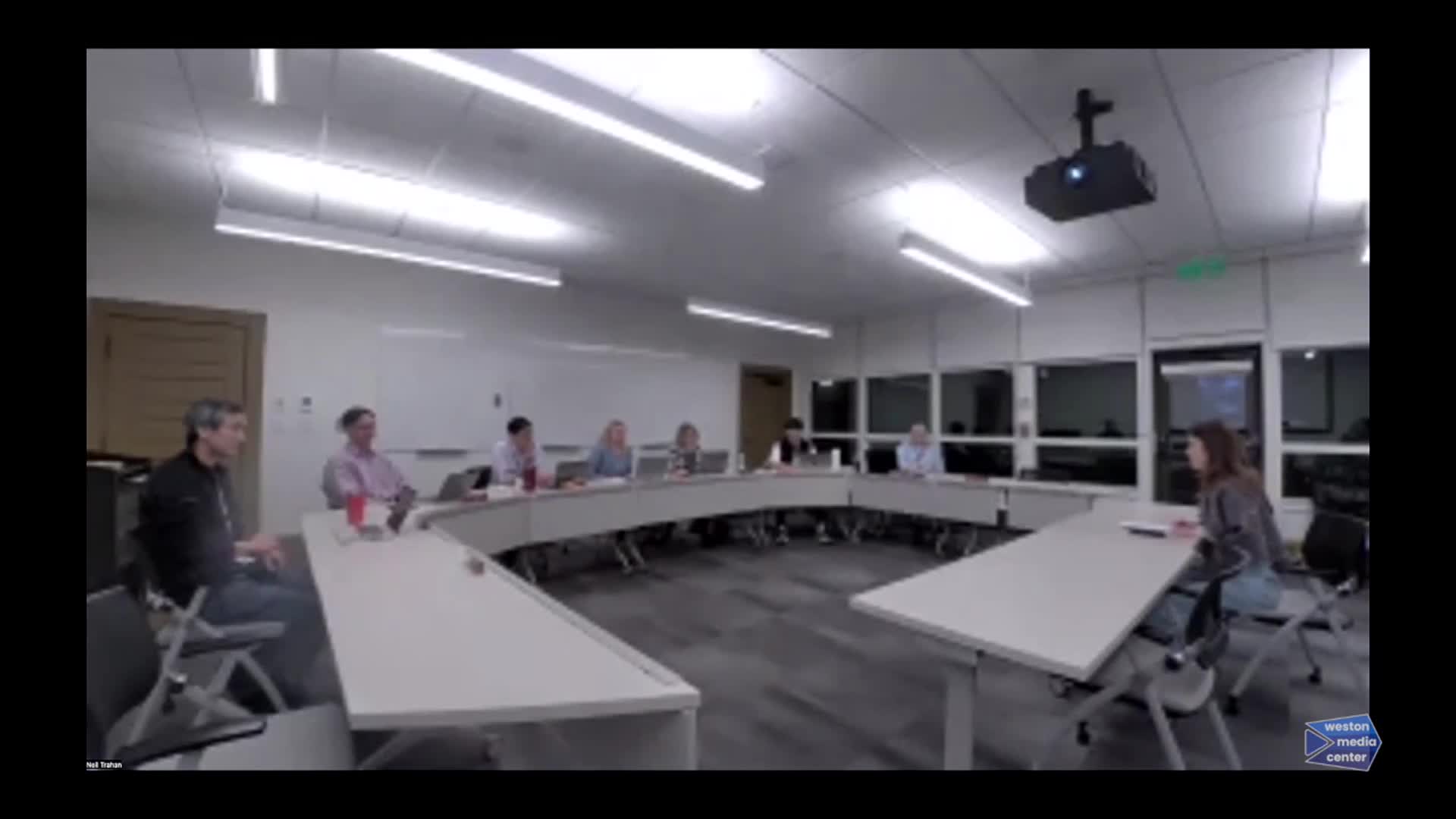
Summary
Dozens of parents urged the Weston School Committee to adopt a “bell-to-bell” ban on personal devices at the district’s high school during public comment. Committee members agreed to sharpen a proposed policy and asked administrators and two committee members to produce a draft for upcoming meetings.
Dozens of parents told the Weston School Committee they want personal cell phones kept out of students’ hands during the school day, pressing the panel to adopt a “bell-to-bell” ban and to move quickly rather than wait for pending state legislation.
The parents’ calls came during public comment, and committee members later devoted the meeting’s main discussion to the issue, asking administrators and committee members Jeff Lucas and Adam (last name not specified in the transcript) to prepare a refined policy for consideration before the end of the school year.
“Don’t let perfect be the enemy of good,” said Erica G. M. Pietro, a Weston resident and parent, relaying advice she said she heard from a state representative and urging local action rather than waiting for a statewide law. “There will be exceptions to rules. That’s okay. What we put in place will be better than what we have today.”
Parents described a range of concerns: classroom distraction, social and mental-health impacts, and unequal experiences for students who do and do not have phones. Several speakers asked the committee to adopt a strict “off-and-away” or “bell-to-bell” approach — meaning devices would be stored and not available from the start to the end of the school day.
At the committee’s discussion, board members and administrators framed the issue in three parts: the policy text; how it would be implemented and enforced; and curricular and community work on digital literacy that would accompany any rule. Committee member Max (last name not specified in the transcript) and others noted that devices other than phones — for example, laptops and smartwatches — can also replicate the same distractions and should be addressed.
Administrators and committee members said they expect a refined policy to include K–8 practice that is already strict in many buildings and a more assertive high-school approach. Board members asked staff to examine technical and implementation tools — including Wi‑Fi configuration and other measures that could reduce students’ ability to use personal devices on campus — and to prepare practical guidance for teachers and families so enforcement does not rest solely on classroom teachers.
The committee did not vote on a policy at the meeting. Instead, committee members asked Jeff Lucas and Adam to prepare a draft policy and committed to additional conversations with administrators, technology staff, and student representatives. Committee members said they want an updated policy in place for fall 2025 but emphasized they will attempt a phased, implementable rollout and will work with school staff on enforcement procedures and digital-literacy curriculum supports.
Several parents proposed staged implementation options if the committee prefers a gradual approach, for example beginning with study halls and cafeterias in year one and expanding to hallways and all instructional time in later years.
The discussion also acknowledged practical exceptions for emergency contacts and for students with documented needs; multiple speakers said such exceptions should be explicitly defined and handled through the school’s existing 504/IEP processes.
The committee concluded by directing staff to compile implementation options, technical constraints, and proposed language for a draft policy and by instructing two committee members to produce an initial policy draft for the committee’s review at an upcoming meeting.
Committee members said they will solicit teacher and student input while retaining adult responsibility for the final policy decision and implementation oversight.