Get Full Government Meeting Transcripts, Videos, & Alerts Forever!
Get email alerts on the School Finance topic
No spam. Unsubscribe anytime.
Duarte Unified accepts clean audit, approves amended budget-stabilization plan and reduced staffing while exempting several high-school special-education cuts
Summary
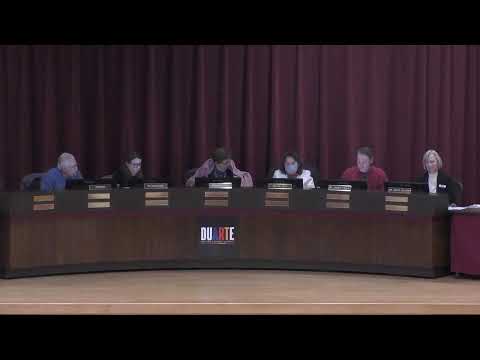
The Duarte Unified School District Board of Education on March 13 accepted an unmodified fiscal-year 2023–24 audit and approved an amended budget-stabilization plan and related staff reductions after hours of public comment and discussion.
The Duarte Unified School District Board of Education on March 13 accepted an unmodified fiscal-year 2023–24 audit and approved an amended budget-stabilization plan and related staff reductions after hours of public comment and discussion.
Auditor Natalie Palma of Christie White told the board the district received the best possible set of opinions: “Our overall financial statement opinion, state compliance opinion, and federal compliance opinion were all unmodified,” and she reported “there were no financial statement or federal or state compliance findings this year.” The board unanimously accepted the audit.
The board then reviewed the district’s second interim financial report, covering actual revenues and expenditures through Jan. 31, 2025. Finance presenter Miss Bell reported declines in enrollment and in funded average daily attendance are the main drivers of lower LCFF (Local Control Funding Formula) revenues; she said funded ADA is currently about $13,600 per ADA measure and that the district’s multiyear projection shows the committed unrestricted leftover declining from about $9.9 million (24–25) to $3.9 million by 26–27. Bell also noted the district is reserving about $8,000,000 for an unresolved SELPA (Special Education Local Plan Area) dispute.
Board members asked questions about the meaning of “unmodified” audit opinions and about the nature of the revenue declines and reserves. Palma summarized: unmodified means the auditors did not identify material misstatements or significant deficiencies that would require a modified opinion. Bell and other staff emphasized ongoing cost controls and that the district had reduced projected expenditures by roughly $2.1 million between first and second interim.
After extended public comment focused primarily on special-education services at Duarte High School, the board considered a resolution titled “Reduction or Discontinuance of Particular Kinds of Service” (Resolution 18‑24‑25). The resolution, as proposed, listed the district’s recommended certificated staffing reductions tied to the broader budget-stabilization plan. Dozens of parents, students and teachers spoke during the public comment period, warning of impacts on small special-education classes, case-manager caseloads and the district’s adult transition program; several speakers described personal educational progress tied to existing staff.
Following that testimony, the board moved to amend the reductions. The board approved an amended version of the resolution that removed five proposed high-school special-education 0.2 FTE reductions (RSP seminar, mild/moderate math, science, social science and career-ed lines) from the list of cuts. The board approved the remaining reductions as amended; the change reduced the total recommended certificated FTE reduction in the budget-stabilization plan from 6.0 to 5.6 FTE. Board members said statutory timelines required actions be posted and notices issued this week, which limited options for delay.
Board President and Superintendent Dr. Hillman and other administrators emphasized that the adult transition program would continue; staff clarified one adult-transition FTE included on the earlier staffing list was currently vacant, and the district intends to maintain at least one adult-transition class.
Votes at a glance
- Acceptance of the fiscal-year 2023–24 audit (auditor: Natalie Palma, Christie White): adopted, voice vote (unanimous). Evidence: auditor presentation and board acceptance recorded in meeting. - Second Interim Financial Report (as of 01/31/2025) with Positive Certification: approved, voice vote (unanimous). Evidence: Miss Bell presentation and board motion. - Budget Stabilization Plan (amended): board approved an amended plan reflecting a reduction target of 5.6 FTE (revised from 6.0). Motion carried; board approved updated plan and authorized staff to file required statutory notices. - Reduction/Discontinuance resolution (18‑24‑25): approved as amended; original list modified to remove five high-school special-education 0.2 FTE lines (see body for specifics). Motion carried after amendment.
Why it matters
The board’s votes reflect a tension many California districts face: declining enrollment and ADA-driven revenue pressure amid legally mandated special-education services that are costly to operate. The audit’s unmodified opinion reduces near-term compliance risk, but the district’s multiyear projections show declining unrestricted reserves and the need for continued budget adjustments.
What the board directed next
Board members and staff agreed to continue stakeholder engagement and to monitor caseloads and services closely. Staff said they will provide updated materials and a revised written version of the staffing-reduction list for signatures and statutory notices. Administrators also reaffirmed an open-door policy for staff and parents seeking explanation of budget documents.
Ending note
Board members repeatedly thanked students, parents and staff who spoke at the meeting; several members said the testimony — particularly from students who credited special-education staff with enabling postsecondary opportunities — influenced the decision to narrow the reductions. The board also stressed that fiscal monitoring, additional cost-control measures and efforts to restore enrollment would determine whether more changes are needed in the coming months.