Get Full Government Meeting Transcripts, Videos, & Alerts Forever!
Get email alerts on the K 12 Budget topic
No spam. Unsubscribe anytime.
Tolland Board narrows budget choices; directs staff to prepare Option 4 with additions for next meeting
Summary
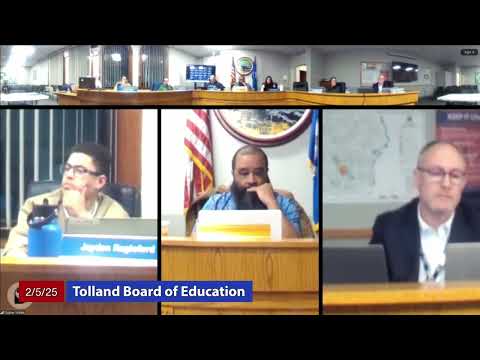
The Tolland Board of Education met in a special session to continue deliberations on the superintendent’s proposed budget and instructed staff to prepare a revised version of Option 4 — preserving a middle‑school social worker, clubs/advisor stipends and the EdTech initiative while modeling several nonstaff reductions — for a formal vote at the next meeting.
The Tolland Board of Education met in a special session to continue deliberations on the superintendent’s proposed budget and a set of five alternative “schemas” presented as options for reducing the district’s proposed spending. After roughly three hours of public and board discussion on program priorities — including staffing for social work and security, the EdTech (1:1) initiative, special education costs, school athletics and pay‑to‑play fees, library services and discretionary program stipends — the board directed staff to prepare a final budget pathway built from Option 4 with targeted additions and reductions for the board’s vote next week.
The board’s direction centers on preserving student supports and co‑curricular opportunities while identifying nonstaff cuts to reach a lower budget target. Board members asked staff to return a single, actionable budget that incorporates the agreed changes so the board can vote at its next meeting and forward the result to the town manager and council for their inclusion in the municipal budget process.
Board members and administrators framed the conversation around a short list of “must haves” and tradeoffs. Board members repeatedly said they wanted to avoid reductions that would eliminate clubs, library services or early intervention supports; several members said adding a social worker to the middle school was a top priority. Administrators explained that deeper reductions to get beneath the district’s roughly 6.7% target (as presented in Option 4) would require staff layoffs and more extensive program eliminations, and they described which lines could be adjusted in each scenario.
Dr. Willett, the district administrator who walked the board through the five schemas, said each option mixes program reductions, use of the district’s reserve/ERF and staff changes. He described Option 1 as preserving staff and most programs but relying on nonprogram reductions; Option 2 as similar but eliminating the district’s pre‑K program; Option 3 as a higher‑priority staffing model that kept MTSS and SROs but required other staff cuts; Option 4 as the “middle” path (6.77% projected increase) that preserved two SROs, MTSS and the Pathways program but reduced several program lines; and Option 5 as the deepest reduction that would require multiple staff eliminations and further program cuts.
Board members pressed administrators for detail on specific lines and consequences. On student support staffing, members pressed on social worker coverage (the district reported four social‑work positions in total, three in the operating budget and one grant‑funded position) and the district’s ratios: total current enrollment was reported in the meeting as 2,145 students, which board members used to calculate current social worker caseloads. Board members cited national association guidance on recommended staff ratios for counselors, psychologists and social workers and said the district’s current social worker coverage fell short of those guidelines.
Administrators explained that special education costs are the budget’s most volatile element: outplacements and transportation can swing the line by tens or hundreds of thousands of dollars. Dr. Willett said the district budgets conservatively by including one additional outplacement as a contingency in some scenarios and noted that cutting the district’s proposed special‑education contingency increases the financial risk if new high‑cost needs arise during the school year.
Technology and instructional software were another focus. The superintendent’s EdTech/1:1 initiative — providing devices and a replacement cycle for students — was listed as a program reduction in some scenarios. Administrators said the district’s EdTech line is one of the larger single program requests (hundreds of thousands of dollars) and that cutting it for all grades would save a material amount but likely require a phased approach or pursuing grants. The board heard an estimate that raising pay‑to‑play fees by $100 could raise roughly $40,000 but that a price increase could also reduce participation. Members asked for more data on device utilization at TIS (the middle school) versus other schools before agreeing to final reductions there.
Other program items discussed included Lexia (an ELA intervention subscription used at Birch Grove Primary, about $9,000); library purchases and a proposed library/media coordinator stipend; middle‑school athletics and pay‑to‑play policy; and maintenance/grounds reductions (summer custodial/maintenance time). Dr. Willett also described how the district might use the district’s ERF (reserves) and insurance resources as temporary offsets.
At the end of the evening the board took a series of roll‑call votes to provide staff with clear direction. The board approved instructing the superintendent to prepare a revised Option 4 for the board’s vote next week that would: add back the middle‑school social worker requested in the superintendent’s proposal; restore clubs and advisor stipends rather than eliminate them; retain a district EdTech/1:1 initiative while staff model options for TIS device use and possible parent cost‑sharing; and restore the library media coordinator and core Lexia subscription. To reach the target in that model the board agreed to remove a set of nonstaff items (for example, the planned Windows‑upgrade monitor purchases and some office equipment) and to model the effect of eliminating or repurposing a limited number of currently unfilled paraprofessional positions rather than immediately filling them, with the superintendent to present options and financial impacts.
Votes at a glance - Motion to extend the meeting past 10:00 p.m.: approved by roll call (board instructed staff to continue work on Option 4). - Direction to staff: prepare Option 4 as the board’s working path, with additions and removals described above (motion approved by roll call). (Each direction was approved by roll call so staff could produce a single, revised budget scenario for next meeting.)
What happens next The board asked Dr. Willett and district staff to return a single revised Option 4 that shows the dollar impact of the board’s additions and the nonstaff reductions they approved in principle. The board plans to take a formal vote on the revised budget at its next meeting; if approved by the board, the budget proposal will be transmitted to the town manager for inclusion in the town’s overall budget work before the town council’s review and eventual referendum process.
Quotes (attributed to speakers in the meeting) - “If we’re talking about…social workers and what they do for students, some of these proposals are not enough to even consider subtracting a social worker,” Board member Jayden said during deliberations. - “Every percent is about $450,000,” Dr. Willett said as he explained the magnitude of the district’s baseline operating percent changes and the tradeoffs between staff and program lines. - “I can’t confidently say I’m voting in favor of subtracting a social worker,” Board member Brian said, emphasizing the district’s student‑support needs and the caseload numbers discussed in the meeting.
Budget context and tradeoffs Board members repeatedly said they wanted a responsible, transparent product to present to taxpayers and asked for clearer documentation of insurance and interdistrict reimbursement assumptions used in the superintendent’s proposal. Administrators acknowledged several outstanding Q&A items the board had asked for earlier in the review process and committed to providing updated line‑item detail, vendor quotes and enrollment assumptions with the revised Option 4.
The board chair closed the meeting by restating the process: staff will build the revised Option 4 document with the additions and reductions the board directed and return it for a formal vote next meeting. The board emphasized it prefers a single path forward so town leaders and the public have one clear proposal to consider during the municipal budget and referendum timeline.