Get Full Government Meeting Transcripts, Videos, & Alerts Forever!
Get email alerts on the Postsecondary Consumer Protections topic
No spam. Unsubscribe anytime.
Senate committee hears bill to assert Washington consumer protections over interstate online colleges
Summary
A Senate committee heard Engrossed House Bill 1279, which would require the Student Achievement Council to ensure Washington's student-consumer protections apply to interstate reciprocity agreements for distance education and set surety-bond parity for out-of-state institutions beginning July 1, 2028.
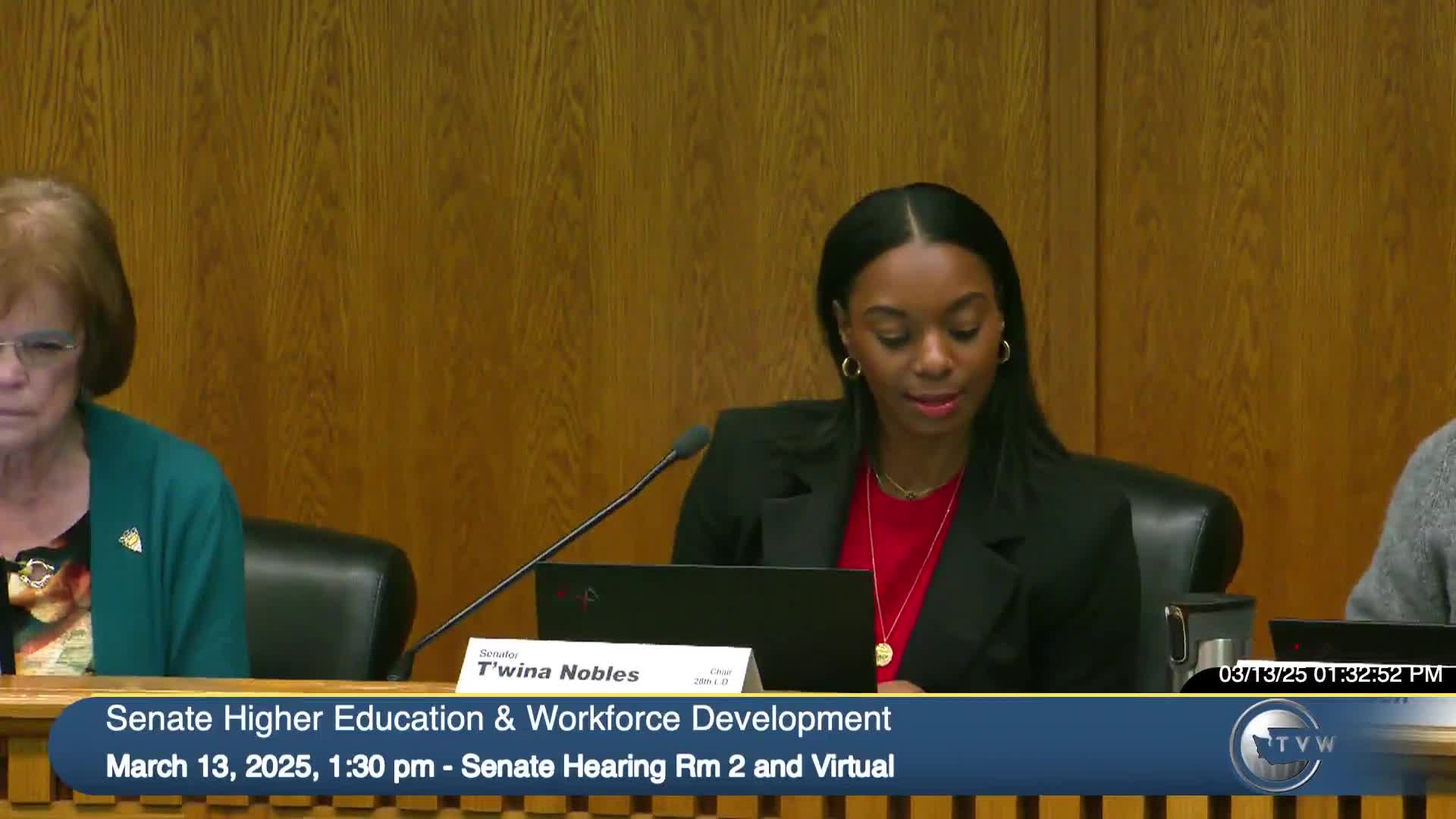
The Senate Higher Education & Workforce Development Committee on an unrecorded date heard Engrossed House Bill 1279, an act to strengthen student consumer protections for interstate delivery of postsecondary distance education.
Kelly Gunn, committee staff, summarized the bill as “relating to post secondary education consumer protections,” saying the measure would require the Student Achievement Council to adopt minimum standards, expand the types of complaints the council may accept and require surety-bond levels for institutions headquartered outside Washington to be equivalent to those imposed in Washington.
Representative Gerry Pollet, the bill sponsor, told the committee Washington already has “some of the strongest student consumer protections in the nation” and described a practical problem under the existing national reciprocity agreement: a Washington student seeking to complain about an out-of-state online program can be directed to the institution’s home state, which may lack comparable consumer protections or an enforcement staff. “If the second student sitting in the apartment 1 floor above is enrolled in an institution, say from Nevada, the student achievement council under the agreement is supposed to only say go to Nevada,” Pollet said. “The student goes to finds out there is no 1 to complain to. That's it.”
Senator Schlatter sought confirmation of the committee staff summary. “So it's WASAC then that has responsibility for this process?” he asked. Kelly Gunn confirmed that, beginning July 1, 2028, if the consumer protections in the bill are not reflected in the national reciprocity rules, the Student Achievement Council would be responsible for administering an alternative reciprocity process that conforms to Washington’s consumer-protection standards.
The bill would also narrow public-records exemptions for financial disclosures by degree-granting private vocational schools so those disclosures are not withheld from Washington programs that rely on the information, and it changes the Student Achievement Council’s role from negotiating interstate agreements to maintaining and developing interstate agreements consistent with state protections, according to the staff briefing. A fiscal note was included in the committee bill packet.
The committee received no public testimony on the bill and closed the public hearing without further action. No final vote on HB 1279 was taken in this meeting; the item was heard as part of the committee’s public hearing docket.
The bill references the national-state reciprocity framework (NC-SARA) and directs the Student Achievement Council to pursue changes or alternate agreements if the national rules do not align with Washington policy. The bill sets a compliance date of July 1, 2028, for the interstate-reciprocity requirements stated in the draft text.
Implementation and further action will depend on subsequent committee scheduling and any changes to the national reciprocity agreement.