Get Full Government Meeting Transcripts, Videos, & Alerts Forever!
Get email alerts on the School Calendar topic
No spam. Unsubscribe anytime.
Tolland Board approves 2025–26 school calendar; Nov. 26 becomes half day, Feb. 17 set as PD
Summary
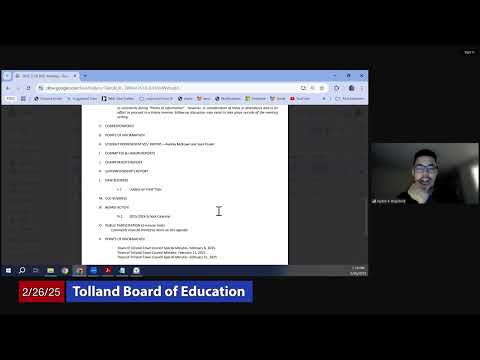
The Tolland School District Board of Education voted on Feb. 26 to adopt the 2025—6 calendar with three modifications: Nov. 26 changed to a half day in school, Feb. 17 designated a professional development day, and Feb. 18 designated a student school day.
The Tolland School District Board of Education voted on Feb. 26 to adopt the 2025–26 school calendar with three modifications: change Nov. 26 from a full day off to a half day in school, designate Feb. 17, 2026, as a professional development day, and designate Feb. 18, 2026, as a student school day. The motion passed by recorded votes of board members recorded in the meeting transcript.
The calendar matter drew the meeting—s most sustained discussion. Board members and staff debated whether to start the school year the Friday before Labor Day, the number and placement of early-release days, and the limits set by the district—s negotiated teacher contract for in-service and professional development days. Several members said they were reluctant to reduce contractually negotiated full professional development days, while others urged consolidating half days into full days where possible to reduce disruption for working families.
Board members described tradeoffs between attendance concerns and family scheduling. Several members noted the board historically adjusted early-release days to reduce chronic absenteeism linked to long weekends. A district administrator told the board that state attendance guidance and local accountability measures treat repeated absences as a risk to the district—s performance, and warned that chronic absences (discussed in the meeting as four absences in a month or 10 in a year) can affect accountability scores.
Board discussion also reviewed feedback the district received in advance: staff said the district received email comments about the calendar and that the submissions were mixed in preference. Student representatives and committee liaisons spoke about program scheduling and other operational items, but the calendar vote was the only formal policy action on the agenda.
The board—s final approved motion (with the three modifications listed above) was moved and seconded during the meeting and carried by a majority in the recorded roll call. Individual recorded votes in the final roll call, as captured in the transcript, included: Brian (Aye), Bill (Aye), Dana (Aye), Dan (Aye), Jaden (Nay), Rene (Aye), Katie (Aye). The chair—s recorded vote was not clearly stated in the transcript; the motion outcome was announced as passed in the meeting minutes.
Superintendent comments in the discussion reiterated that the timing and format of professional development days are constrained by the district—s negotiated contract and that some scheduling choices (regional calendar alignment, PD sequencing, and attendance trends) inform how the calendar is constructed. Several board members urged that contract negotiations be the venue to address longer-term changes such as reducing half days or consolidating PD time into full days.
The board will proceed with the calendar as modified; future discussions about professional development scheduling and contract language were identified as follow-ups. Public participation at this meeting included no in-person speakers; the district staff said they received written comments by email prior to the meeting.