Get Full Government Meeting Transcripts, Videos, & Alerts Forever!
Get email alerts on the Housing Policy topic
No spam. Unsubscribe anytime.
Committee hears support for expanding Multifamily Property Tax Exemption program in House Bill 1494
Summary
Senate committee received a staff briefing and public testimony on House Bill 1494, which would change eligibility and compliance rules for the Multifamily Property Tax Exemption (MFTE) program.
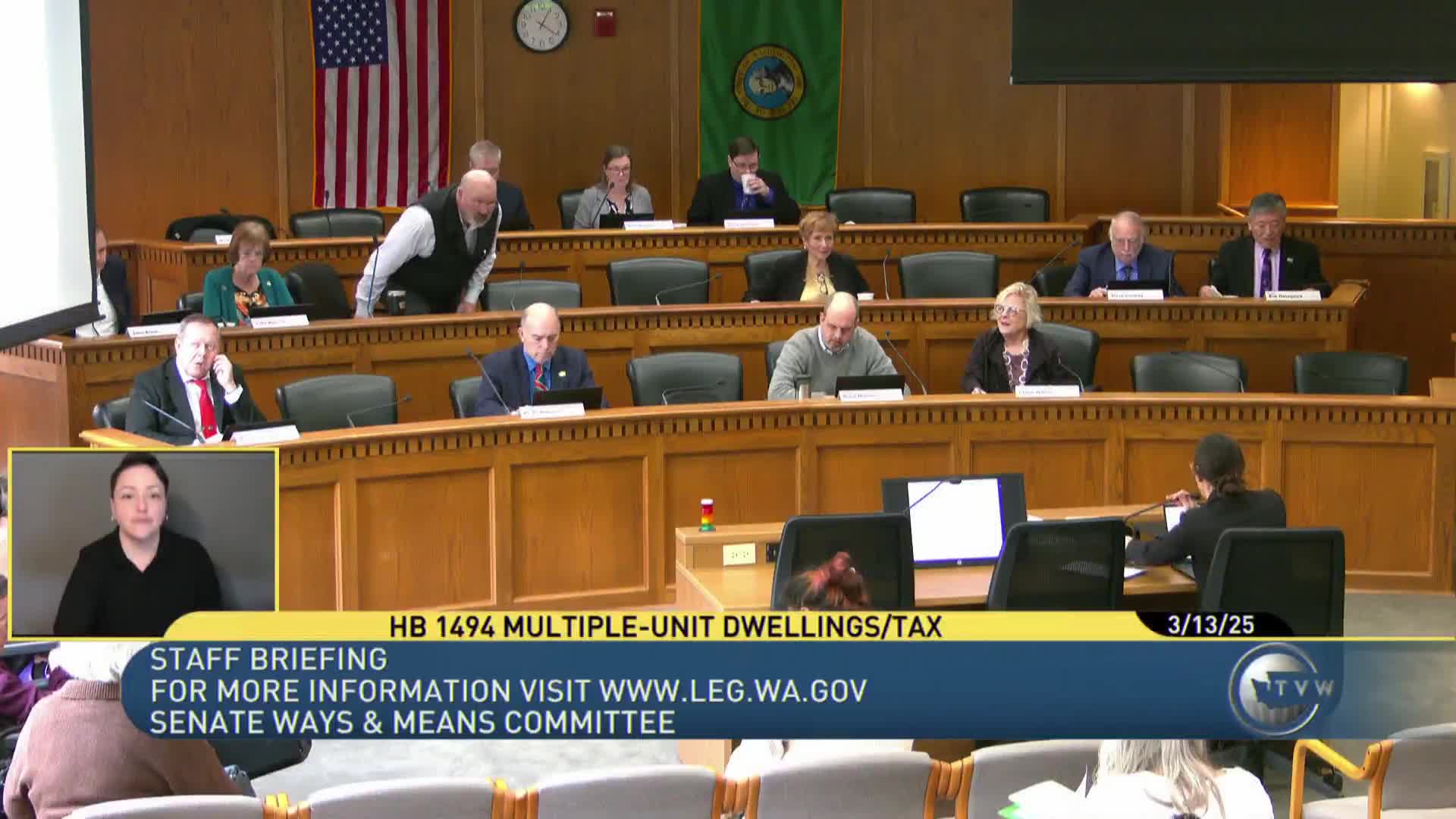
The Senate Ways & Means Committee heard a staff briefing and public testimony on House Bill 1494, which would modify the Multifamily Property Tax Exemption (MFTE) program by changing eligibility rules for cities and counties, clarifying affordability requirements, and tightening compliance and reporting.
Committee staff introduced the MFTE framework and the bill's changes. Ollie Kennedy, staff to the committee, summarized the program options (8-, 12-, and 20-year exemptions) and described eligibility changes that would allow any city with at least 15,000 people and a mandatory inclusionary zoning requirement to offer the 20-year rental exemption within one mile of high-capacity transit. The bill would also remove the requirement that certain rural county areas be served by sewer systems and instead allow other county-specific criteria. Kennedy described additional provisions requiring deed restrictions for owner-occupied projects that receive a 12-year exemption, anti-displacement requirements under the Growth Management Act for newly designated residential targeted areas, strengthened compliance penalties, and expanded reporting to the Department of Commerce.
Why it matters: supporters said MFTE is a developer tool that can increase housing production — including affordable units — without direct state subsidy. Opponents did not dominate the hearing; testimony was generally supportive from housing advocates and developers. Nicholas Carr, Governor Ferguson's senior policy advisor for housing, testified in support and said the program has helped produce roughly 70,000 units statewide, including about 12,000 affordable units. He said the bill implements recommendations from the Lieutenant Governor's housing plan and a 2023 Commerce legislative study. Anthony Hempstead, representing multifamily developers, said expanding MFTE eligibility in unincorporated urban county areas would make several projects financially viable and estimated his client could add more than 500 units in Snohomish County alone if the county adopts the program.
Committee members asked about the reason for reverting some eligibility to population thresholds and for clarification about affordability definitions. Staff committed to follow up on some definitional questions about the income thresholds and affordability calculations.
What was not decided: the committee held the public hearing and took testimony; no committee vote was shown in the transcript. A fiscal note is available and staff said there is no expected state revenue impact; any shifts would be between exempt and nonexempt taxpayers and are indeterminate.
Context: MFTE is a local tool that cities and some counties use to incentivize multiunit housing and affordable units. This bill would widen or narrow program access in different ways and add compliance and anti-displacement measures. Supporters argued the changes would expand production and strengthen safeguards; staff and some senators asked technical questions about definitions and thresholds.