Get Full Government Meeting Transcripts, Videos, & Alerts Forever!
Get email alerts on the Education Competency Based Education topic
No spam. Unsubscribe anytime.
Public testimony splits as committee hears bill to expand competency-based funding and update transcripts
Summary
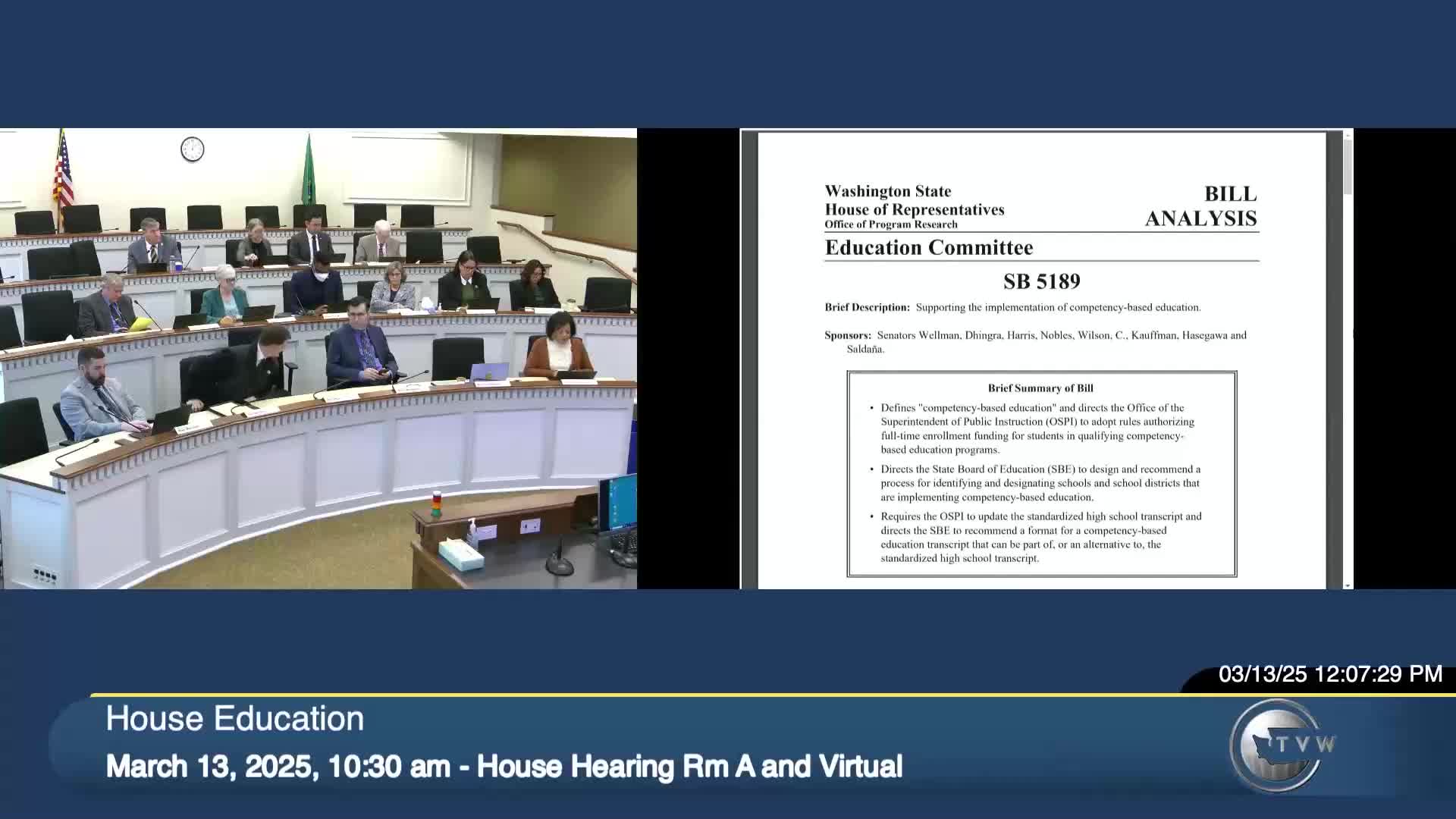
House Education Committee heard testimony for and against Senate Bill 5189, which would allow competency-based programs to report FTE under OSPI rules, direct the State Board to recommend designation processes and require updates to the standardized high school transcript to accommodate competency-based records.
The House Education Committee held a public hearing March 13 on Senate Bill 5189, a measure that would update Washington education law to recognize competency-based (mastery-based) education for funding and transcripts.
Ethan Moreno, nonpartisan committee staff, summarized the bill and said it would require OSPI to adopt rules by Sept. 1, 2025, permitting districts to report full-time-equivalent (FTE) enrollment for students in competency-based programs that meet State Board–approved criteria. The bill also directs the State Board of Education to design a recommended process for identifying and designating schools and districts implementing competency-based education, and it directs the Superintendent to update the standardized high school transcript to offer a competency-based format.
Supporters included the State Board for Community and Technical Colleges, which said expanded competency-based transcripts would support adult high school completion and the High School Plus program; Troy Grama of SBCTC said the bill will “improve the quality of Washington high school students' educational records.” State Board of Education staff reiterated their support and said the bill aligns with strong interest from districts and the Mastery Based Learning Collaborative.
District leaders and school principals with experience operating competency-based schools described benefits and implementation challenges. Tanya Bridal, principal of Gibson Neck High School (Issaquah School District), said competency-based programs “allow students to engage in meaningful community problem solving while developing core academic knowledge” and that prototypical funding would help sustain partnerships and internships. Julia Bamba, who led Gibson Neck's launch, called the model “student centered” and said projects and internships often exceed what traditional assessments measure. Teachers from small districts (for example La Conner) said current funding rules force them to convert mastery-based grades into traditional scales for eligibility checks and athletics, creating administrative burdens.
Several students from competency-based programs testified in favor, giving examples of internships, project work and improved engagement. Matthew Brewer of Quincy Innovation Academy said a standard competency transcript would reduce friction for mobile students moving between districts and postsecondary programs.
Opponents urged caution. Sarah Garriott, a parent, cited external evaluations and an Aurora Institute summary indicating mixed evidence for large-scale, transformative academic gains and argued that many parents and administrators question the approach. Gabriel Jacobs, a parent and former foster parent, said competency-based models can vary widely and warned against scaling programs without consistent statewide standards. Linda Wojciechowski testified she opposes the bill on ideological grounds, saying the approach embeds DEI principles into instruction; her remarks were cut short by the committee's timed testimony rules.
The committee clerk read a sign-in tally for the hearing that the vice chair later summarized as 95 pro, 2,125 con, and 5 other (this figure reflects sign-in counts the committee clerk reported in the hearing). Committee members said they would hold detailed questions to allow many witnesses to speak; no vote was taken during the hearing.
The bill raises several operational questions that committee members and speakers flagged: how to define eligibility criteria for FTE reporting, how to ensure consistent competency rubrics across classrooms and districts, how to protect extracurricular eligibility rules (for example WIAA) when districts use nontraditional grading scales, and whether additional funding is needed to sustain partnerships, coaches and professional learning. Supporters urged that designated competency programs help prepare students for college, careers and civic life; opponents asked for more rigorous, scalable evidence before the state changes funding and accountability rules.