Get Full Government Meeting Transcripts, Videos, & Alerts Forever!
Get email alerts on the Equitable Development topic
No spam. Unsubscribe anytime.
Bill would let King County use short‑term lodging tax for community‑led equitable development, proponents say
Summary
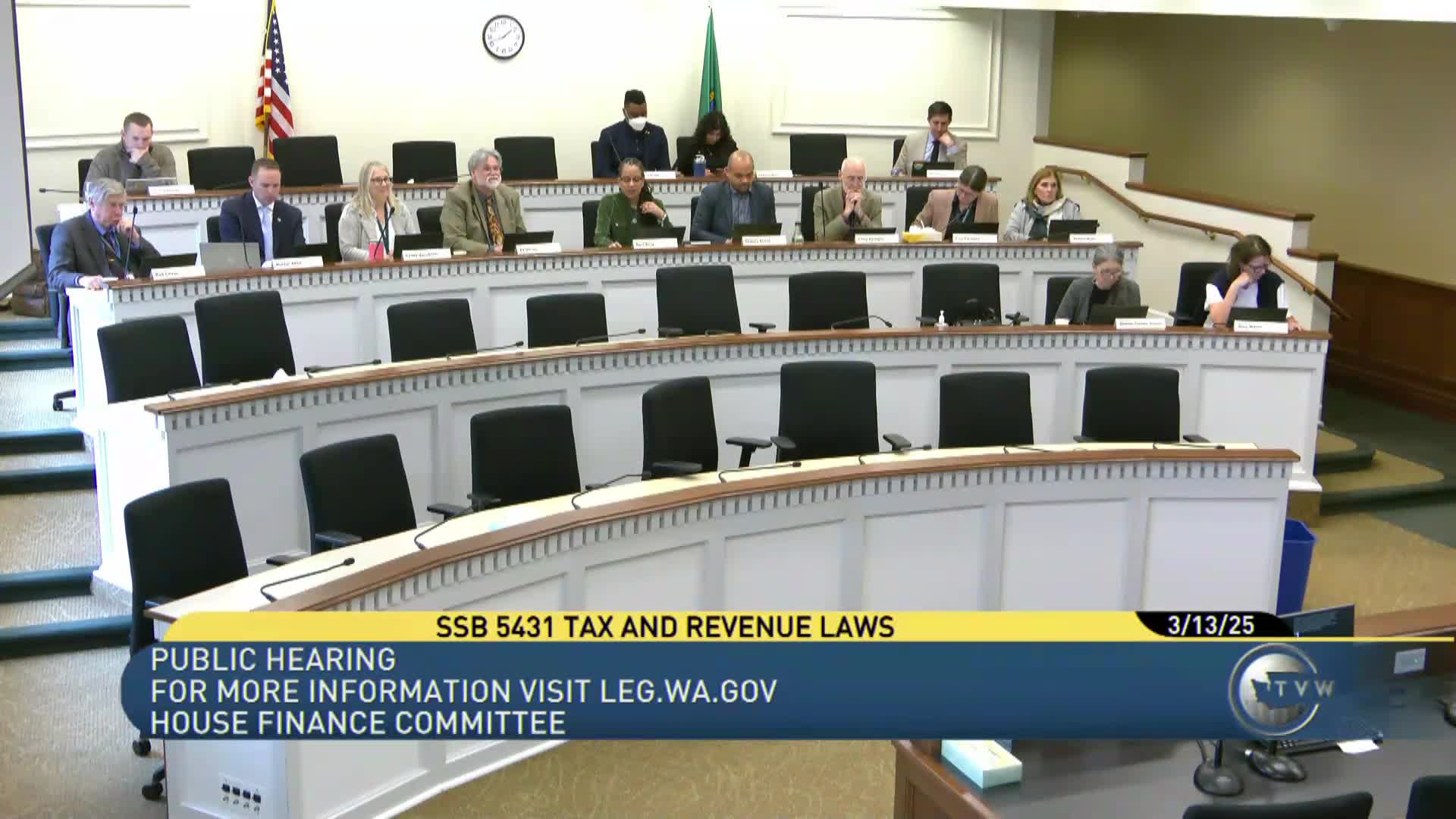
The House Finance Committee heard testimony on SB 51 38 on Thursday, March 13, a bill that would allow King County to use convention‑center lodging tax revenues attributable to short‑term rentals for community‑initiated equitable development in addition to affordable housing.
The House Finance Committee heard testimony on SB 51 38 on Thursday, March 13, which would allow a public facilities district in a county with a population of 1.5 million or more to use convention‑center lodging tax revenue attributable to short‑term rentals for community‑initiated equitable development in addition to affordable housing programs.
Michelle Harris, staff briefing the committee, explained that public facilities districts are municipal corporations with independent taxing authority that can be created by a city, a group of cities, a county, or a combination. Harris described the existing tax framework: within the largest city in a district the convention‑center lodging tax cannot exceed 7 percent and 2.8 percent in the rest of the district; an additional 2 percent can be imposed inside the largest city as a credit against state sales tax. When the district collects revenue attributable to short‑term rentals within a city that does not impose its own short‑term rental lodging tax, the district distributes those revenues to the city; after the city share is deducted, 50 percent of the remaining revenues are distributed to the county and, under current law, the county must use those funds only for affordable housing programs.
Sen. Rebecca Saldana, the prime sponsor, told the committee she brought the bill so King County could use revenues for community‑initiated equitable development (EDI) projects — programs that supporters say provide capacity building, acquisition funding, and construction resources for BIPOC‑led housing, community and cultural spaces, and agricultural projects. Saldana said community‑led projects vary by community and include examples such as Filipino and Ethiopian community senior housing programs, community food programs, and other culturally specific services.
Multiple testifiers representing community groups and coalitions told the committee they support the change and described local models and needs. Alyanna Thorne, a policy analyst for Puget Sound Sage and a lead for the King County Equitable Development Initiative Coalition, said the coalition secured county funding for an EDI program and that nearly half of that funding came from short‑term lodging revenue; she asked that the county program be afforded the same statutory flexibility Seattle has to use short‑term lodging revenue for equitable development as well as housing.
Howard Green, research director at Puget Sound Sage, provided historical context: Seattle adopted a short‑term lodging tax and directed some revenues to housing and community‑led projects as a response to housing loss associated with short‑term rental platforms. When the tax was later absorbed at the state level and expanded to King County, he said the equitable‑development use was not carried over for the county portion; SB 51 38 would align county law with the city’s practice.
Chelsea Lee, equitable development coordinator at Eastside For All, and other community leaders said EDI funds could support a range of needs the community identifies — from mixed‑use community centers to childcare, cultural spaces, and agricultural infrastructure — and that flexibility is important to prevent displacement and to support BIPOC‑led development. Aaron Clark of N'a'ilahi Fund and Frangley Bank Johnson of Friendly Hmong Farms described indigenous, immigrant, and BIPOC community projects that proponents say would benefit.
Staff noted a fiscal note is available and that the bill, as drafted, is not expected to change state or local revenues because it only adds an allowed use. Committee members asked for a clearer statutory definition of “community‑initiated equitable development”; supporters and staff said the term is defined in implementation plans and resolutions used by King County and Seattle rather than in the state statute, and staff said they would coordinate with the prime sponsor and testifiers to provide a definition for committee consideration.
Representatives asked whether the change applies only to King County; staff and the sponsor confirmed the bill’s language is specific to a county meeting the population threshold (King County). The committee closed the public hearing on SB 51 38 with supporters from multiple community groups urging passage or further study; no vote was taken at the hearing.