Get Full Government Meeting Transcripts, Videos, & Alerts Forever!
Get email alerts on the Tax Policy topic
No spam. Unsubscribe anytime.
Bill to tax self-storage rentals draws sharp split between cities, land-trust advocates and storage operators
Summary
Senate Ways & Means Committee heard testimony on Senate Bill 5,711, which would classify self-storage rentals as retail sales and subject them to business & occupation and retail sales taxes, with revenue intended for manufactured home communities and affordable housing programs.
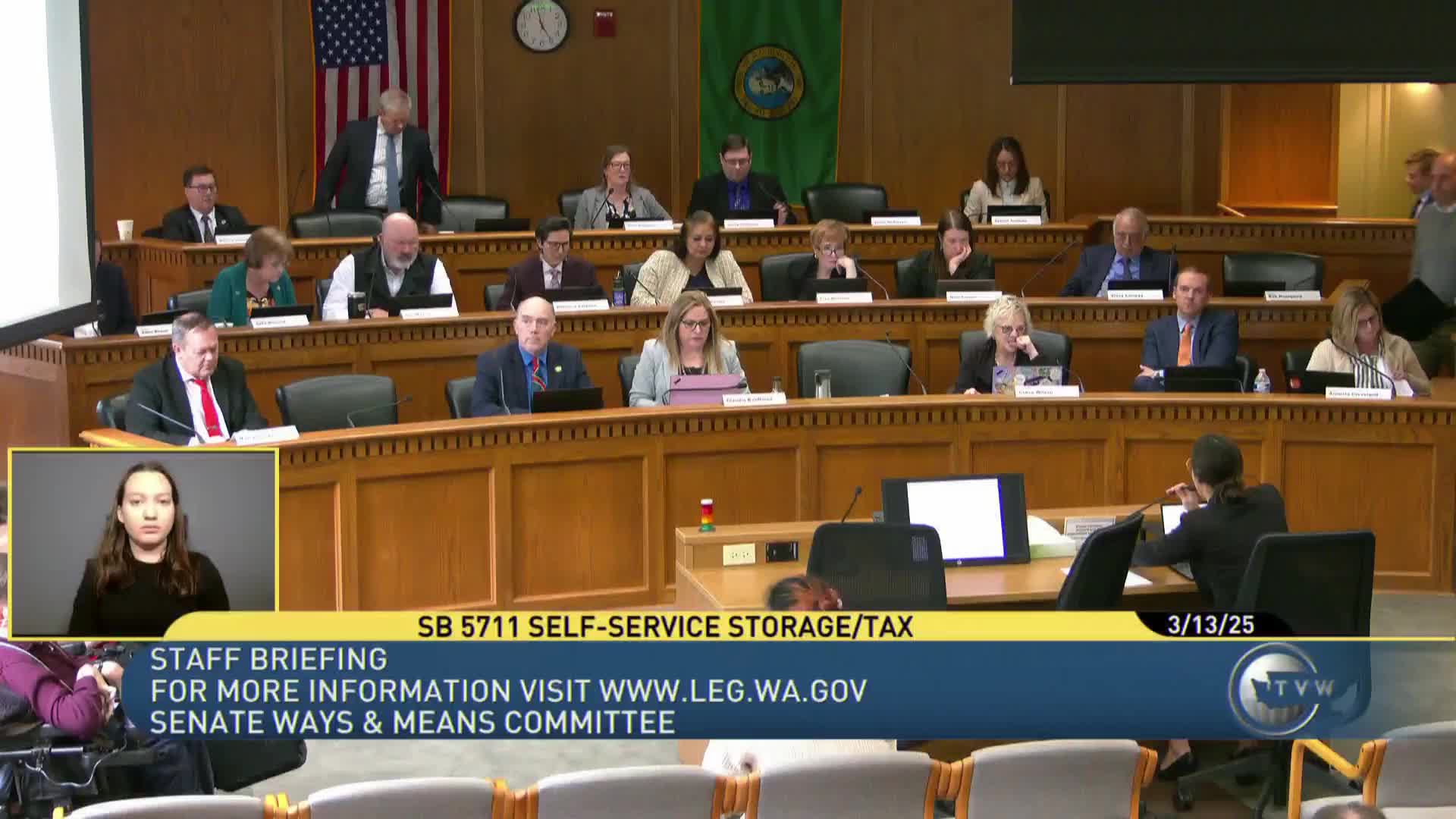
The Senate Ways & Means Committee took public testimony on Senate Bill 5,711, which would tax rentals of individual self-service storage spaces as retail sales (subjecting them to the B&O tax and retail sales tax) and declare legislative intent that revenues support manufactured home communities and affordable housing programs.
Committee staff outlined legal background and fiscal estimates: a 1960 state Supreme Court ruling (Apartment Operators v. Schumacher) previously treated rental income from real property as a property tax subject to uniformity constraints, but staff said a more recent opinion (Quinn v. State) questioned that precedent and could allow a B&O tax on renting storage. Staff estimated general fund revenue increases of about $57.6 million in the upcoming biennium and $147.8 million over four years; a small Department of Revenue implementation cost was also noted.
Why it matters: proponents said the bill closes a tax preference that encourages inefficient land use and creates a new revenue source for affordable housing and land-banking tools. Opponents said the rental of storage is a rental of real property currently exempt from such taxes, that most self-storage businesses are small operators, and that the tax would fall on low-income customers, service members, and small businesses who use storage during life transitions.
Opposition testimony included owner-operators, industry trade groups and small-business owners. Lance Baker, president of the Washington State Self Storage Association, said more than half of Washington's 1,800 storage facilities are single-store operators, and that “one third of our storage users have a household income of less than $50,000.” Pat Sievers, a small Everett operator, described customers who use storage after domestic violence, flooding, or deployment and urged a no vote. Multiple operators and managers emphasized that much of the cost would ultimately be passed to customers on fixed or low incomes; several stressed service members and nonprofits among their tenants.
Supporters included the Association of Washington Cities and housing advocates. Carl Schrader of AWC said the preferential tax treatment encourages inefficient uses of urban land and argued proceeds should be dedicated to mitigating housing impacts. Nick Federici of the Washington State Community Land Trust Coalition urged using proceeds to expand permanently affordable homeownership models such as community land trusts.
Committee members asked staff about legal risk and precedent. Staff said the fiscal note assumes the Supreme Court would uphold a B&O tax on rental activity if the court treats the tax as an excise on the privilege to do business (following language in Quinn) rather than a property tax tied solely to ownership. Members also asked whether the tax would ultimately be levied on businesses or consumers; staff explained B&O would apply to businesses while sales tax would be collected from customers.
What was not decided: no committee vote occurred on the bill during this hearing. Opponents urged that the measure would disproportionately burden vulnerable renters and small businesses; proponents urged the measure would generate significant revenue for housing programs and remove a long-standing preferential tax treatment.
Context and next steps: testimony reflected a classic revenue-versus-distribution debate: whether this revenue source should be tapped for housing and whether the distributional consequences and legal risks are acceptable. The bill's intent language (to fund manufactured home communities and affordable housing) appears in the draft but committee members noted the intent language does not by itself create a legally binding earmark.