Get Full Government Meeting Transcripts, Videos, & Alerts Forever!
Get email alerts on the Developmental Disabilities topic
No spam. Unsubscribe anytime.
Senate committee hears hours of testimony on proposed closure of Rainier School
Summary
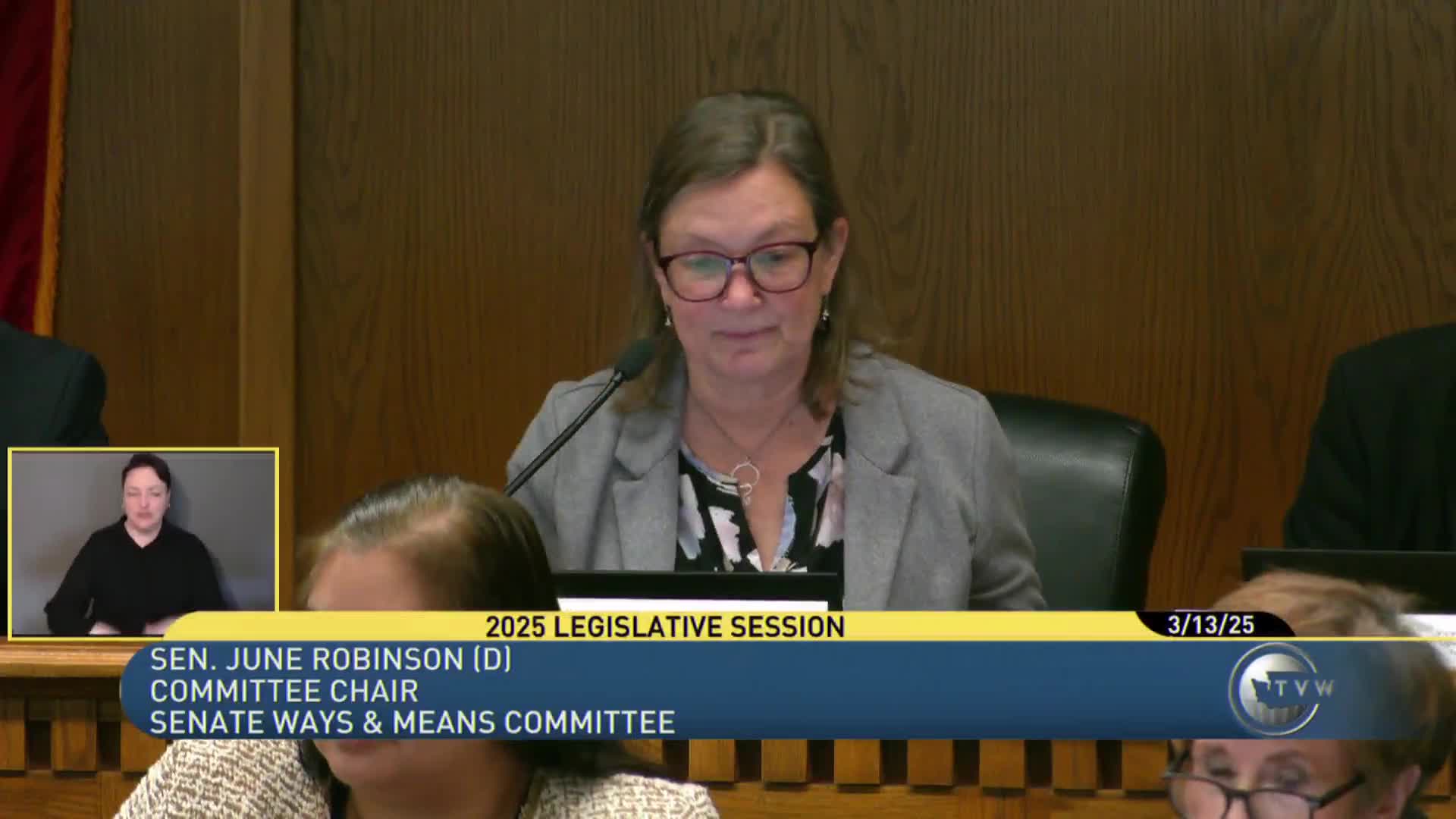
Senate Ways & Means Committee opened a public hearing on proposed substitute Senate Bill 5,393, which would close Rainier School in Buckley and require DSHS to transition current residents by June 30, 2027.
Senate Ways & Means Committee opened a public hearing on proposed substitute Senate Bill 5,393, which would close Rainier School in Buckley and require the Developmental Disabilities Administration (DSHS/DDAs) to transition current residents by June 30, 2027.
Maria Hovde, committee staff, said, “Rainier School is currently supporting 75 individuals in the intermediate care facility.” She told the committee the bill would bar new admissions on enactment and, “by 06/30/2027, DSHS shall transition current residents to state operated living alternatives, supported living facilities, adult family homes or other residential habilitation centers in accordance with client preferences.” Hovde summarized DSHS cost estimates: a potential net general fund cost of about $1.2 million in the 2025–27 biennium (preliminary) and estimated net general fund savings of roughly $24 million over a four-year outlook, with an ongoing annual general fund savings of about $12.8 million once fully closed, depending on the mix of placements.
Why it matters: supporters and opponents framed the bill as a test of whether the state should accelerate a shift from large residential habilitation centers (RHCs) to community-based services. Proponents said many people now receive services in the community and that closing Rainier would expand community integration. Opponents said Rainier operates as a safety net for people with complex medical and behavioral needs and that community alternatives are insufficiently scaled or proven for every resident now served at Rainier.
Supporters who testified included self-advocates and family members who said closures would expand community living options. Sean Latham, a self-advocate, said, “We believe everyone can live in the community. Now is the time to close institutions like Rainier.” Several disability advocacy organizations and family members described successful community living for many people and cited legal obligations under the Americans with Disabilities Act and Olmstead decisions to avoid unnecessary institutionalization.
Opponents — including Rainier staff, families of long-term residents, and employee representatives — argued Rainier provides essential, around-the-clock medical and behavioral services that many community providers currently cannot match. Nicole Gomez of the Washington Federation of State Employees said in testimony the 2018 Ruckelshaus Center report recommended maintaining a full continuum of care, “including RHCs like Rainier, because those community providers cannot meet the needs of every individual.” Several family members recounted individual histories, describing placements that had failed in community settings and a stabilization they said occurred at Rainier.
Mixed testimony highlighted operational and safety concerns on both sides. Todd Carlisle of Disability Rights Washington told the committee, “Rainier School is a uniquely dangerous place,” citing federal findings of abuse and neglect and saying some parts of the facility have been shut down since 2019. In contrast, family members described programs and activities on Rainier’s campus and said, for some residents, it is the only setting where they are safe and stable.
Committee members pressed staff on the fiscal assumptions and on where residents would be transitioned. Hovde said DSHS’s assumptions for the estimate were that roughly 50% would move to other RHCs, 25% to state-operated living alternatives (SOLAs), and 25% to supported living settings, and that the DSHS estimate assumed new SOLAs would be opened.
What was not decided: the hearing did not include committee action or a floor vote. Committee staff and multiple members requested additional information on family locations, SOLA capacity in Pierce County, renovation costs at other RHCs and the basis for DSHS assumptions.
Context: Rainier School is certified by the federal Centers for Medicare & Medicaid Services as an intermediate care facility and has been downsized in recent years. Testimony included personal accounts of medical crises, assaults, staff misconduct allegations, and both praise and criticism of Rainier’s care. Advocates for closure argued Washington lags peer states in moving to community-based models; opponents warned about service gaps, transition risks and workforce implications.
What’s next: the committee hearing closed public testimony after extensive oral and remote testimony. No formal action was recorded on the bill in this hearing; future committee consideration will determine whether the bill advances and what amendments or funding lines may accompany any final proposal.