Get Full Government Meeting Transcripts, Videos, & Alerts Forever!
Get email alerts on the Education Mastery Based Learning topic
No spam. Unsubscribe anytime.
State board and partner schools describe early gains, hurdles of mastery-based learning
Summary
State Board of Education staff and participating schools described mastery-based (competency-based) learning models, early outcomes from a 47-school collaborative, and implementation barriers including funding, reporting and the lack of a state-approved mastery transcript.
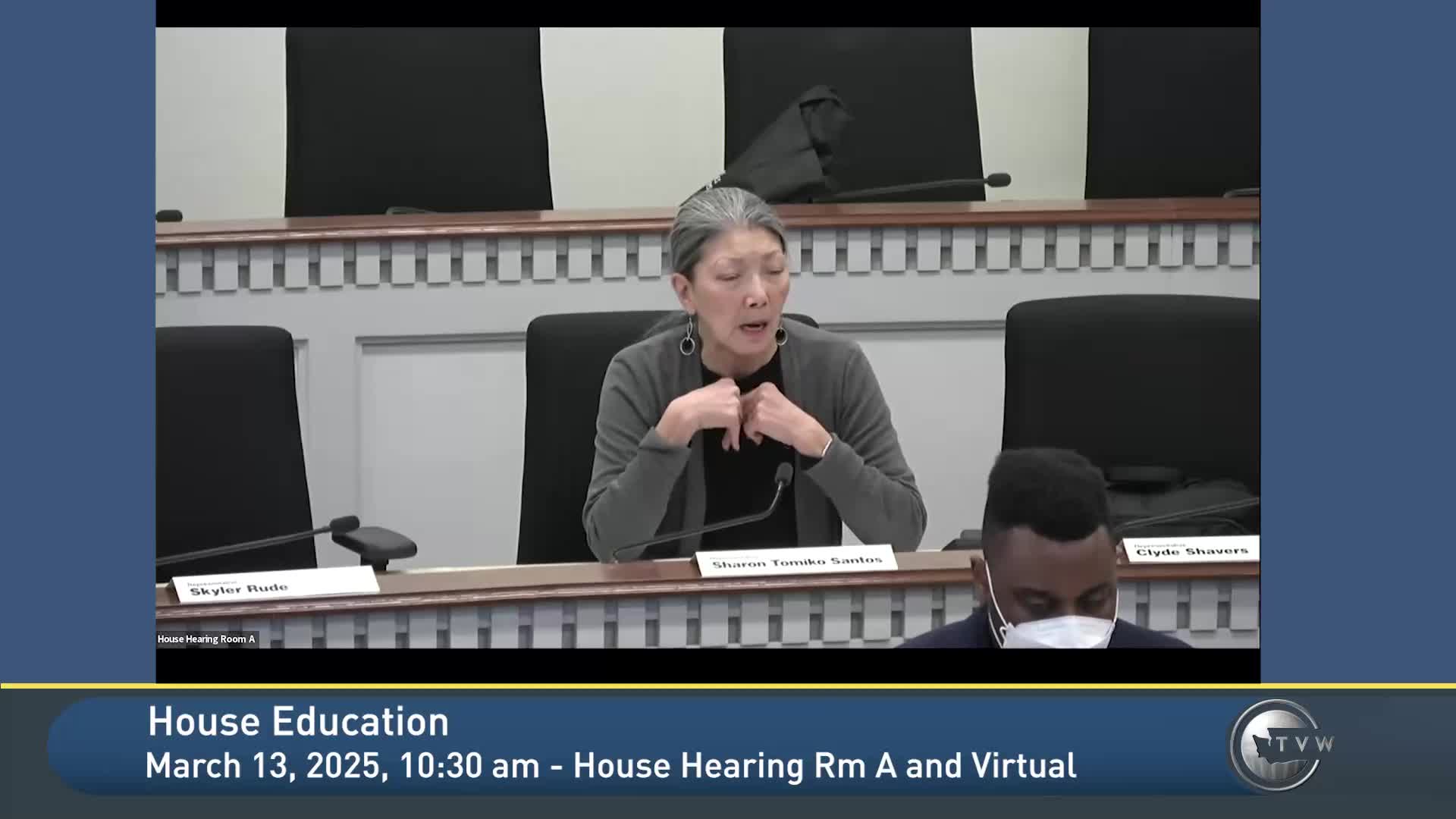
A work session of the Washington State House Education Committee on March 13 focused on mastery-based learning, a competency-based approach that lets students advance when they demonstrate mastery of state standards rather than by seat time. Alyssa Muller, director of policy at the State Board of Education, told the committee the state defines mastery as “meeting state standards at a student's grade level and subject area.”
The State Board oversees a mastery-based learning collaborative of 47 schools intended to help buildings implement culturally responsive competency systems, give them dedicated coaching and professional learning, and surface policies that would allow the model to scale. Muller said the program’s independent evaluator, the Aurora Institute, is identifying both promising practices and structural barriers, particularly around reporting and funding.
“Mastery-based learning ensures students fully understand key concepts before moving forward,” Muller said. She told members the collaborative’s goal is to increase student agency and deeper learning by making standards and success indicators more transparent to students, families and teachers.
District and school leaders described how implementation looks locally. Beth Clothier, Director of Teaching and Learning at La Conner School District, said La Conner began piloting mastery-based approaches in 2022 and expanded them through grades 6–12. She said teachers shifted grading to report students’ progress on discrete standards and competencies, and that students can revise and resubmit work to demonstrate improved mastery. Clothier said the district also is developing culturally based credit pathways in partnership with the Swinomish Tribe; students who participate in events such as canoe journeys will work with certified teachers and tribal elders to align that learning to district standards and earn credit.
Clothier asked the committee for help with a practical barrier: the absence of a state-approved mastery-based transcript. “We need a transcript that communicates effectively which standards a student has met and what learning that student has demonstrated,” Clothier said, noting current letter-grade transcripts can obscure what a student actually knows.
Edgemont Junior High in the Puyallup School District described another path to competency-based practices: the school’s principal, Dr. Mark Knight, said staff began with project-based learning and staff professional learning to create transparent “conditions for success.” Knight said the work has shifted staff from compliance-driven instruction toward student engagement and that the school is now building competency rubrics and aligned units to make learning expectations explicit.
Representatives from Quincy Innovation Academy, a Big Picture program, and its students described project- and internship-based competency examples — from building an arcade cabinet while applying math skills to public speaking growth through community engagement. Matthew Brewer, Quincy Innovation Academy, told the committee competency transcripts would ease student transitions between districts and postsecondary institutions because the current translation of competency work into traditional transcripts requires extensive, individualized explanation.
Committee members asked practical questions about staffing, class size and teacher collaboration. Clothier said La Conner has not found competency-based models necessarily require smaller class sizes, though she stressed the work depends on professional learning and time for teacher collaboration. Dr. Knight acknowledged Edgemont is “still in our infancy” on vertical alignment of competencies but said the collaborative and outside partners such as the Great Schools Partnership and PBL Works have helped accelerate staff preparation.
Muller said prior legislative funding supported two cohorts in the collaborative; the first cohort is completing its fourth year and the second its second year. She said the State Board will submit a legislative report with additional findings and recommendations from the Mastery Based Learning Collaborative by the end of the year, and that prior evaluation reports are available on the State Board’s website.
The work session combined local examples with statewide policy needs: coaches and professional learning were cited as critical supports, while divergent district reporting and funding rules were identified as obstacles to scaling. Several presenters urged the Legislature to address transcripts, funding for non-seat-time learning, and formal mechanisms to compensate tribal partners for curriculum work that local tribes currently provide without sustained funding.
Committee members asked the presenters to return for follow-up questions and flagged potential future work sessions on standardized competency transcripts and funding mechanisms.