Get Full Government Meeting Transcripts, Videos, & Alerts Forever!
Get email alerts on the Street Design Pedestrian Safety topic
No spam. Unsubscribe anytime.
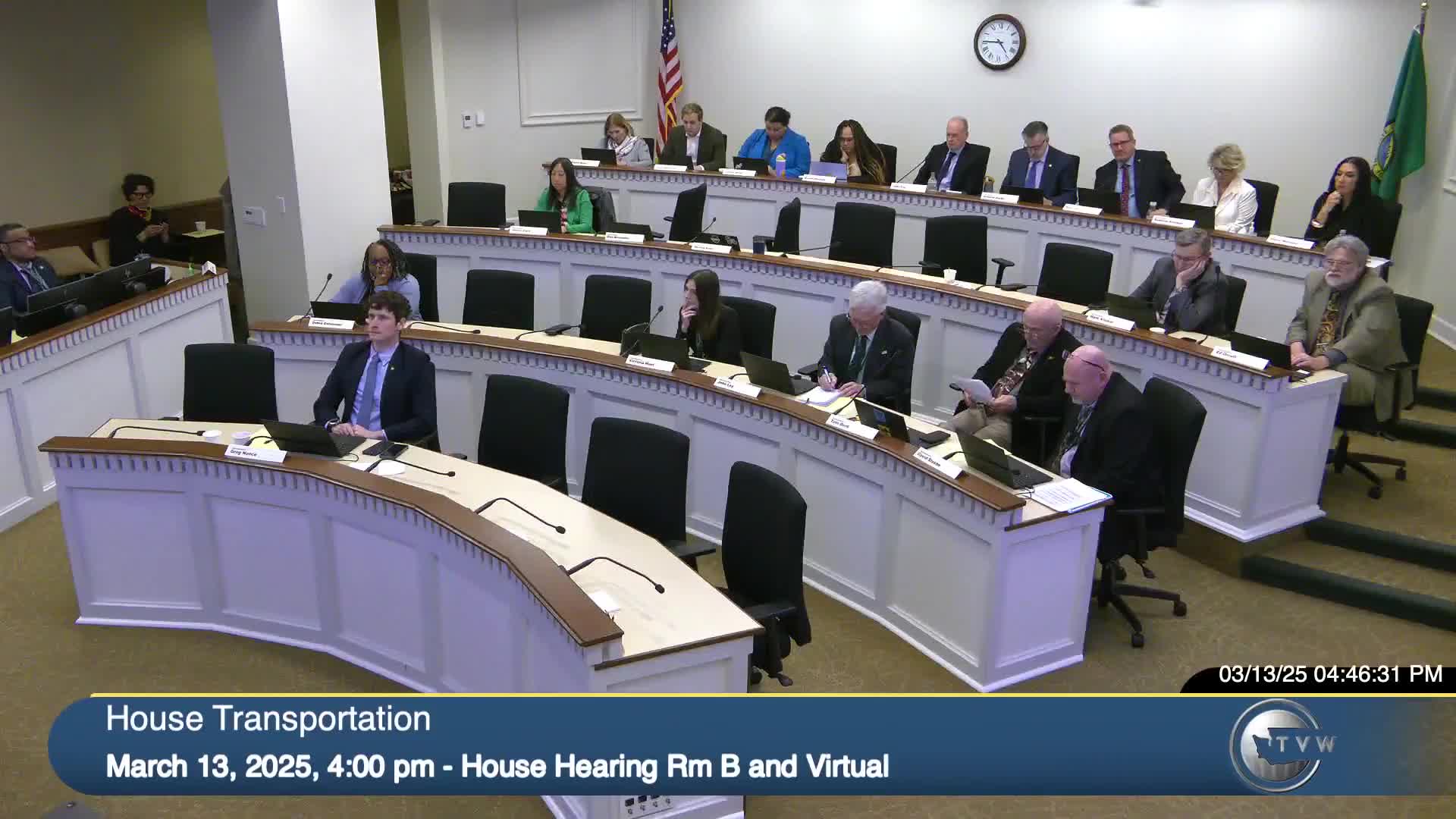
Committee hears shared‑streets bill giving cities option to set 10 mph local zones
Summary
Senate Bill 5595 (companion HB 1772) would allow local authorities to designate non‑arterial streets as shared streets—where pedestrians, bicyclists and vehicles share space—and authorize local speed limits as low as 10 mph; sponsors and municipal traffic engineers testified in support.
Senate Bill 5595, heard March 13 by the House Transportation Committee, would permit local authorities to designate certain non‑arterial streets (excluding state highways) as ‘‘shared streets’’ where pedestrians, bicyclists, micromobility operators and vehicular traffic commingle. The bill provides a local option to set maximum speeds as low as 10 miles per hour on those streets and clarifies the right‑of‑way hierarchy: vehicles must yield to pedestrians, and bicyclists and micromobility operators must yield to pedestrians on shared streets.
Committee staff Jennifer Harris briefed the bill: it aligns with a companion House measure and adds the restriction that state highways may not be designated as shared streets. The bill also allows local authorities to establish procedures for designating shared streets, and it preserves traditional roadway rules outside of shared street designations. Harris said the bill would take effect 90 days after the end of session and that no fiscal note was requested.
Sponsors and municipal officials described use cases and safety goals. Representative (sponsor) Emily Alvarado (30th Legislative District) framed the bill as a local‑option tool to improve walkability, create space for gathering and commerce, and enable tactical changes for events (the sponsor mentioned World Cup preparations). Alvarado noted amendments requiring local reporting on accidents occurring on shared streets and a WSDOT amendment to exclude state highways.
Several municipal officials and planners testified in support. Vindya Nemani, Seattle’s Chief Transportation Safety Officer and City Traffic Engineer, said the bill provides needed authority to redesign streets (for example, in Pike Place Market) to accommodate pedestrians and deliveries in the same roadway space. Nick Bond, community development director for Port Orchard, described the city’s plans for two shared streets and said the city lacked authority to set and enforce 10 mph without the change. Carl Schroeder of the Association of Washington Cities and Mark Austro also testified in favor, citing international precedent and local planning benefits.
Why it matters: the bill gives cities a statutory tool to create people‑priority streets for community events, commercial districts and pedestrian safety, while preserving local control and requiring data collection on incidents.
The committee did not record a formal vote during the hearing; testimony emphasized local design discretion, safety reporting and the need for state‑level legal authority to back local shared‑street experiments.