Get Full Government Meeting Transcripts, Videos, & Alerts Forever!
Get email alerts on the Pensions topic
No spam. Unsubscribe anytime.
House committee hears competing plans to use LEOFF‑1 surplus; retirees and cities split
Summary
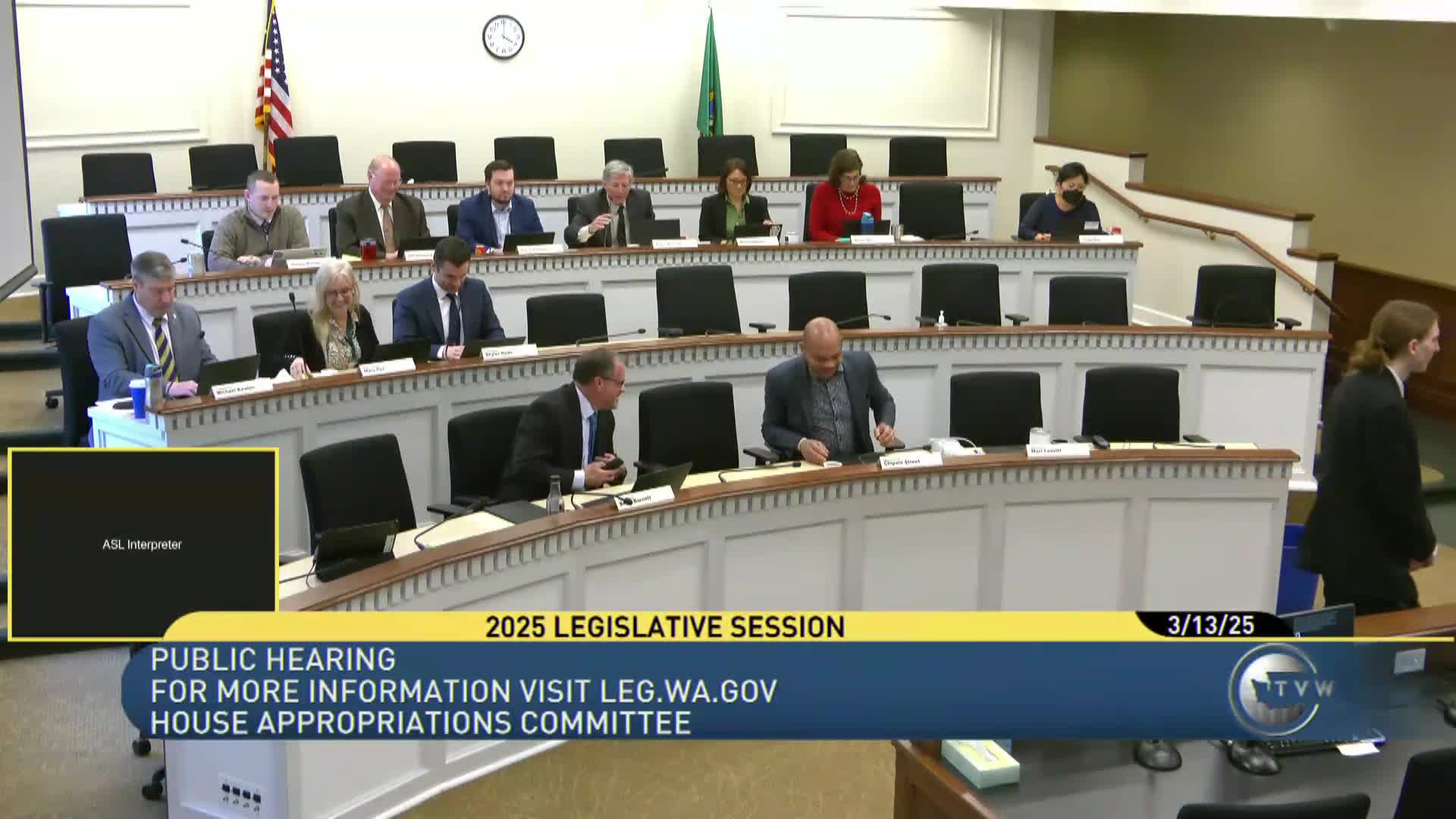
House Appropriations Committee members heard a staff briefing and public testimony on two competing proposals to reallocate surplus funds from the Law Enforcement Officers' and Firefighters' Retirement System Plan 1 (LEOFF‑1).
House Appropriations Committee members heard a staff briefing and more than a dozen public witnesses on two competing bills that would redirect surplus funds in the Law Enforcement Officers' and Firefighters' Retirement System Plan 1 (LEOFF‑1).
David Pringle, staff to the committee, told members House Bill 2,034 would use a legal process called a “restatement and termination” to create a smaller, restated LEOFF‑1 funded at about 120% and make excess assets available to the pension funding stabilization account and, potentially, the State General Fund. Pringle said the bill assumes the plan could be terminated on 06/30/2029 when the plan is projected to exceed 200% funded; the proposal would leave a restated plan sized for roughly 5,300 annuitants and make up to $3.3 billion available for transfer under current actuarial projections.
Pringle described Substitute Senate Bill 5,085 as an alternative that would merge LEOFF‑1 with PERS‑1 and TERS‑1 into a single “legacy retirement system,” combine surpluses and liabilities, and use the surplus both to eliminate certain unfunded‑liability contribution rates and to provide a 3% one‑time cost‑of‑living adjustment (COLA) effective 07/01/2025 and an ongoing COLA beginning 07/01/2026 that would match Plan II/III COLAs.
Why it matters: the two approaches redistribute the same LEOFF‑1 surplus differently. HB 2,034 preserves a separate LEOFF‑1 fund at a reduced funding target and delays material transfers until the projected termination date; SB 5,085 immediately combines assets and liabilities and uses surplus funds to deliver COLAs and reduce pension contribution rates in other plan‑1 systems.
Key figures and technical points presented to the committee: - Pringle said LEOFF‑1 reached and surpassed full funding and was estimated to be about 168% funded at the end of fiscal 2025 and projected to be about 217% funded by 06/30/2029 under current actuarial assumptions. - PERS‑1’s unfunded liability was presented as about $2.1 billion and TERS‑1’s about $1.0 billion, figures the staff identified as largely attributable to past ad‑hoc benefit increases. - Under HB 2,034 a restated plan at 120% would leave roughly $700 million more than the plan would need by current actuarial methods; up to $3.3 billion could be moved to the pension funding stabilization account for possible transfer to the State General Fund. - Substitute SB 5,085 would fund a one‑time 3% COLA (07/01/2025) and an ongoing COLA matching Plan II/III (beginning 07/01/2026), and staff estimated implementation costs for the merger around $1.2 million in the first biennium and about $210,000 ongoing; HB 2,034 implementation was estimated in the “several hundred thousand dollars a year” range for the early biennia.
Public testimony split along predictable lines. Supporters of SB 5,085 — including retirees and representatives of the Retired Public Employees Council of Washington — urged the committee to restore a recurring COLA to PERS‑1 and TERS‑1 and said the merger approach would deliver immediate and recurring relief to older, low‑income retirees. Claire Oliver, President of the Retired Public Employees Council of Washington, said the bill would “restore equity to the pension plans by providing a recurring COLA to PERS TERS 1 retirees.”
Opponents, largely representing LEOFF‑1 retirees and law‑enforcement/firefighter organizations, objected to dissolving or draining the LEOFF‑1 fund. Pete Diedrich, Executive Director of the Washington State School Retirees Association, testified “The state currently faces a dire budget situation… this bill wouldn’t provide any relief until 2029,” urging support for the Senate merger instead of HB 2,034. LEOFF‑1 retirees and advocates repeatedly asked the committee to preserve LEOFF‑1 assets, to negotiate with stakeholder groups, and to account for members who lack Social Security or who are medically vulnerable.
Local governments raised fiscal‑equity concerns. Candice Bach of the Association of Washington Cities noted that cities contributed a share of LEOFF‑1 funding historically and said roughly $250 million of the projected $3.5 billion in excess could be attributable to city contributions; she urged that city contributions and the plan’s medical‑benefit obligations (estimated from a 2022 actuarial study at roughly $2.0 billion over the life of the remaining retirees) be considered when drawing down surplus funds.
Legal and implementation issues were a recurring theme. Pringle told the committee both bills require engagement with the Internal Revenue Service and other federal authorities and that “there are clearly some unknowns” about the unusual legal processes involved in either the restatement/termination or the merger. Several witnesses warned of potential constitutional claims; Michael Duchemin, president of the Retired Firefighters of Washington, referenced Weaver v. Evans as precedent protecting members’ funding interests.
What the committee did: the hearing collected staff briefings and public testimony; committee members asked clarifying questions but no committee vote or formal action on either bill was recorded in the transcript.
Next steps and context: staff identified interactions between these proposals and a separate actuarial funding bill (drafted as a House bill in the electronic bill book) that would change the actuarial assumed rate of return from 7.0% to 7.25% and, under staff estimates, could increase projected LEOFF‑1 surplus by about $166 million. Both HB 2,034 and SB 5,085 expressly condition implementation on federal compliance determinations and substantial plan‑member notifications and rule re‑writing.
Sources: staff briefing by David Pringle; public testimony by retiree and stakeholder representatives listed in the committee record.