Get Full Government Meeting Transcripts, Videos, & Alerts Forever!
Get email alerts on the Maritime Policy topic
No spam. Unsubscribe anytime.
Committee hears bill to raise nonresident vessel length limit, dedicate fees to youth swim grants
Summary
Engrossed substitute Senate Bill 5281 would raise the maximum vessel length eligible for a nonresident vessel permit from 200 to 300 feet, create a graduated fee for vessels 201–300 feet, and direct proceeds to a grant program for youth swim lessons in overburdened communities.
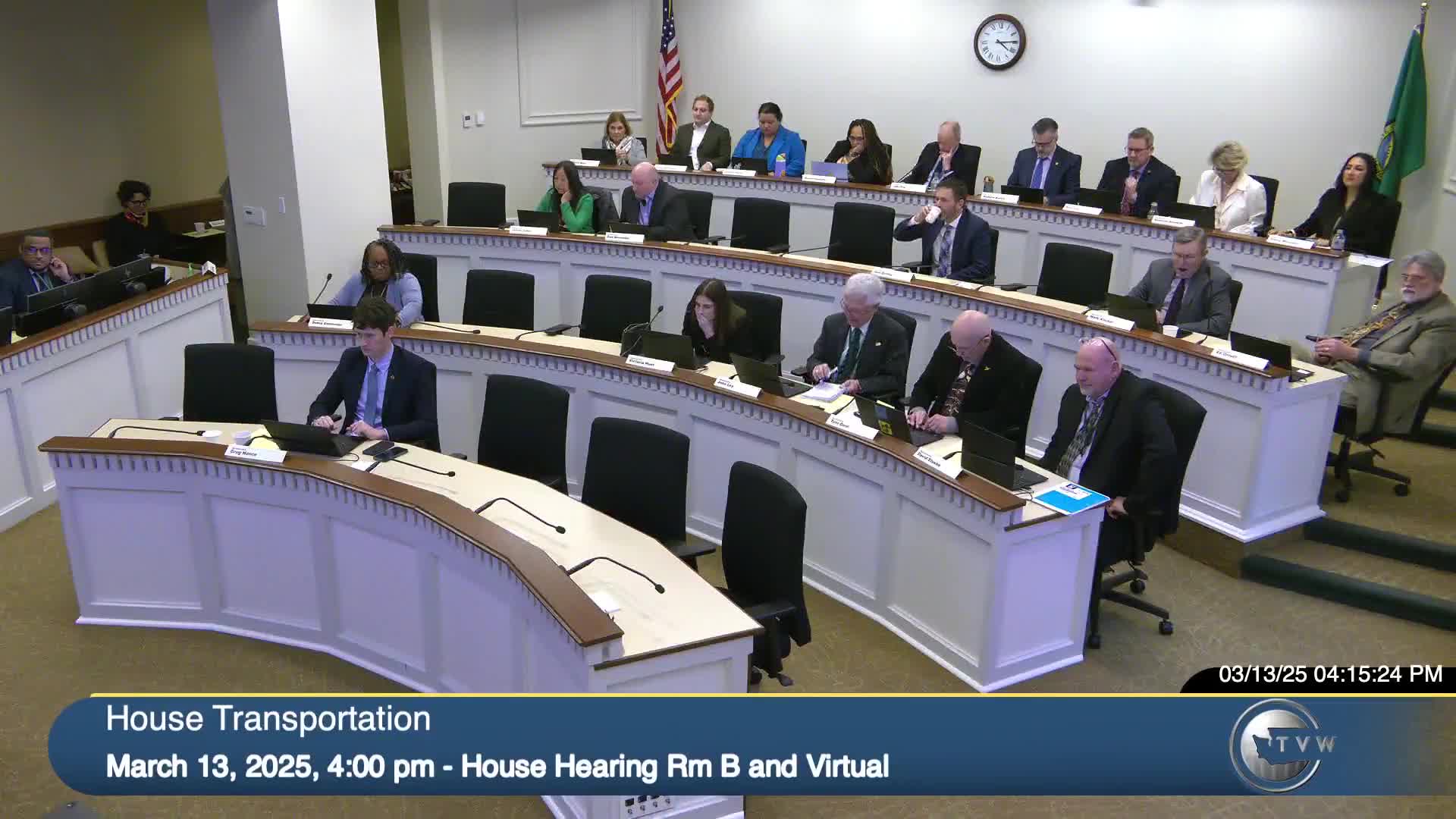
Engrossed substitute Senate Bill 5281, presented March 13 to the House Transportation Committee, would increase the maximum vessel length for which a nonresident entity or a vessel used for charter with captain and crew may obtain a Washington nonresident vessel permit from 200 feet to 300 feet, and create a new fee tier for vessels in the 201–300-foot range.
Staff briefed the committee that current nonresident vessel-permit rules allow nonresident owners to operate in Washington waters under certain time limits (generally up to 180 total days with extensions) and that permits are conditioned on vessel length and intended use. The bill raises the allowable maximum length to 300 feet and directs that, beginning 05/01/2026, a fee for vessels 201–300 feet in length be assessed at $100 per foot of vessel length for nonresident entities (with a graduated structure applying below that length). Until 05/01/2026 the Department of Licensing is to process applications for vessels 201–300 feet as if those vessels were 200 feet in length.
Under the bill, fee proceeds attributable to vessels 201–300 feet must be allocated to the Washington State Recreation and Conservation Office to fund a grant program supporting youth swim lessons in overburdened communities. Staff also summarized multi-agency fiscal impacts: the Department of Licensing estimates one-time system modification costs (roughly $26,000 in fiscal year 2026) to implement the new fee logic; the Recreation and Conservation Office estimated 0.2 FTE and $50,000 in FY26 for program development plus $20,000 to update its PRISM system.
Senator Mike Chapman, the bill’s sponsor in the Senate, told the committee the bill has economic-development and port benefits, and that events such as the World Cup may increase demand for large vessels visiting Washington waters. Committee members asked for clarification on the fee’s structure; staff and the sponsor explained the $100-per-foot charge applies to the additional length above 200 feet and that a graduated fee schedule remains in place for shorter length bands.
Industry and port stakeholders provided public testimony in support. Monique Weber, a yacht agent and operations manager, said the change would allow transient superyachts to use Washington waters and generate economic activity during events such as the World Cup. Representatives of maritime trade groups and public ports emphasized local-job and supply-chain benefits and praised the bill’s earmark for youth swim lessons; the Washington Public Ports Association and others noted the proceeds would extend maritime economic benefits into overburdened communities.
Why it matters: the bill aims to expand the types of large vessels that may legally obtain nonresident permits in Washington, impose a higher fee tier for very large vessels, and dedicate those proceeds to a targeted safety and youth-program grant fund. Committee discussion focused on fee structure, administrative costs, and the programmatic use of fee proceeds.
No formal vote was recorded during the hearing; staff indicated multiple fiscal impacts are one-time costs and that fee revenues would flow to the state general fund and be allocated as the bill specifies.