Get Full Government Meeting Transcripts, Videos, & Alerts Forever!
Get email alerts on the Budget topic
No spam. Unsubscribe anytime.
Bridgeport Public Schools projects large FY26 gap; finance staff outlines cuts, one-time fixes
Summary
Finance staff presented a preliminary fiscal snapshot showing a multi‑million dollar operating gap for fiscal 2026, proposed a mix of personnel reductions and one‑time uses of the internal service fund, and promised additional detail on a discontinued "Relay" contract and other savings before the next board meeting.
Bridgeport School District Finance Committee Chair called a meeting on Feb. 6 to review preliminary fiscal projections showing a sizable budget gap for fiscal year 2026 and planned gap‑closing measures.
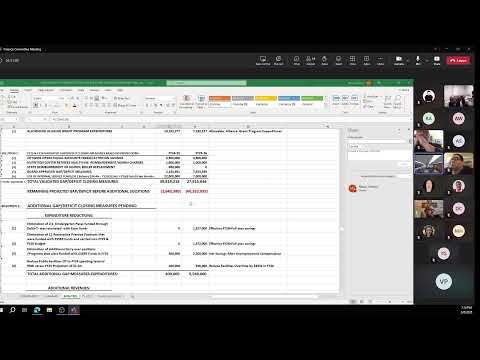
The committee heard a detailed presentation from Nestor, finance presenter, who ran through current‑year projections and a proposed FY26 budget that still shows a substantial shortfall even after identified cuts. "Please, please do not go out and run and say that the district is projecting $42,400,000 deficit. That is not true," Nestor said, stressing that the figures shown were gross numbers before gap‑closing measures and the planned use of internal reserves.
Why it matters: The district is balancing near‑term actions (program reductions, layoffs or attrition, and using the internal service fund) against structural fixes that would reoccur in future years. Committee members repeatedly pressed staff for precise accounting of which line items are one‑time savings and which would reduce recurring costs.
The presentation and key figures
Nestor told the committee the Instructional Support Services Committee identified roughly $1.2 million in savings by reducing or not renewing certain programs and resources. Committee members also raised the Relay vendor contract, which a packet listed at about $1,899,000 and which staff said is not being renewed. Board member Trevor (board member) asked whether the district had prepaid the Relay contract or could recoup any ESSER funds; staff replied that prepayments had not been made for pending commitments but that any amounts already paid would require follow up to determine whether they are eligible for reprogramming or reimbursement.
Nestor summarized the district's approach to closing the current‑year gap with three tiers of measures: board‑approved reductions already identified (netting about $2.1 million this year and roughly $7.9 million in a full year), additional pending expenditure reductions (targets in the hundreds of thousands to mid‑millions), and potential revenue or program adjustments (including grant reprogramming and state aid). He warned the figures shown were "gross numbers before the use or application of the internal service fund" and said the staff expected to rely in part on the internal service fund to limit this year's shortfall.
On reserves and one‑time fixes
The presentation proposed using up to $22 million of the internal service fund this year (and additional use next year) while maintaining a modest minimum balance; Nestor said the recommended minimum was about $5.4 million. Board member Treiber stressed the long‑term risk of using one‑time reserves and urged the committee to seek sustainable, recurring solutions rather than exhaust funds for a single year.
Personnel and program changes
Staff noted three district leadership positions had been referred to the committee: the director of athletics and the director of SEL and student services were not recommended to the full board, while the director of school turnaround was tabled for further discussion. Nestor and Dr. Adrian Avery, Superintendent, discussed possible eliminations of program positions funded previously by ESSER/Alliance grants — for example, proposals to discontinue 2‑to‑1 kindergarten paraprofessionals and up to 11 restorative practices positions were floated as ways to save recurring costs. Staff cautioned that partial year savings this year would be smaller than a full‑year effect in FY26 because some costs already have been incurred.
Requests for follow up and transparency
Several board members asked for detailed breakdowns before the next regular meeting: specifically, a precise reconciliation showing (a) how much of the Relay contract payment was already made and whether any of that was charged to ESSER/Alliance funding, and (b) the split between operating budget and ESSER/Alliance funds in the presented savings. Nestor agreed to provide the requested line‑by‑line detail before the next board meeting.
Advocacy and state funding prospects
Committee members and staff discussed pending state funding streams that could affect the FY26 outlook, including Alliance grant adjustments (staff reported a slight downward revision in the Alliance allocation from $10.7 million to $10.4 million) and possible changes to ECS or special‑education funding. Board members urged coordinated advocacy in Hartford to increase state support and noted such policy outcomes are uncertain and should not be banked in the district's base budget.
What comes next
Staff will supply the requested detailed reconciliations on the Relay contract and the composition of the $1.2 million program savings, plus a grossed‑up budget view that reconciles the district's prior public budget totals with the current presentation. The committee emphasized it will seek permanent, recurring savings where possible and avoid overreliance on one‑time reserve draws.
Ending note: Committee members agreed the district can reach a balanced FY25 position this year with the mix of measures discussed but stressed FY26 will require additional decisions, state advocacy, or new recurring revenue.