Get Full Government Meeting Transcripts, Videos, & Alerts Forever!
Get email alerts on the Capital Planning topic
No spam. Unsubscribe anytime.
Board authorizes staff to begin talks with Orange County on 10-year bond sequencing; recommends Carrboro, Estes Hills lead
Summary
The board on Feb. 3 authorized district administration to develop a prioritized 10‑year funding plan with Orange County for the voter‑approved bond, proposing Carrboro Elementary and Estes Hills Elementary design funding start first and Frank Porter Graham (FPG) follow later.
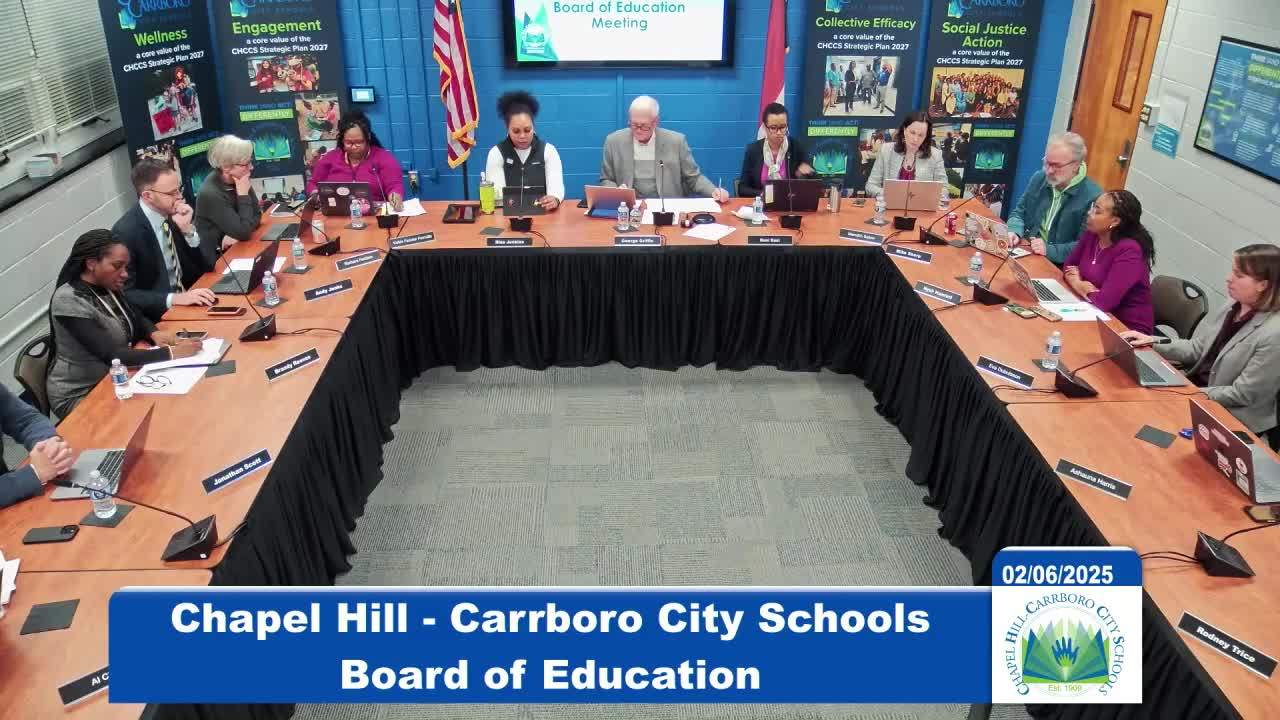
The Chapel Hill-Carrboro City Schools Board of Education voted Feb. 3 to authorize district staff to begin discussions with Orange County about sequencing and financing of a 10‑year bond program approved by voters in November.
Division of Operations lead (presenter identified as Mr. Alseroghe) outlined two sequencing proposals to present to county officials: an aspirational option asking the county to fund design for all three replacement elementary projects (Carrboro Elementary, Estes Hills Elementary and Frank Porter Graham Elementary) simultaneously; and a more incremental plan recommending Carrboro and Estes Hills begin design in July with FPG starting design two years later. Mr. Alseroghe said district staff prefer the latter as the basis for county discussions but wanted the county to understand the district’s readiness for more aggressive sequencing.
Estimated preliminary project costs given in the presentation (in today’s dollars) included a starting estimate of about $53 million for a Carrboro replacement and about $61 million for Estes Hills. Presenters cautioned these are initial estimates and discussed escalation risk: industry advisors recommended using a 3–5 percent annual escalation assumption for budgeting due to volatile materials and labor markets. Mr. Alseroghe discussed construction delivery options allowed under state law (design‑bid‑build; construction manager at risk; design‑build) and the role of program management, and said the county must decide whether it will manage program management or allow the district and a third‑party program manager to do so; any county-managed program would require an interlocal agreement.
The board voted to authorize district administration to collaborate with Orange County on a prioritized 10‑year funding plan; the motion passed by voice vote.
Why this matters: The authorization starts formal negotiations that will determine the pace of replacement of aging schools, how bond proceeds are allocated, the program‑management structure, and the schedule — all of which affect costs, district capacity balancing and community disruption during construction.