Get Full Government Meeting Transcripts, Videos, & Alerts Forever!
Get email alerts on the School Finance topic
No spam. Unsubscribe anytime.
Hendry committee reviews proposed uses of voter-approved sales tax for school upgrades, safety and technology
Summary
Committee members reviewed three years of sales-tax receipts, heard department-level budget proposals and discussed planned projects including access control, cameras, HVAC, doors and student-safety software; the meeting also approved prior meeting minutes by voice vote.
Members of the Hendry County Independent Sales Tax Committee reviewed proposed spending plans for voter-approved sales-tax revenue and department budget requests at a committee meeting. Staff presented revenue collected since the tax began and outlined planned uses for facilities, safety and technology projects.
Committee members heard that collections began in February 2022–23 and that the district’s first full year of receipts totaled about $3.3 million. Fiscal-year-to-date receipts for FY25 were reported as just over $2.0 million, and staff said the quarter close would put the annual run-rate near $3.3 million. A January reporting error was corrected in the meeting (an entry shown as $280,000 was clarified to $245,000).
The presentations focused on two related questions: what the district has collected so far, and how directors propose to use available and forecasted funds. Directors and staff described a mix of near-term maintenance and multi‑year projects. Proposed and discussed items included door replacements and repairs, bathroom renovations (many facilities dated to the 1970s–1980s), roofing and HVAC work, portable-classroom renovations, playgrounds and resurfacing of athletic courts, additional school buses, and school furniture replacements scheduled primarily for summer work.
Officials also described multiple school-safety investments planned with sales-tax revenue. Technology and safety items discussed include campus access-control systems (electronic locks and ID badges), expanded campus fencing (exterior and interior control points), updated camera systems with options to link feeds to emergency dispatch, additional weapon-detection units and new radios or radio upgrades. A presentation noted a prior camera procurement at a high school that cost about $320,000 and said similar installations and inflation mean future camera work will be costly and may need supplementation despite state grant funding for part of some projects.
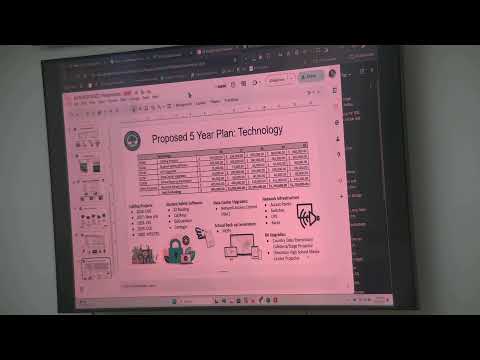
Information-technology spending proposals included student-safety and monitoring software (CalAmp and GoGuardian, with an added GoGuardian module called Beacon Core for Google apps), network access control (NAC) for the district data center, consolidated network-infrastructure funding to cover access points, switches, battery backups and racks, and the addition of backup generators for core network hubs in schools so the network remains operational during outages. Staff proposed combining a pair of smaller hardware accounts into a single network-infrastructure account to allow flexible purchases tied to re-cabling projects.
Presenters said many projects will be staged over multiple years and that directors have already encumbered or set aside funds for summer projects; the five-year plan will be updated annually. Staff also said that because the new high school construction will require substantial capital, the district is pursuing state funding and lobbying support; sales-tax funds are being positioned to cover renovations, maintenance and “light work” while major capital may depend on external funding.
Committee members and presenters emphasized prioritization and that the district will not overspend available funds. Staff noted a healthy fund balance from unexpended prior-year appropriations that can be used if revenue exceeds baseline forecasts. Several attendees asked about reallocation flexibility — whether a director can move substantial sums between line items — and staff described using encumbrances and the prioritization process during the formal budget review.
Votes at a glance: the committee approved past meeting minutes by voice vote after a motion from a committee member (mover named Matt); the motion was seconded and approved by those present.
The committee agreed to propose a September meeting date (the second Thursday at 5:30 p.m. was discussed) and said staff will circulate updated, corrected budget documents and a revised five-year plan prior to the next meeting.