Get Full Government Meeting Transcripts, Videos, & Alerts Forever!
Get email alerts on the Immigration Enforcement topic
No spam. Unsubscribe anytime.
Students and community members urge District 51 to clarify policy on immigration enforcement in schools
Summary
Multiple student speakers and community advocates asked the District 51 board for clearer guidance and stronger protections after federal changes to 'sensitive locations' enforcement; speakers urged the board to issue directives distinguishing judicial warrants from administrative requests and to protect students' safety and records.
Multiple students, parents and community organizations told the Mesa County Valley School District No. 51 board they are frightened by recent federal immigration enforcement actions and want clearer, written protections for students and families.
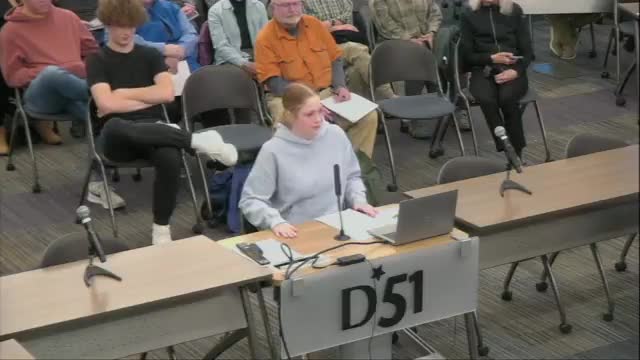
Student speakers at Grand Junction and other high schools described seeing hate speech at school and said teachers are hesitating to teach controversial but factual topics. “Schools should be a welcoming environment,” said Colleen Moore, a senior at Fruita Monument (first reference as Colleen Moore, senior at Fruita Monument). Moore and other students said district communications that emphasize political neutrality can feel like avoidance when student safety is at stake.
Community advocates asked the board to issue specific directives. Jan Mormon, speaking for the League of Women Voters in Mesa County, said the League will review the ACLU’s January 30 letter to superintendents and urged the district to add clarity to its guidance to staff. “We are going to look through what the ACLU has recommended and work to try to find the different procedures and things that D51 has in place,” Mormon said.
Tom Aker, a community speaker, urged the district to treat requests from immigration enforcement as requiring either consent or a judicial warrant and to demarcate public and nonpublic areas on school property. “Steps must be taken…to demarcate the public and non public areas in the schools and make clear what hours those spaces are available or not to the public by posting signage,” Aker said.
Bert Neslanyk, who has represented recent resettled families, urged parents to carry documentation for children until the district adopts clearer protections and encouraged the board to adopt a policy that prevents data sharing that could be used for enforcement. Amanda Akers, a bilingual educator and clinician, told trustees that if parents fear sending children to school, attendance and learning suffer and urged clearer communications to families and staff.
Several speakers requested the board distinguish judicial warrants from administrative or other enforcement requests and to name a trained contact person in each building — typically the principal — to be the point of contact for any official request to enter school property.
Ending: Trustees did not announce immediate policy changes at the meeting. Multiple speakers left written materials with the board and asked for follow-up; the board indicated staff would continue reviewing guidance and could return to the topic in a future meeting.