Get Full Government Meeting Transcripts, Videos, & Alerts Forever!
Get email alerts on the School Budget topic
No spam. Unsubscribe anytime.
Vernon Township schools submit preliminary $74 million 2025–26 budget, schedule May 1 public hearing
Summary
Vernon Township Board of Education staff presented the district—s preliminary 2025'526 budget and the board voted to submit the tentative budget to the county for review; a May 1 public hearing was scheduled.
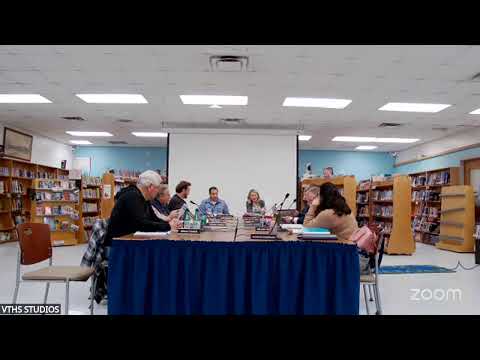
Vernon Township Board of Education staff presented the district—s preliminary 2025'526 budget at the board—s March 13 public meeting and the board voted to submit the tentative budget to the county for review.
Business office presentations laid out the broad picture: projected total operating revenue around $74 million, a proposed tax levy increase equal to the 2% local cap (about $998,000), a roughly $1.02 million net increase in state aid, and a planned use of about $2.5 million in fund balance to balance the budget.
Why it matters: administrators said salaries and benefits make up roughly 70—0% of the budget and remain the major cost driver, while sharp increases in energy and certain insurances create a narrow margin between revenues and expenses. The board set a public hearing on the proposed budget for 7 p.m. on May 1 in the Lounsbury High School library.
In his presentation, the staff member leading the briefing described a budget as "a living document" and summarized the process the business office used: reviewing prior-year spending, projecting current-year outlays and revenues, and working with departments to prioritize next-year needs. He told the board the district plans to draw on fund balance and reserves to cover one-time capital and maintenance needs while emphasizing the goal of reducing the amount drawn from fund balance over time to avoid a future "revenue cliff."
Key revenue and expense points presented: - State aid: an increase of about $1,018,001, including changes tied to how special-education aid is calculated. - Tax levy: proposed increase equals the 2% levy cap, about $998,000. - Fund balance/excess surplus: staff proposed using approximately $2.5 million from audited 2023'4224 surplus as a one-time revenue source in the 2025'526 budget. - Energy: administration projected a 35% increase versus the original 2024'525 budget because of recent contract expirations and high meter (BGS) rates; staff said bids due in April likely will reduce that peak and they modeled a more conservative 17% long-term increase when estimating costs. - Health benefits: the district moved off the state plan and negotiated a private self-insured option, which staff said reduced projected health-cost increases and produced about $700,000 in savings across the budget and prior year adjustments.
Staff also reviewed capital and facility needs and how the district will pay for some projects: a proposed $525,000 withdrawal from capital reserve to fund planned 2025 projects (including elevator replacements and a PA-system replacement) and a $225,000 maintenance-reserve withdrawal for priority repairs. Administrators noted the district—s capital reserve has been drawn down in recent years to address safety and deferred-maintenance items.
Programs and offsets discussed: - Preschool expansion aid (PEA): staff said the district expects about $3.9 million in PEA next year (recorded in special revenue Fund 20) and that PEA funds will offset certain staff salaries and transportation costs associated with preschool expansion. - Energy-savings improvement plan (ESIP) and solar: the district completed a free energy assessment and expects solar PPA proposals; staff said ESIP financing can budget savings into a bond payment and noted proposals arriving in mid-March will determine project scale. - Cell-tower leases: staff reported a new tower lease on district land projected to generate roughly $52,000 a year when active, plus additional revenue if other carriers collocate; existing rooftop carrier rent at the high school was reported at roughly $11,000—0515,000 annually.
Staffers stressed that, even after the state aid increase and internal reductions, the preliminary budget still required careful balancing because many costs (salaries, contracted services, energy) continue to rise faster than revenue options.
Board action and next steps: The board voted to approve and submit the tentative budget to the county executive superintendent for review (the motion passed; roll call recorded one "no" vote). The board also authorized the required public hearing to be held May 1 and set a capital-reserve withdrawal and maintenance-reserve withdrawal as part of the submission.
Votes at a glance: - Tentative 2025'526 budget submitted to county for review (vote: 8 yes, 1 no). Public hearing set for 7 p.m. May 1. (No mover/second recorded in minutes.) - Capital reserve withdrawal $525,000 and maintenance reserve withdrawal $225,000 included in submission (approved as part of the tentative budget package).
What administration emphasized: presenters repeatedly noted contingency planning remains necessary because fund-balance use cannot be a long-term revenue source, and staff said they will continue to refine figures as grants, bids (energy), and audited results are finalized. The business office encouraged the public to review budget documents online and attend the May 1 hearing.
Ending: The board—s preliminary submission begins the statutory review cycle; administration and committees will continue presenting more detailed breakdowns to the public and the board before final adoption in May.