Get Full Government Meeting Transcripts, Videos, & Alerts Forever!
Get email alerts on the Water Treatment Plant topic
No spam. Unsubscribe anytime.
North Brookfield opens Bell Hill water treatment plant, replaces open reservoir
Summary
Town of North Brookfield held a ribbon-cutting for a new filtration plant and enclosed 1.5-million-gallon storage tank at Bell Hill, a project funded in part by a state revolving fund loan and built ahead of schedule to meet federal and state drinking-water requirements.
North Brookfield on Oct. 21 opened a new water treatment plant and a 1.5-million-gallon enclosed storage tank on Bell Hill that replaces an open reservoir in service since the 1890s. The town and project officials said the facility is designed to improve water quality, meet state and federal filtration mandates and accommodate future demand.
The project was financed in part with a $5,500,000 no-interest loan from the state revolving fund, officials said during the ceremony. Representative David Tuttle, state representative, called the plant “a state of the art facility” that “is gonna provide clean drinking water for many, many, many, years and generations.”
The plant’s operators and engineers described the treatment process and the changes residents should expect. Steve Jones, operator of the new Bell Hill plant, said the plant uses chemical coagulation, polymer, two upflow clarifiers and mixed-media filters to remove turbidity, color and tastes and odors. “We can take out over 90% of the turbidity, 95% of the color, and all the taste and odors so far,” Jones said, adding the system was still in startup adjustments.
Town and project presenters gave these key technical and program details discussed during the event: the treatment plant was designed for roughly 500,000 gallons per day average capacity, with two filters installed that can treat up to 2,000,000 gallons per day if run continuously; projected peak daily flow for the next 20 years was cited at about 1,800,000 gallons per day; the enclosed tank capacity is 1,500,000 gallons; the clearwell immediately under the plant holds about 20,000 gallons and a separate 80,000-gallon room captures and recycles filter backwash water; the transmission main from the raw water pump station to the treatment plant is planned as a 12-inch line running roughly 5,800 feet up Oakham Road, with portions reported installed as 16-inch pipe at some crossings; and the existing open reservoir and earthen dam (built in the 1890s) will be removed and replaced with the enclosed tank and a new gatehouse plan to retain historic elements.
Officials said the plant’s chemical system includes ferric chloride and a polymer to promote flocculation, powdered activated carbon and potassium permanganate to address taste-and-odor problems, and an on-site disinfection generator (referred to in the meeting as a Myox system) that produces disinfectant from brine. The plant also includes continuous analyzers in the lab for turbidity, pH and chlorine residuals and a corrosion-control step to raise pH for distribution.
The project team and contractors were named during remarks and a site tour: Graves Engineering and a soils consultant performed earlier pilot studies; JE Murray was identified as the contractor working on the tank; and Natgun (named by speakers) was named in relation to tank engineering and upcoming slab and wall work. Tom Salinas, H.O. Engineering, reported excavation and subgrade work were proceeding and that tank construction was “as per schedule.”
Speakers described construction timing: a contract was reported signed on May 9, 1999, and the project team said that, from that start point, the plant began providing treated water to the town about 14 months and two weeks later—approximately four months ahead of the originally planned 18-month schedule. The enclosed storage tank was reported finished in January 2000; speakers also discussed ongoing site work, clearing and pipe installation in advance of foundation pours.
State and federal requirements were discussed as drivers of the project. Project presenters said that state and federal mandates require filtration and metering for systems undergoing filtration projects; as a result, all unmetered residential and commercial services served by the filtration system will be required to receive meters as part of the program. Officials cautioned that some pipeline work along Oakham Road and near the school will cause localized disruption as trenches are dug and transmission pipe is installed.
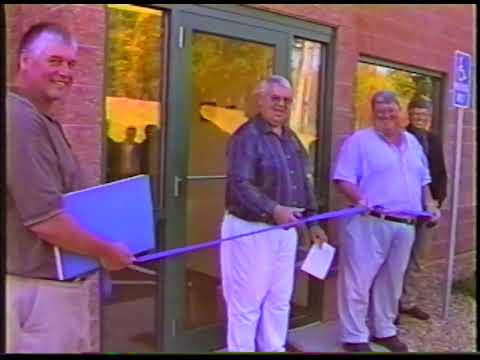
At the ribbon-cutting, town officials and representatives thanked past commissioners and staff who worked on the project, and members of the public and project video teams were recognized for documenting construction. The ceremony concluded with an official ribbon-cutting and photographs at the new facility.
Ending
Town staff and project engineers said the new plant is intended to provide treated, disinfected and filtered water to North Brookfield while reducing exposure of stored water to the open air and improving system automation and pressure stability. Officials said the metering rollout and remaining transmission-line work will continue on a construction timetable described at the ceremony, and that additional startup adjustments to chemical feeds and analyzers would continue after the ribbon-cutting.