Get Full Government Meeting Transcripts, Videos, & Alerts Forever!
Get email alerts on the Highly Capable Services topic
No spam. Unsubscribe anytime.
Seattle Public Schools proposes three‑year hybrid plan to deliver highly capable services
Summary
Superintendent and staff recommended a three‑year “hybrid” approach that keeps cohort schools while expanding neighborhood services, with professional development, new reporting and a data review after three years. The board heard broad public comment for and against cohort and neighborhood models.
Seattle Public Schools on March 12 outlined a three‑year plan intended to preserve existing highly capable cohort options while expanding services in neighborhood schools and adding new reporting and evaluation. The proposal comes after months of public comment from families, teachers and community groups urging clearer access and enforcement of state rules on acceleration.
The plan presented by district staff would run the hybrid model in school years 2025–26 through 2027–28. Families of students in grades 2–5 would be offered a choice between receiving highly capable (HC) services through the cohort model or at their neighborhood school. District staff said the hybrid approach is designed to buy time to “reduce variation and improve fidelity” in neighborhood HC services while maintaining cohort options.
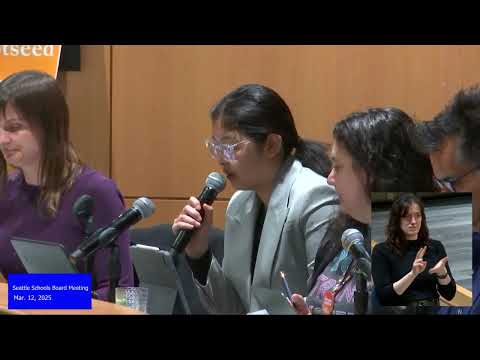
In a staff presentation, Superintendent Jones said the district will produce a written plan by April 1 that includes a description of services, professional development, program evaluation, a fiscal report and assurances of legal compliance. Doctor Torres Morales, who presented the update to the board, said all schools will be offered professional development aligned to the district’s Inclusion Initiative during 2025–26, including training in Universal Design for Learning, Multi‑Tiered Systems of Support (MTSS) and restorative practices.
Torres Morales described an evaluation framework the district will run while the hybrid model is in place. The district will compare Smarter Balanced Assessment (SBA) outcomes, Measure of Academic Progress (MAP) growth and student responses to the district’s Safe and Welcoming survey for HC‑eligible students across the two delivery models. The goal, Torres Morales told the board, is to learn where services are producing the strongest academic progress and where additional resources or changes are needed.
Staff also said the district will hire a director of advanced learning and update related superintendent procedures that currently reference the prior cohort phase‑out. Board directors asked for clarity on staffing, budget implications and how math acceleration would be made accessible to HC‑eligible students in neighborhood schools. Torres Morales said staffing and budget analysis are still in progress and pledged to supply that information to the board as it becomes available.
Public testimony leading up to the staff recommendation included numerous speakers supporting continued cohort options and urging stronger HC services in neighborhood schools. Speakers also cited state law and Washington Administrative Code language they said require above‑grade acceleration for identified students. Some family speakers described relying on cohorts to secure appropriate instruction for neurodiverse or low‑income students; teachers and advocates urged the district to expand equitable screening and to restore proven, teacher‑led acceleration practices.
Board members did not take a formal roll‑call vote on the recommendation at the March 12 meeting. President Taub said the district would proceed with the recommended hybrid model "with your concurrence" and that the plan would be embedded in the district’s strategic plan and returned for board review and public reporting. Torres Morales said the district will bring more detailed implementation steps and engagement plans to the board before or at the April update.