Get Full Government Meeting Transcripts, Videos, & Alerts Forever!
Get email alerts on the Education Competency Determination topic
No spam. Unsubscribe anytime.
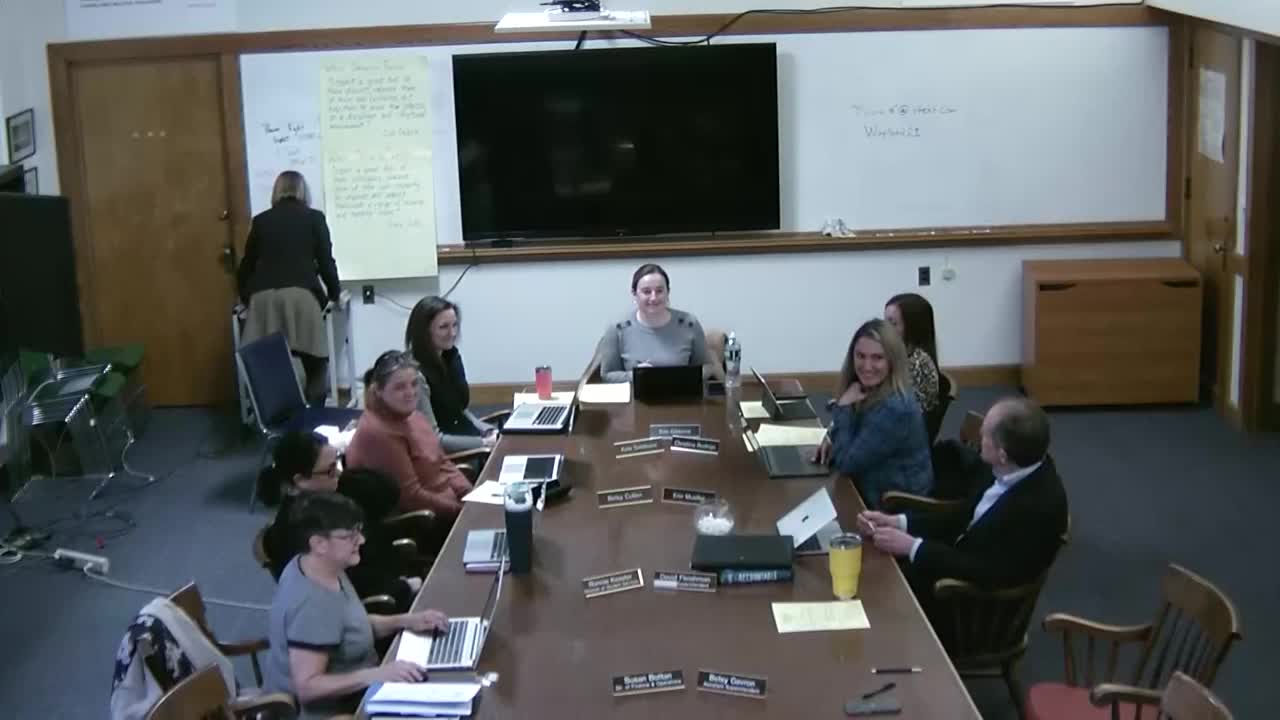
Wayland School Committee approves competency determination based on courses and alternative pathways after MCAS requirement removed
Summary
After Massachusetts voters removed the MCAS graduation requirement, the Wayland School Committee approved a local competency determination for the Class of 2025 that ties competency to specific ninth- and tenth-grade courses, with alternatives such as portfolios and credit recovery for students who need different paths to demonstrate mastery.
The Wayland School Committee voted to approve a local competency determination for the Wayland High School graduating class of 2025, replacing the prior MCAS-based requirement with course-based and alternative pathways.
The decision, moved and seconded during the March 12 meeting and approved by voice vote, adopts a competency definition centered on passing English 9 and 10, geometry and algebra 2, and biology or physics, while also permitting alternative demonstrations of mastery such as summer-school credit recovery, online courses, and student portfolios.
The change follows a ballot question last November that eliminated the statewide MCAS graduation requirement and placed responsibility on each Massachusetts district to define a local competency determination. Betsy Gavron summarized the district’s process, saying the recommendation “is the fruits of a lot of conversations, particularly starting with our content area department heads.”
Allison (school administrator) described the committee’s proposed specifics: “the competency determination will be defined as passing these courses, English 9 and 10, geometry and algebra 2, and biology or physics.” She said the district’s content-area department heads framed course selection to reflect the 10th‑grade frameworks formerly measured by MCAS.
Committee members pressed on practical implications. One member asked whether enough schedule “runway” exists for students who fail a prerequisite course, and the panel replied that retake and credit-recovery paths (including an intermediate algebra course and, in rare cases, a fifth year of high school) are available. Ronnie Kessler and Mikaela Cohen (student services administrator at the high school) participated in planning alternative pathways for students who need special-education or English‑learner accommodations.
The committee also discussed differences with neighboring districts: many peers propose algebra 1 as the required high‑school math sequence, while Wayland’s math department recommended algebra 2 given the district’s course sequence and the common practice of students taking algebra 1 in eighth grade. Allison noted the math department’s view that algebra 2 better “sets the foundation for future learning,” while also acknowledging portfolio or alternative routes for students who struggle.
The motion approved reads in substance as the acceptance of the proposed competency determination for the graduating class of Wayland High School for 2025. Committee members agreed to publish the local determination to the community in multiple languages and to monitor state Department of Elementary and Secondary Education guidance; district leaders said statewide recommendations expected in May could prompt updates for next year.
Why this matters: the local definition determines multiple students’ paths to a diploma and creates official alternative routes for students with interrupted or atypical transcripts, English‑learner status, or documented learning needs. The committee emphasized close monitoring and adjustment once the state issues its formal recommendations.
The committee agreed to revisit the policy as state guidance emerges and as local implementation raises clarifying questions.