Get Full Government Meeting Transcripts, Videos, & Alerts Forever!
Get email alerts on the Law Enforcement Immigration topic
No spam. Unsubscribe anytime.
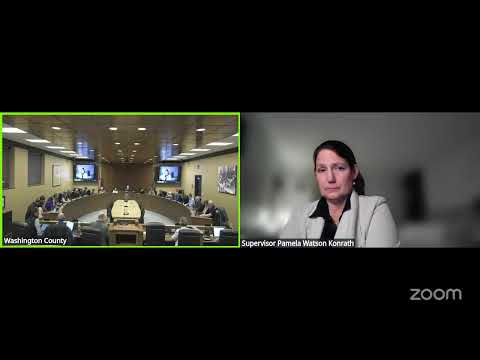
Washington County sheriff outlines limits on local immigration enforcement, says he signed 287(g) warrant-service MOU
Summary
Sheriff described how local law enforcement interacts with federal immigration authorities, described daily reporting to ICE, participation in an HSI tasking and a 287(g) memorandum of understanding limited to warrant service, and said the jail currently holds seven people on ICE detainers.
The Washington County sheriff told the county board of supervisors that immigration enforcement is primarily a federal responsibility, described how the sheriff’s office shares fingerprint data with federal agencies, and said he signed a Memorandum of Understanding under the 287(g) program to allow jail staff to serve immigration administrative warrants during a 48-hour custody window.
The sheriff told the board that criminal immigration violations (for example, deported felons or failure to appear in immigration proceedings) are distinct from civil immigration-status violations, and that local deputies generally do not have authority to enforce civil-status violations. He said the sheriff’s office collects booking information — including fingerprints, country of birth and other biographical data — which the state forwards to the FBI and which can be shared with ICE for immigration screening.
The sheriff said the office sends two automated reports each day to ICE in Milwaukee: one listing foreign‑born people booked in the prior 24 hours and one listing the total number of foreign‑born people currently in custody. He said ICE may then request a detainer and the sheriff’s office has been holding people up to 48 hours after state charges are completed to allow federal authorities to take custody.
To reduce legal and financial risk tied to that 48‑hour hold, the sheriff said he signed a 287(g) memorandum of understanding limited to warrant service (the variant he described as the warrant‑service model). Under that MOU, he said, certain jail correction sergeants can serve administrative immigration warrants on behalf of ICE inside the jail during that limited window. He said the MOU was intended to address legal questions about whether the county could lawfully hold people on immigration detainers without state charges.
The sheriff also described other federal partnerships: one deputy in the sheriff’s office is federally deputized to work part‑time with Homeland Security Investigations (HSI), and supervisors in the department have contact information for ICE deportation officers in Milwaukee. He said the sheriff’s office participates in a federal reimbursement program the sheriff called “SCAP” to recapture a small amount of federal money for holding persons in custody; he estimated last year’s reimbursement at roughly $8,000.
In numbers the sheriff provided: the jail population that morning was about 248 inmates and seven people were being held on ICE detainers. He said detainers include some individuals arrested for property and violent crimes. The sheriff framed his approach as balancing enforcement with public‑safety concerns, saying he does not want people who may be victims or witnesses to be fearful of contacting police.
Board members asked a few procedural questions about reporting and program variants; the sheriff said he chose the narrower warrant‑service variant of 287(g) rather than jail‑enforcement or task‑force models because those other options would expand federal enforcement activity inside the jail. He also said the 48‑hour holding practice and the daily reports to ICE have been part of the jail’s operations for years.
The presentation was informational; the board took no formal action on the sheriff’s MOU or on immigration enforcement policy during the meeting.