Get Full Government Meeting Transcripts, Videos, & Alerts Forever!
Get email alerts on the Conservation Strategy Instream Flows topic
No spam. Unsubscribe anytime.
CDFW presses rewrite of Clear Lake conservation strategy, starts instream-flow study and clarifies streambed permits
Summary
A California Department of Fish and Wildlife official told a Lake County forum the agency wants major revisions to the county’s Clear Lake conservation strategy so it can serve as a recovery document, and that CDFW is leading an instream-flow study of priority tributaries with a draft expected in fall 2025.
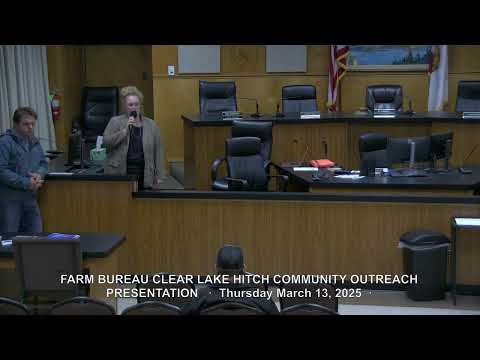
Felipe La Luz, a senior environmental scientist with the California Department of Fish and Wildlife (CDFW), told local stakeholders the department reviewed a May 2024 draft conservation strategy for the Clear Lake hitch and judged it in need of major revisions on structure and clarity before it could serve as a state or federal recovery document.
La Luz said CDFW and partner agencies have restarted monthly meetings, prepared a structured outline and will solicit formal input through the Fish and Wildlife Advisory Committee and agricultural committees. He said partners agreed a five-year review cycle would be useful and that the department will work to add performance measures, clearer goals and an implementation section that assigns actions and reporting responsibilities.
The department is also conducting an instream-flow study designed to identify minimum flows and habitat relationships for the hitch. La Luz said the work builds on a 2-D hydrodynamic model developed by Big Valley Rancheria, that CDFW’s study will emphasize Middle, Scotts, Manning, Adobe, Kelsey and Cole (Coal) creeks because of their importance as hitch habitat and available data, and that a draft report is expected in fall 2025.
On permitting and streambed work, La Luz reviewed when a lake and streambed alteration (LSA) permit is required and when it is not. He said CDFW typically issues LSA permits for activities that break ground, bring heavy machinery into a channel, drive pilings, dig or remove roots and otherwise disturb soil or the channel bed; by contrast, he said, trimming or cutting vegetation above the ground and manual removal of debris or garbage can often be done without a permit. He also described an emergency notification process for urgent debris removal when equipment is needed and urged landowners to contact the CDFW LSA unit for guidance.
La Luz invited local groups and the Farm Bureau to help improve the strategy and to suggest a Clear Lake–specific permitting workshop so landowners can better navigate permit requirements.
Ending: CDFW will continue to draft the conservation strategy outline, hold monthly coordination meetings, publish the instream-flow study draft in fall 2025 for public review, and maintain a permitting help line for landowners and community partners.